


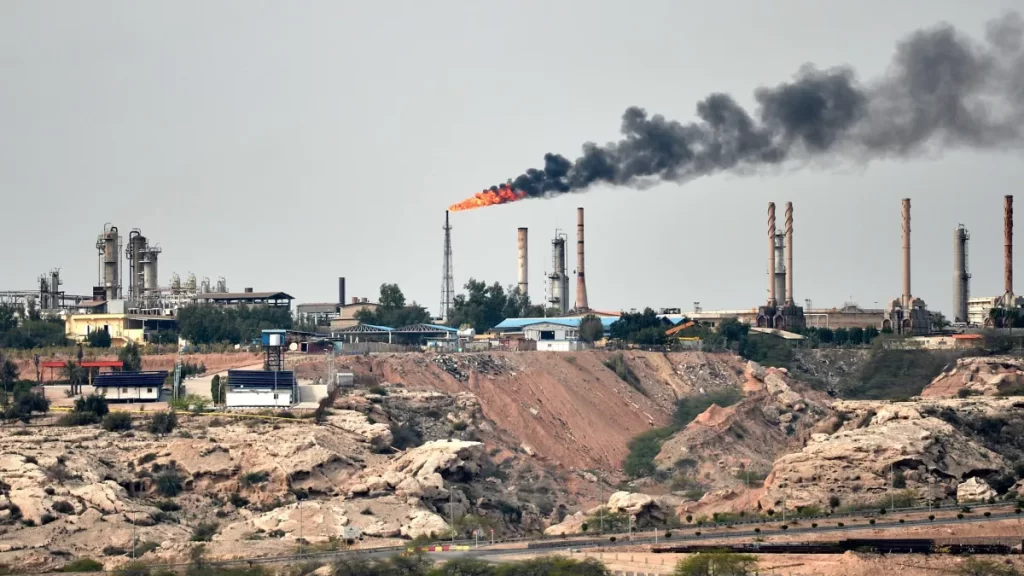
WASHINGTON / PERSIAN GULF — The conflict between the United States and Iran entered a potentially transformative phase late Friday after Donald Trump announced that U.S. forces had carried out strikes on Kharg Island, the strategic oil hub that handles the overwhelming majority of Iran’s crude exports.
The island, located roughly 15 miles off Iran’s southern coastline in the Persian Gulf, is widely considered the economic lifeline of the Iranian state. Nearly 90 percent of Iran’s oil shipments flow through terminals there, making it one of the most sensitive targets in the ongoing conflict that erupted during Washington’s campaign against Iranian military infrastructure.
Trump announced the operation in a message on Truth Social, claiming U.S. forces had “totally obliterated every military target in Iran’s crown jewel.” While independent verification of the extent of the damage remains limited, the statement alone sent shockwaves through global energy markets already rattled by weeks of escalating hostilities.
Trump Gas Prices Iran War: Why the U.S. President Says $100 Oil Is Good for America
The president, speaking while traveling aboard Air Force One, warned Iran that further interference with international shipping would trigger even harsher retaliation. In particular, he signaled that the United States could strike energy infrastructure directly if Tehran continues attempts to block maritime traffic in the Strait of Hormuz, the world’s most important oil transit chokepoint.
Strategic Target at the Heart of Iran’s Economy
Kharg Island’s significance extends far beyond its modest geographic footprint. The island hosts multiple oil loading jetties, storage facilities, and an airstrip, all surrounded by a layered Iranian defensive network that includes missile batteries, naval bases and surveillance systems spread across nearby islands and the mainland.
Military analysts say targeting the island carries enormous strategic implications. By neutralizing Iranian military defenses around Kharg, Washington could weaken Tehran’s ability to protect its oil exports — effectively squeezing one of the government’s last remaining financial arteries.
Trump says U.S. bombed Kharg Island, striking core of Iran’s oil economy
According to Michael Rubin, a senior fellow at the American Enterprise Institute, the strikes could represent the opening phase of a larger campaign.
“The bombing is setting the stage to take the island,” Rubin said, suggesting that disabling Iranian defenses may precede a potential amphibious operation.
U.S. officials have not confirmed any plans for a ground assault, but several developments indicate Washington is preparing for broader military options.
Pentagon Signals Intensifying Operations
Earlier Friday, Pete Hegseth, the U.S. defense secretary, and Dan Caine, chairman of the Joint Chiefs of Staff, warned that the coming days would see the heaviest round of American strikes since the start of the conflict.
Trump threatens to hit Iran’s Kharg Island oil network if shipping lanes remain blocked
Caine said U.S. forces were intensifying attacks on Iranian ballistic missile sites, drone-launch facilities and naval assets capable of threatening commercial shipping. Particular emphasis is being placed on Iran’s ability to deploy naval mines in the Strait of Hormuz.
Meanwhile, the Pentagon confirmed that a Marine Expeditionary Unit—roughly 2,200 Marines supported by thousands of Navy personnel—has begun deploying from Okinawa aboard amphibious assault ships including the USS Tripoli. Such forces specialize in island seizures and maritime warfare, a capability that analysts say could be relevant if the U.S. seeks direct control of Kharg.
Global Energy Markets on Edge
The strategic implications extend well beyond the battlefield. Since Washington launched its regional campaign—known in U.S. military planning circles as Operation Epic Fury—oil markets have surged amid fears of prolonged disruption to Gulf energy supplies.
Shipping through the Strait of Hormuz has slowed dramatically, and insurance costs for tankers traveling through the corridor have soared. Energy traders warn that even the perception of danger near Kharg Island could remove millions of barrels per day from global supply chains.
The Trump administration has attempted to cushion the impact by temporarily easing restrictions on Russian crude exports and coordinating with allied producers. Nevertheless, gasoline and jet fuel prices across global markets have climbed sharply.
Forecast: A Turning Point in the War
Strategically, the Kharg Island strike may represent a pivotal moment in the U.S.–Iran confrontation.
If the attack significantly degrades Iran’s defensive capabilities around the island, Washington could gain leverage over the country’s economic lifeline, forcing Tehran into a difficult strategic choice: escalate militarily or risk economic collapse.
However, the risks are equally profound. Iran retains extensive missile and drone capabilities across the region, including the ability to target U.S. bases and shipping lanes. Any direct attempt to seize Kharg Island would likely provoke intense retaliation and could trigger a wider regional war.
Energy analysts also warn that a prolonged disruption around Kharg could send oil prices far above $100 per barrel, threatening fragile global economic recovery.
For now, the battlefield and energy markets alike are bracing for what may be the most consequential phase of the war yet.