


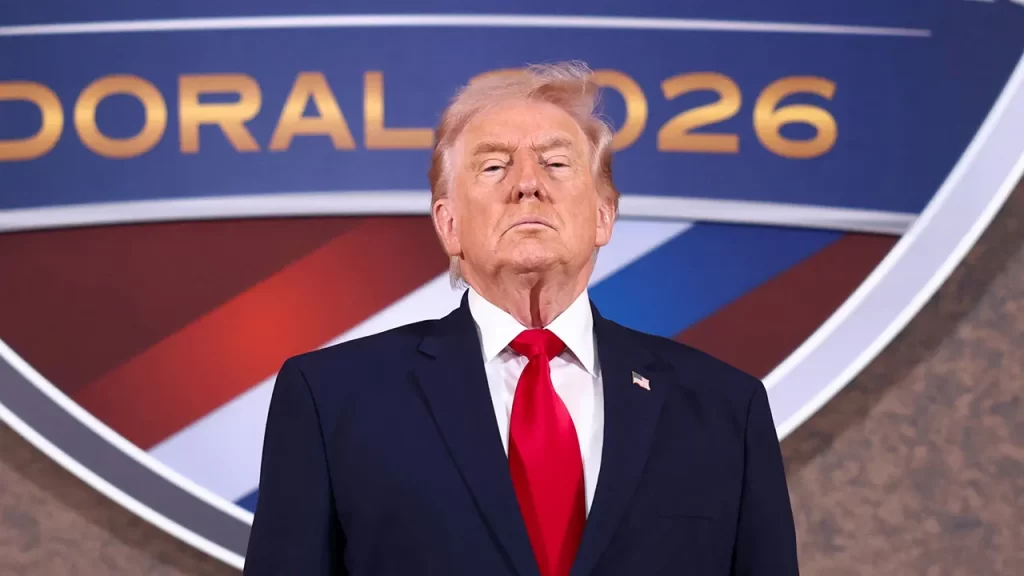
- Trump gas prices Iran war narrative: President Donald Trump argues higher oil prices benefit the U.S. economy as the conflict with Iran drives crude above $100 per barrel.
- Rising fuel costs are emerging as a political issue ahead of U.S. midterm elections, with Democrats accusing Trump of ignoring consumer pain at the pump.
- Energy markets are reacting sharply as tensions threaten shipping through the Strait of Hormuz, a key artery for global oil supplies.
- Analysts say Washington may see strategic advantage in higher oil prices due to America’s status as the world’s largest crude producer.
As the Iran war drives global oil prices above $100 per barrel, U.S. President Donald Trump has taken a strikingly different tone from past American leaders facing rising fuel costs. Instead of signaling alarm, Trump has openly argued that higher oil prices benefit the United States economically — a claim that is already shaping the political and strategic narrative of the ongoing conflict with Iran.
In a message posted on Truth Social, Trump dismissed concerns about surging gasoline prices, stating that the United States “makes a lot of money” when oil prices rise. The comment came just days after the United States and Israel launched a joint military operation targeting Iranian assets, triggering market panic across global energy markets.
According to the American Automobile Association, the average price of gasoline in the United States jumped to $3.60 per gallon, marking the fastest weekly rise since the early days of the Russian invasion of Ukraine. The spike reflects a broader surge in crude oil prices after Iranian retaliatory strikes against energy infrastructure across the Middle East threatened global supply chains.
Oil at $200? Iran’s Strait of Hormuz Gamble Could Shake the Global Economy
For many analysts, Trump’s statement is not merely rhetorical bravado but a reflection of a deeper strategic calculation tied to America’s energy dominance.
The United States is currently the world’s largest crude oil producer, surpassing both Saudi Arabia and Russia. When global oil prices rise, American shale producers, energy exporters, and oil companies generate significantly larger revenues. Higher prices also strengthen the U.S. trade balance through expanded petroleum exports.
‘We make a lot of money’: Trump downplays rise in gas prices during Iran war
In essence, Trump appears to be signaling that the economic pain at the pump may be offset by the strategic advantage of a booming U.S. energy sector.
But the political calculus is far more complex.
Rising gasoline prices historically damage American presidents politically. Inflation and energy costs remain among the most sensitive economic indicators for voters, particularly ahead of the upcoming U.S. midterm elections where Republicans are defending narrow majorities in Congress.
Democrats have already begun weaponizing Trump’s comments, arguing that the president is prioritizing geopolitical confrontation over domestic affordability. Critics claim the war risks becoming a political liability if energy prices continue climbing.
Yet Trump’s messaging suggests his priorities lie elsewhere.
The president framed the conflict with Iran as a civilizational struggle rather than a conventional geopolitical dispute. In his statement, Trump described Tehran as an “evil empire” and emphasized that preventing Iran from acquiring nuclear weapons remains his administration’s overriding objective.
That framing signals that the White House is preparing the public for a potentially prolonged confrontation.
Energy markets are responding accordingly.
Oil traders increasingly believe the Iran conflict could reshape global supply routes, particularly if tensions disrupt the critical shipping lanes of the Strait of Hormuz — the maritime chokepoint through which roughly one-fifth of global oil flows.
Even limited disruptions in the Strait could send crude prices soaring well beyond the $100 threshold, intensifying volatility in global markets.
Ironically, such a scenario could strengthen the very economic argument Trump is making.
Higher prices would dramatically boost revenue for U.S. oil producers in Texas, North Dakota, and other shale regions, reinforcing America’s position as the dominant energy supplier to Europe and Asia. Washington could simultaneously weaken rival exporters like Iran while tightening strategic leverage over global energy flows.
However, the risks are equally significant.
Sustained oil prices above $100 per barrel could accelerate global inflation, strain fragile economies, and deepen political divisions inside the United States. Consumer backlash could intensify if gasoline prices continue rising through the summer driving season.
For now, Trump appears willing to accept that trade-off.
His comments reveal a strategic worldview in which energy dominance, geopolitical confrontation, and economic leverage are intertwined. From the White House perspective, the Iran war is not only about security in the Middle East — it is also about reshaping global energy markets in America’s favor.
Whether voters will accept that argument remains uncertain.
But one thing is clear: as the Iran conflict escalates and oil prices surge, Trump is betting that America’s oil power can turn a global crisis into a strategic advantage.