


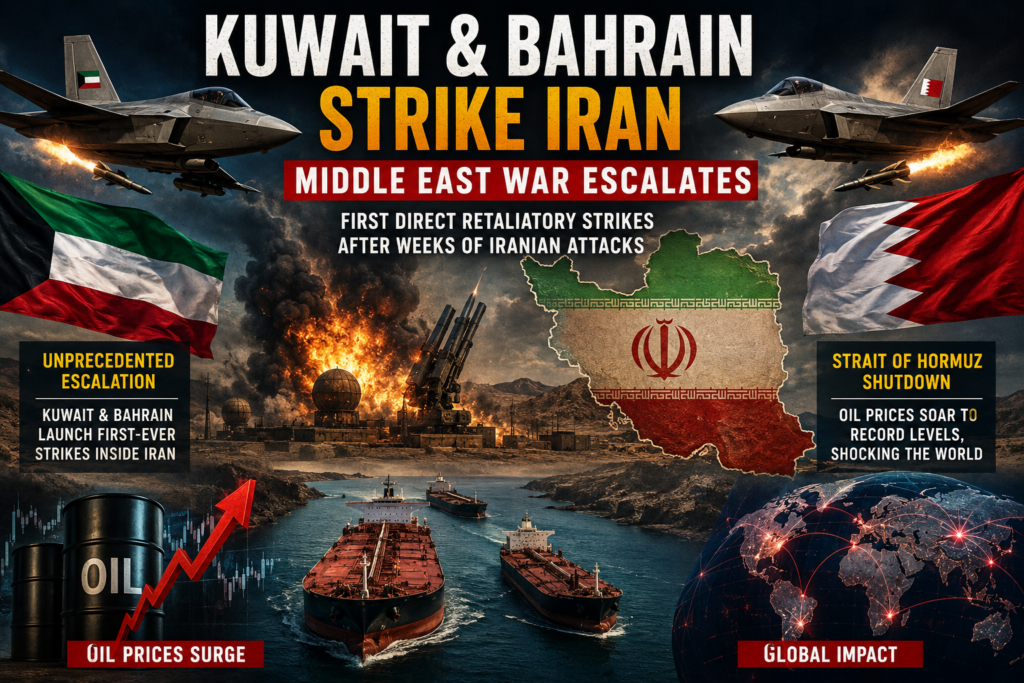
- Kuwait Bahrain Iran strikes signal a historic escalation as Gulf states directly retaliate against Tehran after sustained missile attacks on their territory.
- Strait of Hormuz remains shut, driving oil prices sharply higher and sending economic shockwaves across Asia, Europe, and the United States.
- UAE-backed coordination and growing Arab involvement risk expanding the US-Iran war into a full-scale regional conflict.
ISLAMABAD — In a dramatic escalation that risks engulfing the Middle East in a wider war, Kuwait and Bahrain have carried out their first direct retaliatory airstrikes inside Iran following weeks of what they describe as sustained and unprovoked Iranian missile attacks on their territory.
According to officials and sources familiar with the operation, both Gulf states secretly dispatched warplanes earlier this month to target Iranian military installations, including drone and missile storage depots. The strikes mark a historic shift in Gulf security dynamics, as Kuwait and Bahrain—long cautious actors—moved from defensive postures to direct military retaliation against Tehran.
The unprecedented action underscores the deepening regional crisis and signals the potential expansion of the ongoing U.S.-Iran conflict into a broader, multi-state war.
Retaliation After Weeks of Iranian Strikes
For weeks prior, Iran had intensified missile and drone attacks targeting critical infrastructure in both Kuwait and Bahrain. Energy facilities, power plants, and desalination units were among the sites reportedly hit, raising alarm across the Gulf.
Officials say the sustained nature of these attacks left both nations with little choice but to respond militarily.
“This was not a decision taken lightly,” a regional security source said. “But continued Iranian strikes made retaliation inevitable. Kuwait and Bahrain could not allow themselves to be targeted with impunity.”
Oil at $100: Iran–U.S. War and Houthi Attacks Push Global Economy Toward the Brink
Both countries host key American military bases, making them strategic targets in Iran’s broader confrontation with the United States. Their relatively small but technologically advanced air forces—equipped with U.S. and European fighter jets—were mobilized in what analysts describe as a calibrated but consequential escalation.
UAE’s Role Signals Emerging Arab Military Coordination
Sources indicate that the United Arab Emirates played a critical supporting role in the operation, providing intelligence on Iranian targets as well as defensive air cover for Kuwaiti and Bahraini jets.
This coordination points to a growing, albeit discreet, alignment among Gulf Arab states against Iran.
READ MORE: US-Iran War Escalates: Deep Strikes Hit Tehran as Hormuz Shipping Halts
The UAE, which had earlier conducted multiple strikes on Iranian targets in the initial phase of the war, reiterated its official stance calling for de-escalation while simultaneously expressing solidarity with Kuwait and Bahrain.
In a statement, the Emirati Foreign Ministry condemned Iranian attacks on Gulf states and reaffirmed support for “all measures aimed at safeguarding their security and stability.”
Kuwait Bahrain Iran strikes: Conflicting Narratives and Diplomatic Denials
Despite mounting evidence and multiple sources confirming the strikes, Kuwait’s ambassador to the United States publicly denied any involvement.
“The State of Kuwait has not participated in any military operations against Iran,” Ambassador Al-Zain Al-Sabah said, adding that Kuwait has not allowed its territory to be used for offensive actions.
Bahraini officials have so far remained silent, declining to comment on the reports.
Read More: Bahrain, Kuwait Warplanes Struck Iran in Rare Gulf Retaliation
Analysts suggest such denials may reflect the delicate balancing act Gulf states face—seeking to defend themselves while avoiding full-scale war with a far larger and more powerful Iran.
Strait of Hormuz Shutdown Triggers Global Oil Shock
Meanwhile, the Strait of Hormuz remains effectively shut down amid the escalating conflict, choking one of the world’s most critical النفط transit routes. The disruption has triggered a sharp and unprecedented surge in global oil prices, sending shockwaves through major economies across Asia, Europe, and North America.
Energy markets have reacted violently, with benchmark crude prices surging amid fears of prolonged supply disruptions. Key economies such as Singapore, China, and major European nations are already feeling the economic strain, while the United States faces mounting pressure over rising fuel costs.
The crisis has also been compounded by attacks on shipping lanes in both the Persian Gulf and the Red Sea, including operations by Iran-backed Houthi forces, further destabilizing global trade routes.
A Region on the Brink
The direct involvement of Kuwait and Bahrain represents a turning point in the conflict, transforming what was largely a U.S.-Iran confrontation into a broader regional war.
“This significantly raises the stakes,” said a Gulf-based analyst. “Once smaller Gulf states begin launching strikes inside Iran, the conflict is no longer contained—it becomes regionalized.”
Experts warn that the escalation could draw in additional actors, including Saudi Arabia, which is reportedly reassessing its military posture, and other Gulf states that have so far remained cautious.
The war, now entering its fifth month, shows no signs of abating. Instead, it is evolving into a prolonged and complex confrontation with far-reaching implications for global security and economic stability.
Gulf States Face Strategic Dilemma
For Gulf Arab governments, the situation presents a profound strategic dilemma. Long reliant on stability to sustain their economic models, these states now find themselves caught between an aggressive Iran and the risks of deeper military engagement.
“The continuation of this war is their worst-case scenario,” said a regional economist. “It undermines their role as safe economic hubs and threatens long-term investment and growth.”
Tourism has sharply declined, foreign investment is under pressure, and critical infrastructure remains vulnerable to attack.
Toward a Wider War?
Analysts increasingly warn that the conflict could spiral into a full-scale regional war if current trends continue. The combination of direct state-on-state strikes, disrupted النفط flows, and expanding military alliances suggests a trajectory toward deeper confrontation.
“There is a growing realization among Gulf states that this war may not end anytime soon,” said a security expert. “And that means they may have to confront Iran more openly.”
Some analysts have even raised the possibility of long-term strategic shifts, including discussions around regime change in Tehran—an idea that would have been unthinkable just months ago.
The entry of Kuwait and Bahrain into direct military operations against Iran marks a watershed moment in Middle Eastern geopolitics. As the Strait of Hormuz remains closed and global oil markets spiral, the conflict is rapidly evolving into a broader regional war with global consequences.
With tensions at a breaking point and no diplomatic breakthrough in sight, the Middle East stands on the edge of a prolonged and devastating confrontation—one that could reshape the geopolitical order for years to come.