


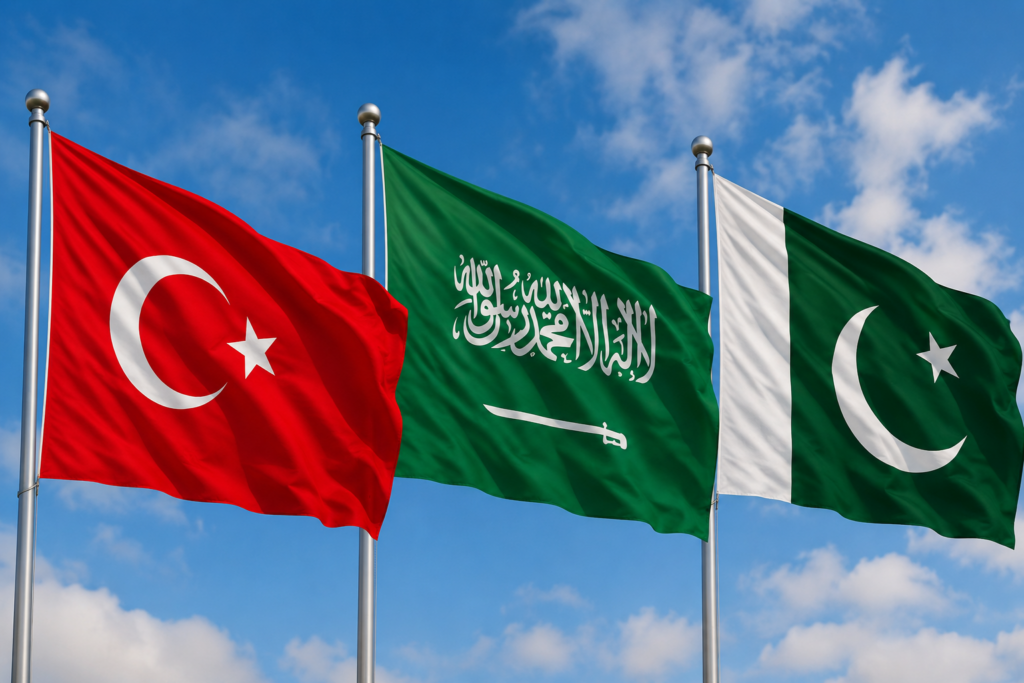
- Makkah defence pact signals a strategic realignment as Saudi Arabia, Türkiye and Pakistan deepen security coordination amid regional tensions.
- The agreement reflects a broader shift toward regional deterrence and reduced reliance on traditional Western security frameworks.
- While largely symbolic for now, the pact could evolve into expanded defence cooperation, joint production and maritime security coordination.
ISLAMABAD/MAKKAH — A trilateral defence agreement signed in Makkah by Saudi Arabia, Türkiye and Pakistan marks one of the most consequential strategic shifts in the Muslim world in recent years, as regional powers move to recalibrate security arrangements amid the ongoing Iran war.
Framed officially as a collective defence mechanism, the agreement commits all three states to mutual assistance in the event of external aggression. While the language echoes NATO’s Article 5, regional analysts caution that its true significance lies less in legal obligation and more in the political signal it sends: a move toward strategic coordination among key middle powers at a time of declining reliance on traditional security guarantors.
The pact comes against the backdrop of an expanding regional conflict triggered by U.S. and Israeli strikes on Iran earlier this year, followed by retaliatory actions targeting Gulf infrastructure and critical maritime routes.
For Saudi Arabia, the agreement reflects a gradual but clear shift toward diversifying its security partnerships. Long anchored in its defence relationship with Washington, Riyadh has, in recent years, explored alternative frameworks to hedge against geopolitical uncertainty.
READ NEXT: Pakistan Saudi Arabia Defence Pact: Army Chief Warns Against Escalation After Attack on KSA Facilities
Türkiye and Pakistan, each with distinct strategic compulsions, find in this arrangement an opportunity to extend influence while consolidating defence cooperation with a key Gulf partner.
Makkah Defence Pact: Complementary Capabilities
The trilateral framework rests on a convergence of capabilities rather than formal alliance structures.
Saudi Arabia brings financial leverage and strategic geography, underpinned by sustained high defence spending estimated at roughly $75–80 billion annually.
Pakistan contributes military depth and nuclear deterrence. With one of the largest standing armies in the Muslim world, Islamabad’s inclusion lends the pact symbolic and strategic weight, even as its nuclear doctrine remains primarily India-centric.
READ MORE: Saudi Arabia, Turkey and Pakistan sign defence pact
Türkiye adds a rapidly expanding defence industrial base and operational experience within NATO systems. Its growing footprint in drone warfare and defence exports has enhanced its relevance as a security partner across multiple theatres.
Deterrence, Not Alliance
Officials in Ankara and Riyadh have been careful to emphasise that the pact is defensive in nature and does not seek to replace existing alliances. Rather, it appears designed to enhance deterrence in an increasingly volatile environment shaped by missile warfare, drone proliferation and proxy conflicts.
Such arrangements, analysts note, function primarily as political instruments. By signalling collective resolve, they aim to raise the cost of aggression without necessarily creating binding operational commitments.
Iran and the Emerging Balance
Tehran has responded critically, dismissing the pact as strategically ineffective. Yet its formation reflects a broader regional trend: the gradual emergence of parallel security frameworks as Middle Eastern states seek greater autonomy.
The agreement may not constitute a formal bloc, but it contributes to an evolving balance in which regional actors are increasingly shaping their own security architectures rather than relying exclusively on external powers.
Limits and Open Questions
Despite its symbolism, the pact leaves key questions unanswered. The scope of mutual defence obligations remains undefined, particularly in scenarios beyond the Gulf theatre. It is unclear, for instance, how the agreement would apply in the event of crises involving South Asia or Eastern Mediterranean tensions.
As with many such arrangements, its durability will depend less on formal clauses and more on sustained political alignment and practical cooperation.
Beyond Security
The agreement also carries economic and industrial implications. Expanded defence collaboration could accelerate joint production, technology transfers and procurement partnerships—particularly benefiting Türkiye’s defence sector and Saudi Arabia’s localisation ambitions.
At a broader level, coordinated maritime security efforts could contribute to stabilising vital energy corridors, including the Strait of Hormuz, through which a significant share of global oil supplies transit.
A Measured Shift, Not a Bloc
Past attempts at collective defence structures in the Muslim world have struggled under the weight of political divergence. What distinguishes the current initiative is its pragmatic foundation—focused on shared strategic interests rather than ideological alignment.
Whether this evolves into a more formalised security architecture remains uncertain. For now, it represents a measured but notable step toward regional self-reliance in an increasingly multipolar order.
The Makkah defence pact is less a traditional alliance than a strategic signal: that key regional actors are repositioning themselves for a more uncertain geopolitical landscape.
Its success will ultimately depend on whether political intent can be translated into sustained cooperation. Even in its current form, however, the agreement underscores a quiet but significant shift—one that may, over time, reshape the contours of security in the Middle East and beyond.