


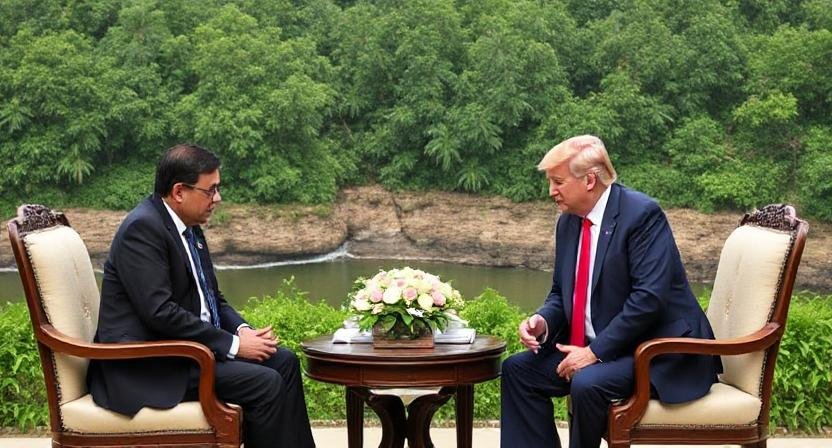
- Trump’s tariff threat ended hostilities: A U.S. warning to block trade deals with Thailand and Cambodia forced both sides into a ceasefire after a week of deadly clashes.
- Malaysia steps in as neutral peace broker: Kuala Lumpur is hosting the General Border Committee meetings, offering a credible platform amid deep mistrust.
- Core dispute remains unresolved: Talks focus only on preventing future military clashes; decades-old territorial claims are deliberately excluded.
- Tensions persist despite truce: Both nations continue mutual blame campaigns and military posturing, highlighting how fragile the current peace really is.
KUALA LUMPUR – Malaysia has stepped into the heart of Southeast Asia’s most dangerous border standoff in over a decade, hosting the first formal peace negotiations between Thailand and Cambodia after a week of deadly clashes that left scores dead and over a quarter-million displaced. In a dramatic geopolitical twist, it was U.S. President Donald Trump’s blunt economic ultimatum—not ASEAN diplomacy—that forced both nations to back away from the brink.
Key Analysis Points:
-
Trump’s trade threats—not regional diplomacy—triggered ceasefire.
-
Malaysia emerges as neutral power broker amid ASEAN inertia.
-
Centuries-old Thai-Cambodian rivalries flare up over disputed border zones.
-
Peace fragile: Each side continues international blame campaign despite truce.
What began as a simmering border flare-up rapidly escalated into an undeclared war in late July, as Thai and Cambodian forces exchanged artillery and small arms fire across disputed sections of their 805-kilometer border. By the time guns fell silent on July 28, at least 70 people had been killed and nearly 260,000 civilians driven from their homes—a humanitarian emergency ASEAN struggled to contain.
Trump’s Iron Fist Diplomacy Ends Firestorm
While regional bodies scrambled, it was a blunt warning from Trump that proved decisive. The White House, according to senior officials, threatened to suspend all trade negotiations and impose sweeping economic penalties on both countries unless hostilities ceased immediately. The pressure worked. A day later, a tentative ceasefire was in place. By August 1, the U.S. slashed punitive tariffs on Thai and Cambodian exports—from 36% to 19%—rewarding compliance.
Trump the Peacemaker: Thailand-Cambodia Agree to Immediate Ceasefire After US Pressure
This is Trump’s latest attempt to shape world conflicts through economic coercion rather than boots on the ground. “Trump didn’t just speak; he used America’s wallet,” noted a Bangkok-based political analyst. “It wasn’t diplomacy—it was deterrence by trade.”
Malaysia as the New Mediator
Despite being the rotating chair of ASEAN, Malaysia was not the first choice for these high-stakes peace talks. Initially set for Phnom Penh, the venue was moved after both sides agreed to a neutral location—a subtle acknowledgement of how deeply mutual distrust runs.
READ MORE: Thailand Defends Its Sovereignty Amid Cambodian Aggression and Diplomatic Breakdown
In hosting the General Border Committee (GBC) meetings this week, Malaysia has assumed a quiet but powerful role. Kuala Lumpur now appears to be repositioning itself as a stabilizing force in a region where intra-bloc conflicts are becoming increasingly common and where ASEAN’s consensus model often falls short in real crisis situations.
Malaysian observers, joined by delegations from the U.S. and China, are attending Thursday’s plenary session in Kuala Lumpur, giving the talks international legitimacy and extra eyes to prevent backsliding.
Tense, Tactical, and Temporary
Still, the outlook remains uncertain. Discussions are deliberately narrow—focused solely on military coordination and preventing further clashes. The core issue—ownership of disputed lands like the Preah Vihear Temple area—has been kept off the table, underlining how fragile the peace remains.
ALSO READ: Cambodian and Thai officials meet in Malaysia to iron out ceasefire details
Each side accuses the other of violating humanitarian law, with both governments arranging press tours of damaged villages to highlight civilian suffering. Cambodian officials allege the Thai army used cluster munitions; Thailand insists Cambodian troops planted land mines that maimed several soldiers. Neither claim has been independently verified, but the PR war rages on.
Meanwhile, both countries have downgraded diplomatic ties, and no ambassadorial reinstatements are expected soon.
Century-Old Wounds, Modern Flashpoints
The border dispute is anything but new. The latest clashes have roots in a long and bitter rivalry dating back to the era of the Khmer and Siamese empires. The contested Preah Vihear temple complex—awarded to Cambodia in a 1962 International Court of Justice (ICJ) ruling—remains a powder keg.
In 2011, deadly skirmishes around the site led to another ICJ ruling, which reaffirmed Cambodia’s claim but failed to resolve competing claims to adjacent land. This latest flare-up was triggered in May when a Cambodian soldier was killed during a border scuffle—an incident that reignited nationalist passions on both sides and led to mutual trade sanctions.
Who’s at the Table
Thailand has dispatched an expansive team led by Deputy Defense Minister Gen. Natthaphon Nakpanit, featuring top brass from the military, police, and diplomatic corps. Cambodia’s delegation, led by Defense Minister Tea Seiha, includes armed forces chief Gen. Vong Pisen.
While both sides have agreed to maintain the ceasefire, observers fear any misstep—real or perceived—could unravel the fragile truce. With foreign diplomats and military observers now walking the ruins of once-disputed battlefields, the negotiations are under global scrutiny.
Peace Brokered, Not Built
Malaysia’s diplomatic stage may have given the two sides a neutral platform, but Trump’s economic fist ended the fighting. For now. With core territorial issues unresolved, and both militaries entrenched along a tense border, this week’s peace talks may deliver a cooling period—not a resolution.
In Southeast Asia’s latest conflict, diplomacy arrived late. But trade power spoke first—and loudest.