


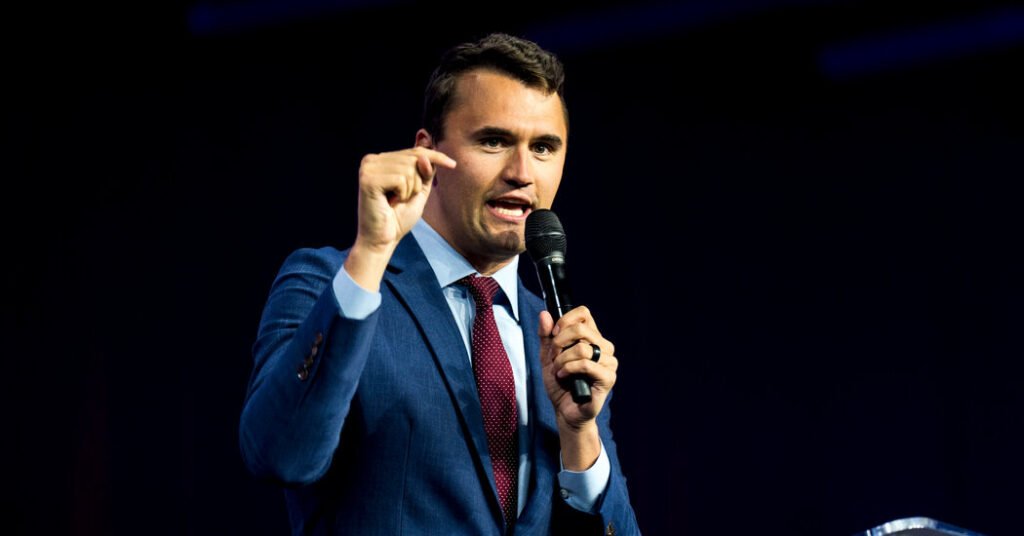
- Charlie Kirk : U.S. launches one of the largest manhunts in history after the assassination of conservative activist Charlie Kirk at Utah Valley University.
- FBI releases photos, video, and DNA evidence of a masked suspect who used a Mauser bolt-action rifle in the precision killing.
- Public outrage surges as Trump vows to award Kirk the Presidential Medal of Freedom, while online forums erupt with anger and conspiracy theories.
- Security lapses, FBI missteps, and deepening political polarization raise fears of escalating violence across America.
The gunshot that felled Charlie Kirk on a crisp September afternoon in Utah did more than silence one of the most polarizing and influential voices in American conservatism. It ignited a political firestorm, set millions of Americans seething with grief and rage, and unleashed what federal officials now describe as one of the largest manhunts in U.S. history.
Kirk, just 31 years old, was gunned down in front of 3,000 students at Utah Valley University while answering a question about mass shootings. In a moment of dark irony, the advocate of gun rights and tireless critic of progressive politics was struck in the neck by a single, precise shot fired from a rooftop. Panic erupted as students scattered. Witnesses recall the sound of bodies crashing into chairs, screams echoing across campus lawns, and the sickening silence that followed when it became clear that Kirk, a father of two and the founder of Turning Point USA, would not rise again.
The Killing That Shocked a Nation
Investigators say the killer acted with chilling calculation. Surveillance footage shows a slender figure in black clothing, sunglasses, and a cap climbing stairwells before positioning himself on the roof. Minutes later, Kirk collapsed. Within seconds, the shooter was gone—descending from the roof, crossing a street, and vanishing into a wooded area where police later recovered a high-powered, bolt-action Mauser rifle.
The weapon, a relic of older wars but renowned for its accuracy, bore engravings on its ammunition that FBI analysts are still examining. Beside it lay a spent cartridge, the round that had ended Kirk’s life. Officials believe the assassin discarded the rifle to avoid detection as he slipped through nearby neighborhoods.
The U.S. House of Representatives Passes $892.6 Billion Defense Bill Amid Deep Partisan Divisions
Despite video footage and photographs, the suspect remains unidentified. Authorities describe the figure as “a person of interest,” but speculation has exploded across social media, filling the vacuum left by official silence with conspiracy theories and blame games.
A Nation in Rage
The murder of Charlie Kirk has fractured an already polarized nation. Conservatives have described the killing as an act of war, a “Reichstag Fire” moment meant to cripple the Make America Great Again movement. On Patriots.Win, a pro-Trump forum, calls for vengeance surged within hours. “They couldn’t beat him in a debate, so they assassinated him,” one activist wrote.
READ MORE: What we know about the shooting of Charlie Kirk
At the same time, Democrats condemned the murder as a vile act of political violence, warning against exploiting the tragedy to inflame divisions. California Governor Gavin Newsom called the attack “disgusting, vile and reprehensible,” urging Americans to “reject political violence in EVERY form.”
But online, grief quickly mutated into fury. Analysts tracking extremist activity reported a spike in radical rhetoric, with some Trump supporters openly calling for civil war. For Kirk’s supporters, his assassination was proof that America had entered an era where ideas were no longer debated but silenced by bullets.
Security Failures in the Spotlight
Questions swirl about how such an attack could occur at a high-profile event attended by thousands. Kirk was midway through a national “American Comeback Tour,” a series of campus events drawing large crowds and predictable controversy. Security, however, appears to have been minimal.
“Charlie was on the radar. Everyone knew he attracted heated opposition,” said Brad Garrett, a former FBI agent. “Yet the killer had time to position himself, fire a round, and escape. That’s a catastrophic failure of event security.”
ALSO READ: Trump’s National Guard Deployments: A Strategic Sacrifice to Secure America’s Cities
The fact that Kirk was killed outdoors—without protective barriers or a comprehensive rooftop sweep—has triggered criticism from law enforcement veterans and Kirk’s allies alike. His death underscores the vulnerability of public figures in an era when political violence has surged across the ideological spectrum.
The FBI’s First Big Test Under Patel
Compounding the outrage is the FBI’s handling of the case. Kash Patel, Trump’s hand-picked FBI director, initially announced that a suspect had been arrested, only to be contradicted by Utah authorities hours later. The premature claim sowed confusion and drew scorn from former FBI officials.
“At the outset of an investigation, much of the intelligence is wrong. That’s why you don’t go public until you’re certain,” said Dan Brunner, a retired agent. “Patel’s mistake undermined confidence at the very moment Americans needed clarity.”
The White House has stood firmly behind Patel, dismissing criticism as the work of anonymous “deep state” sources. Yet within the FBI, unease lingers. Patel has purged dozens of career officials deemed insufficiently loyal to Trump, and his heavy-handed style is raising fears about the bureau’s independence. The Kirk case is his crucible: solve it swiftly, or risk losing what remains of public faith.
Trump’s Response and a Nation on Edge
President Trump, visibly shaken, has vowed to honor Kirk with the Presidential Medal of Freedom, calling him a “martyr of the America First movement.” Vice President JD Vance flew Kirk’s casket home aboard Air Force Two, symbolizing the activist’s towering role in shaping the administration.
“He didn’t just help us win in 2024, he helped us staff the entire government,” Vance wrote in a tribute. “So much of the success we’ve had traces directly to Charlie’s ability to organize and inspire.”
Yet Trump has also inflamed tensions. Blaming the “radical left,” he warned, “We just have to beat the hell out of them.” His words, critics argue, risk turning grief into mobilization for vengeance. Senator Elizabeth Warren countered sharply: “Why don’t you start with the president of the United States? And every ugly meme he’s posted and every ugly word.”
For many Americans, Kirk’s assassination has become more than the murder of a conservative firebrand—it is a flashpoint in the nation’s long slide toward political violence.
The Legacy of Charlie Kirk
To his supporters, Kirk was a visionary. From founding Turning Point USA as a teenager to becoming a household name in conservative media, he built an empire that energized young Republicans and gave Trumpism a permanent foothold in America’s future. He was brash, often combative, but undeniably effective.
“Charlie was a fighter,” said Steve Bannon on his podcast, calling him “the America First martyr.” For Bannon and others, Kirk’s death proves the movement is under siege.
But Kirk was also a husband and father of two. Friends say his Christian faith anchored him, even as he sparred with critics across ideological lines. He relished debate, often inviting opponents to challenge him live. In his final moments, he was answering a question about mass shootings—a subject that defined much of his political identity.
A Nation at a Crossroads
The manhunt continues, with over 7,000 tips pouring into hotlines and a $100,000 reward on the table. Satellite imagery, DNA imprints, and hours of surveillance footage may yet yield answers. But for now, the killer remains a shadow, haunting a wounded nation.
Kirk’s assassination comes amid a wave of violence unprecedented since the 1970s. Trump himself has survived two assassination attempts. Democrats and Republicans alike face threats with alarming regularity. The line between political rhetoric and political violence has grown perilously thin.
In the days since Kirk’s death, flowers have piled outside Turning Point USA headquarters in Phoenix. Vigils have been held across campuses. Students wept openly at Utah Valley University, where the bloodstains on the stage have yet to fade.
Charlie Kirk once said that the greatest threat to America was not foreign enemies but division within. His killing may prove him right. And as federal agents scour woods, streets, and screens for his assassin, the bigger question looms: can a fractured America prevent itself from tearing apart?