


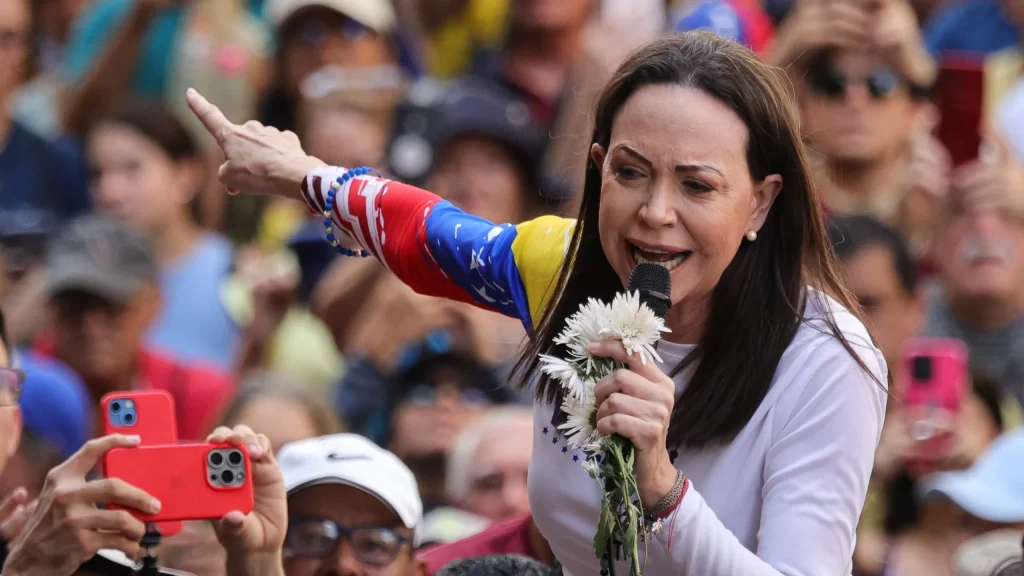
- María Corina Machado Nobel journey began with a clandestine midnight boat escape from Venezuela to Curaçao to evade arrest and assassination threats.
- The Wall Street Journal first exposed her perilous route to Oslo, revealing a global operation involving U.S. officials, activists, and underground networks.
- Machado missed the Nobel Peace Prize ceremony but vowed to reach Norway, reuniting with her children after two years in hiding.
- Her journey reshapes geopolitics as President Trump’s support, U.S. pressure on Nicolás Maduro, and regional security tensions intensify worldwide attention.
Long before dawn broke across Caracas on Tuesday, an aging wooden boat—its engine barely stronger than a motorcycle—slipped quietly into Venezuelan waters. It carried no flag. No official manifest. No crew of consequence. Only a single, trembling passenger whose name, in recent months, had become both a prayer and a death sentence: María Corina Machado, the Venezuelan Nobel laureate whose courage has ignited a nation and unsettled a regime.
What happened in the next 48 hours—the boat ride, the Caribbean shadows, the frantic dash through Curaçao, the failed race to reach Oslo before the ceremony—remains one of the most dramatic, perilous Nobel journeys in modern history.
And it was first revealed by The Wall Street Journal, whose exclusive account has stunned human-rights defenders and foreign capitals alike.
This is the full story—told with the color, drama, and emotion that define the extraordinary life of a woman who has sacrificed everything, including her freedom, for her people.
A Champion With Death on Her Trail
For years, María Corina Machado has lived on the razor’s edge—hunted, threatened, and forced into hiding by a regime she accuses of turning Venezuela from a semi-authoritarian state into a merciless dictatorship.
She has been beaten at rallies. Followed by unmarked cars. Forced underground. Her allies jailed, her offices raided, her family exiled. Yet her resolve—sharp, metallic, almost unbelievable—never softened.
“She is living with a death threat from the regime, pure and simple,” said Kristian Berg Harpviken, head of the Nobel Institute. “It stretches beyond Venezuela’s borders. The risk is global.”
READ MORE: Machado Made It Out of Venezuela by Boat a Day Before Nobel Ceremony
Even receiving the Nobel Peace Prize could not be done in daylight.
Her escape had to be plotted with the precision of a military operation.
The Secret Departure — A Boat, A Black Sea, A Breathless Gamble
On Tuesday night, in a moment that felt more Cold War than 2025, Machado left Venezuela on a small boat steered by fishermen loyal to the opposition. To the regime, she was a fugitive. To the world, she was a Nobel laureate. But at sea, she was simply a target—one arrest, one bullet, one disappearance away from becoming a memory.
The destination: Curaçao, a Caribbean island that suddenly became the frontline of democracy.
U.S. officials later confirmed the crossing. Nothing about the journey was standard. Her allies coordinated decoy convoys, misleading rumors, and false location pings to prevent intelligence operatives from tracking her.
“So many people risked their lives for this,” Machado would later say, her voice cracking over a phone call with Nobel Committee Chairman Jørgen Frydnes. “What this recognition means to the Venezuelan people cannot be measured.”
ALSO READ: Trump Venezuela Patience: Why the U.S. President Is Holding Fire on Maduro
She was supposed to land in Oslo. She was supposed to walk into the city hall like every laureate before her. She was supposed to accept her prize with her head high and the world watching.
She never made it.
The Missed Ceremony — A Race Against Time
By the time she reached an airport—exhausted, shaken, carrying only a small bag—Machado was already behind schedule. Her plane couldn’t reach Norway on time.
The Nobel Committee didn’t know her whereabouts. World leaders gathered in Oslo were anxiously checking their phones. Her three children, who had not embraced her in two long years, waited in silence.
Then came the call.
“I am very sad and very sorry to tell you that I won’t be able to arrive in time,” she told Frydnes. “But I will be in Oslo. I am on my way to Oslo right now.”
Her daughter, Ana Corina Sosa, took the stage instead.
“And what keeps us moving,” she said, her voice echoing through Oslo City Hall, “is the idea that we will be reunited in a free country.”
The Political Earthquake Behind Her Journey
Her escape unfolded against a dramatic geopolitical backdrop.
President Trump, in his second term, has turned Venezuela into a testing ground for Washington’s new, muscular foreign policy.
A massive U.S. military buildup sits off Venezuela’s coast. Drone strikes, naval patrols, and covert extractions have redefined the regional order.
In May, the U.S. executed a daring mission to rescue Machado’s aides from a besieged Argentine diplomatic residence—flying them to America alongside her mother.
Machado publicly thanked Trump in her Nobel remarks, praising his “decisive support” and dedicating her prize to the Venezuelan people and the U.S. president.
The message was unmistakable:
Her struggle is no longer just Venezuelan—it is global.
Oslo Awaits — But Exile Looms
If Machado steps foot outside Venezuela, the regime insists she becomes a fugitive.
If she returns, she risks arrest.
If she stays abroad, she risks irrelevance—the fate that befell so many opposition leaders before her.
Yet she refuses to bend.
“I want to assure every single Venezuelan that I will be back,” she said defiantly. “I have not fought this long to watch my country fall.”
Harpviken says her arrival in Oslo was “far more complicated than anyone expected.”
That complexity lies at the center of her legend.
The Reunion — A Mother’s Victory Against Fear
In Oslo, somewhere beyond the cameras and the chaos, three young adults waited for a woman they once called mamá and now call heroína.
Two years of silence.
Two years of uncertainty.
Two years of wondering whether they’d ever see her again.
Now, finally, she is on her way.
“As soon as I arrive,” Machado said, “I will embrace my family and the Venezuelans and Norwegians who share our struggle.”
It was not the Nobel Prize that brought tears to her voice.
It was the idea of hugging her children without fear.
A Nation in Darkness, A Woman Carrying the Light
For Venezuela, Machado represents something fragile and rare: faith in a democratic dawn.
Nearly nine million Venezuelans have fled their homeland. Poverty, repression, and lawlessness have become constant companions. The Nobel Committee praised her for “keeping the flame of democracy burning amid a growing darkness.”
Her supporters say she didn’t win the Nobel Prize.
She earned it.
What Comes Next?
Her journey has only begun.
The question now—asked in Washington, Oslo, Buenos Aires, and every Venezuelan household—is simple:
Will she be allowed to return home alive?
The world watched a secret boat cross a dangerous sea.
It watched a mother race time for a prize she dedicated to her people.
It watched a regime tremble as its fiercest critic escaped their grasp.
And it watched, once again, how far one woman will go when history calls her name.
María Corina Machado’s Nobel journey is more than a story.
It is a warning, a testament, and a rekindling of hope—
the kind of human-interest drama the world rarely witnesses and never forgets.