


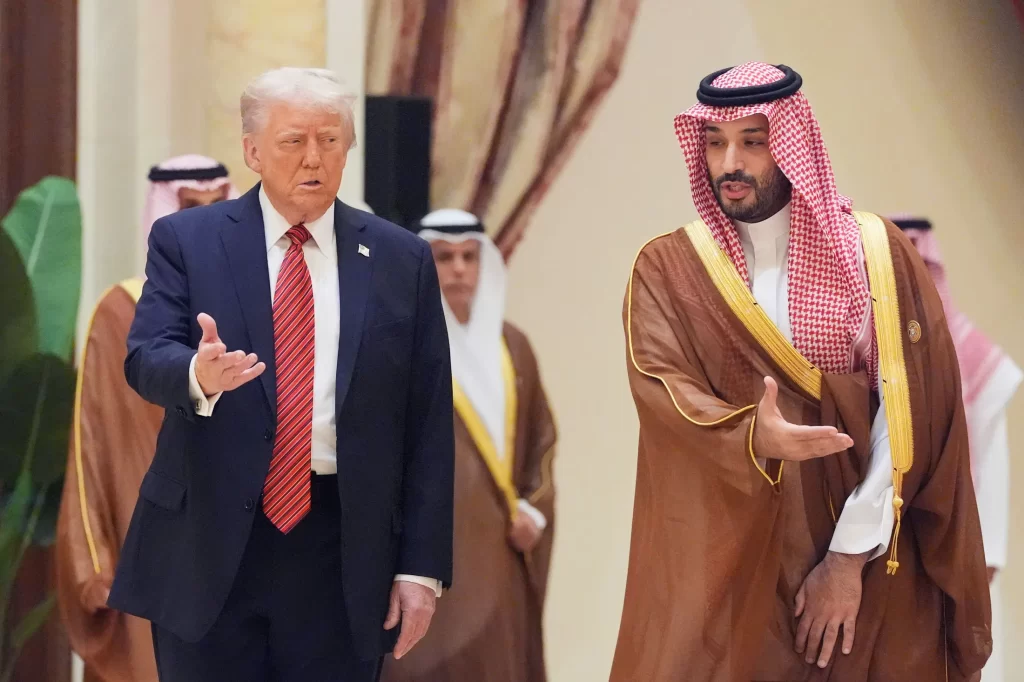
- MBS’s visit to the USA marks a new phase in Saudi-US relations, emphasizing defense, technology, energy diversification, and long-term strategic alignment.
- The Crown Prince’s Washington engagements highlight his global stature, reflecting Riyadh’s shift from traditional diplomacy to assertive, future-focused leadership.
- During the visit, multibillion-dollar agreements across AI, clean energy, and advanced defense systems strengthened Saudi Arabia’s global positioning.
- The trip underscores how MBS is shaping world politics — recalibrating ties with the U.S. while projecting Saudi Arabia as the Middle East’s dominant power center.
When Crown Prince Mohammed bin Salman walks into the White House on Tuesday for high-stakes talks with U.S. President Donald Trump, he will be received not just as the de facto ruler of Saudi Arabia but as one of the most pivotal power brokers of the 21st century. This visit marks a new chapter in a relationship defined by personal chemistry, strategic alignment, and an unusual diplomatic symmetry between two leaders who, over the years, have come to understand each other’s political instincts with remarkable ease.
It will also be the crown prince’s first visit to the U.S. in several years — timed deliberately, and symbolically — just months after Trump returned to the presidency and made Riyadh the destination of his first overseas trip. Few decisions could have signaled more clearly how seriously Trump values his personal alliance with the Saudi leadership, especially with Mohammed bin Salman.
From Riyadh With Power: Trump’s First Trip Back Puts MBS at the Center of U.S. Strategy
For MBS, who has transformed Saudi Arabia’s foreign policy and economic ambitions in less than a decade, the visit represents not only a bilateral milestone but an opportunity to cement long-term strategic frameworks on defense, technology, commerce, energy, and regional security.
Above all, Tuesday’s meeting is expected to produce the outlines — if not the full text — of a sweeping U.S.-Saudi defense pact that analysts have anticipated for months.
The Symmetry of Power: Trump in Riyadh, MBS in Washington
There is a striking balance in the choreography of these two visits — May in Riyadh and now May in Washington.
READ MORE: Trump’s Historic Saudi Visit: How MBS Positioned the Kingdom as a Global Powerhouse
When Trump touched down in Saudi Arabia earlier this year, he received one of the most spectacular welcomes in modern diplomatic history. Long before Air Force One reached Saudi airspace, the Kingdom scrambled six Royal Saudi Air Force F-15 fighter jets to escort the presidential aircraft. The sight of America’s presidential jet flanked by state-of-the-art Saudi combat aircraft sent a deliberate message: Trump was not just a guest — he was a strategic partner worthy of a royal salute.
A senior White House official, Margo Martin, posted video of the escort with the caption:
“Saudi F-15s providing honorary escort for Air Force One!”
ALSO READ: Saudi Crown Prince MBS Aims to Parlay Trump Ties Into Deals
Such aerial gestures are extraordinarily rare in Saudi protocol. Only a handful of global leaders — among them Xi Jinping and Vladimir Putin — have received anything remotely similar, and even those instances lacked the precision and symbolism of Trump’s escort.
But the spectacle in the sky was only part of the message. On the ground, Mohammed bin Salman personally greeted the U.S. president at King Khalid International Airport. The crown prince — widely considered the most powerful leader in the Muslim world — broke with traditional protocol to receive Trump himself.
The welcome included gilded reception halls, military salutes, and red carpets rolled out under an Arabian sun. But the most consequential element was the “$600 billion salute,” a package of investment pledges, defense agreements, technology partnerships, and strategic memoranda that represent one of the largest bilateral commitments in U.S.-Saudi history.
Now the symmetry is complete. MBS arrives in Washington with Trump preparing to offer an equally powerful welcome — not merely ceremonial, but strategic in substance.
Inside the White House Agenda: A New Defense Pact
At the heart of Tuesday’s meeting is a long-discussed U.S.–Saudi defense pact that would upgrade the bilateral relationship to a new, treaty-like level of cooperation.
Saudi Arabia seeks:
- Formal U.S. security guarantees against external threats
- Access to advanced American weaponry including next-generation air defense systems
- Joint defense production
- Expanded intelligence and counterterrorism cooperation
In recent years, Riyadh’s strategic calculus shifted after the U.S. did not respond militarily to attacks on Saudi oil infrastructure in 2019. The shock prompted the Kingdom to reassess its reliance on U.S. protection and diversify its partnerships across China, Russia, and the broader region.
Trump’s return to the White House opened a fresh path.
Trump wants:
-
Large-scale Saudi investment — the $600 billion pledge being the centerpiece
-
Energy production coordination
-
Partnerships in artificial intelligence and future technologies
-
Long-term stability in oil markets
-
Regional alignment against Iran’s influence
For both men, the pact is not a symbolic victory. It is a strategic necessity.
This new agreement — expected to be announced in framework form on Tuesday — would effectively realign the Middle East’s security architecture around a stronger, more explicitly defined U.S.-Saudi partnership.
Civilian Nuclear Cooperation: A Potential Breakthrough
Another major topic on the table is the possibility of a civilian nuclear cooperation deal.
Riyadh has long sought:
- U.S.-supported civilian nuclear program,
- domestic uranium enrichment,
- and long-term technology transfer under American oversight.
- The crown prince has made clear that Saudi Arabia intends to match any nuclear capability Iran may pursue — peacefully or otherwise.
While Washington once hesitated, the White House now appears willing to support a tightly regulated, internationally monitored nuclear cooperation framework. If announced, it would mark one of the most consequential U.S.-Saudi agreements since the 1945 meeting between King Abdulaziz and President Franklin D. Roosevelt aboard the USS Quincy.
Resetting the Relationship: Forward, Not Back
The past decade has seen seismic shifts in the Middle East. New alliances emerged; old ones fractured; regional diplomacy evolved beyond the linear, predictable patterns of prior decades.
Saudi Arabia normalized relations with Iran under Chinese mediation. Israel and Gulf states pursued new channels of engagement. Qatar and Gulf states mended their rifts after years of tension. China grew increasingly influential in the region.
But despite these realignments, Washington and Riyadh have never fully decoupled.
The U.S. remains Saudi Arabia’s primary security guarantor. Saudi Arabia remains one of America’s largest investors and the world’s indispensable oil producer. And both nations recognize the limits of diversifying alliances in an increasingly volatile global landscape.
MBS’s White House visit signals not a reset, but a recalibration — forward-looking, pragmatic, and grounded in mutual self-interest.
Why Trump and MBS Understand Each Other
The personal chemistry between Trump and the Saudi crown prince is often understated by analysts but cannot be overestimated.
Their political instincts align in several ways:
- Both view global politics as a series of strategic deals, not ideological crusades.
- Both prefer clarity and strength over diplomatic ambiguity.
- Both believe economic modernization is inseparable from national power.
- Both are deeply skeptical of Iran’s regional ambitions.
- Both see personal relationships as crucial to statecraft.
Trump remembers the extraordinary welcome he received in Riyadh. MBS knows the symbolic weight of being received triumphantly in Washington.
They speak a similar diplomatic language — one defined by bold gestures, decisive commitments, and shared strategic priorities.
Regional Stakes: Why This Visit Matters Globally
If the White House meeting delivers what is expected, the geopolitical consequences will be significant.
1. A New Regional Security Architecture
A U.S.-Saudi defense pact would represent a transformative moment for Middle Eastern geopolitics — realigning regional power balances and increasing deterrence against Iranian adventurism.
2. Stabilizing Global Energy Markets
Saudi Arabia’s ability to regulate production and influence global prices gives it unmatched leverage. Washington wants long-term coordination, especially as global conflicts strain markets.
3. Countering China’s Expanding Influence
While Riyadh will maintain its strategic ties with Beijing, a strengthened defense pact with Washington would counterbalance China’s growing diplomatic presence in the Gulf.
4. The Future of AI and Advanced Technology
Saudi Arabia seeks to become a global AI hub. The U.S. wants a reliable partner for technology deployment and energy-intensive data infrastructure. Joint AI development could reshape the global tech landscape.
The Meaning of the Moment
As Mohammed bin Salman walks into the Oval Office, it will not only symbolize the continuation of U.S.-Saudi relations but the beginning of a new, more ambitious phase.
Just as Trump received a royal-level welcome in Riyadh, MBS is set to receive an equally grand — if American in flavor — demonstration of strategic respect.
This is not merely the exchange of diplomatic courtesies. It is the manifestation of a partnership rooted in shared strategic imperatives, mutual benefit, and a clear-eyed understanding of each other’s political worlds.
In the end, both men know that in geopolitics, symbolism and substance often travel together. The F-15 escort in the Riyadh sky and the White House handshake in Washington are not isolated gestures — they are chapters in the same evolving story.
A story of two leaders who see opportunity in boldness, stability in strength, and partnership in power.