


- Historic defence pact granting Saudi Arabia F-35 jets and Major Non-NATO Ally status
- Gaza roadmap backed by the Palestinian Authority and driven by MBS’s practical vision
- Star-studded White House dinner attended by Musk, tech CEOs, and global elites
- Trump–MBS synergy redefining Middle Eastern power, economics, and security
MBS Visits USA: In Washington this week, the world witnessed a spectacle that only history’s most consequential alliances ever produce. It was not merely a state visit; it was a moment when two of the world’s most dynamic and unapologetically transformational leaders—U.S. President Donald J. Trump and Saudi Crown Prince Mohammed bin Salman (MBS)—stood side by side and revealed a shared roadmap that may very well define the next century of Muslim and Western geopolitics.
From the thundering F-35 and F-15 flyover over the South Lawn to the candlelit East Room dinner filled with billionaires, global icons, and tech visionaries, Trump and MBS projected a rare symmetry of confidence, ambition, and power. It was a display no other pair of leaders today could match.
And behind the grandeur, something far more profound occurred:
a defence pact of historic proportions, an F-35 acquisition deal unmatched in the Muslim world, a Gaza reconstruction roadmap backed by the Palestinian Authority, and a Middle Eastern order built on stability, sovereignty, and economic reinvention.
MBS’s Visit To USA: A White House Welcome That Mirrors Trump’s Royal Reception in Riyadh
This was not pomp.
This was power—crafted by two men who believe in doing, not merely talking.
A Night of Legends: The Glittering Trump–MBS Dinner in the East Room
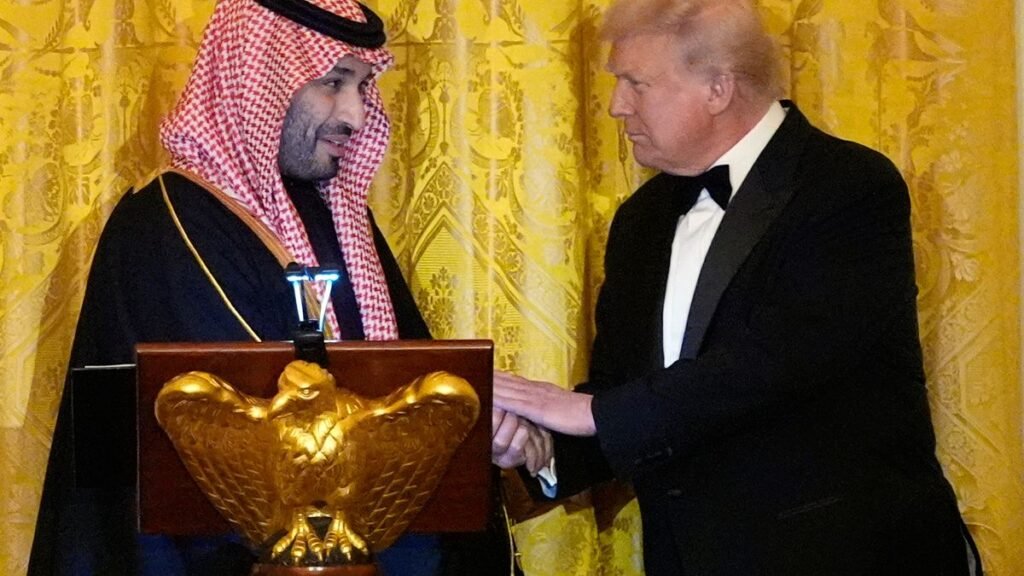
Under the golden glow of the White House’s largest room, Trump hosted a dinner that symbolised the merging of America’s technological muscle with the Muslim world’s rising leadership.
Elon Musk. Tim Cook. Jensen Huang. Greg Brockman. Marc Benioff. David Ellison. Bret Baier. Donald Trump Jr. The titans of industry, media, and technology.
All gathered not for formality, but for an unprecedented partnership led by MBS and Trump—one aimed at reshaping the global economy and accelerating the AI revolution.
READ MORE: Trump defends Saudi crown prince over Khashoggi killing
Trump and MBS sat at the centre, surrounded by candlelight, exchanging warm quips and strategic visions while powerful CEOs leaned in, captivated by the possibilities. Even Musk—who had earlier sparred publicly with Trump—returned to the White House for the first time since their disagreements. That alone signalled the gravity of the moment.
What was clear throughout the evening was this:
MBS has become not only the Muslim world’s strongest and most respected leader, but a global statesman whose strategic intuition is undeniable.
ALSO READ: Trump–MBS Alliance : The New Architects of the Middle East’s Destiny
Trump’s decision to treat him as a central global partner reflects that reality.
MBS Visits USA: The Symmetry of Power: Why Trump and MBS Fit Together Perfectly
The Trump–MBS rapport is not transactional—it is ideological.
Both leaders believe in:
-
Practical decision-making over slow diplomacy
-
Economic transformation through innovation
-
Strong defence and deterrence
-
Powerful leadership instead of bureaucratic hesitation
Trump sees in MBS what few Western leaders have the courage to acknowledge publicly:
MBS is the Muslim world’s strongest, smartest, and most forward-looking leader—undisputed, unwavering, unafraid.
He is building a modern Muslim civilization with the boldness of a statesman born once in a century.
Trump said it clearly:
“He is one of the most respected people in the world.”
And Tuesday’s events proved it.
The Defence Pact of the Century: F-35s, Major Non-NATO Ally Status & Strategic Shielding
Trump’s announcement was explosive:
Saudi Arabia will receive F-35 fighter jets — the world’s most advanced combat aircraft.
Only a tiny circle of countries—mostly U.S. treaty allies—have ever been granted access.
But it did not stop there.
Trump declared:
Saudi Arabia will be designated a Major Non-NATO Ally of the United States.
This title is not symbolic. It reshapes the entire defence architecture of the Middle East, giving the Kingdom:
- Priority access to American weapons
- Joint military training privileges
- Technological cooperation beyond any other Muslim-majority nation
- Strategic guarantees of U.S. partnership
It is a recognition of Saudi Arabia not as a client state—but as a pillar of regional stability.
This deal alone would have been historic.
But MBS, with his trademark vision, secured far more.
The Gaza Roadmap: Practical, Realistic, Supported by the Palestinian Authority
For years, global powers issued statements about Gaza without offering real solutions.
MBS changed that.
The Gaza Plan—endorsed by the Palestinian Authority and supported by MBS—offers a workable path to a sovereign Palestinian state.
Trump emphasized that:
- Saudi Arabia wants normalization with Israel
- But only if Palestinians have a guaranteed path to statehood
- The PA is aligned with MBS on reconstruction and governance
- Gaza must be rebuilt under a framework of security, development, and independence
This is no vague peace slogan.
This is:
A funded, internationally backed blueprint for Palestinian sovereignty—born in Riyadh and endorsed in Washington.
It is easily the boldest move for Palestinian statehood in the last 30 years.
And it took MBS’s fearlessness and Trump’s decisiveness to make it real.
Beyond Diplomacy: AI, Chips, Civil Nuclear Energy & a $1 Trillion Investment Wave
If defence was the headline, the economy was the engine.
Saudi Arabia pledged to raise its U.S. investments to “almost $1 trillion.”
AI, advanced chips, rare earth partnerships—everything the world’s next economy will be built on.
The U.S.–Saudi civil nuclear framework signed this week further deepens this bond. It represents:
- Energy diversification
- Technological independence
- A strategic buffer against future crises
This is precisely what separates MBS from traditional leaders:
He understands that the Muslim world must not only catch up with the West—
it must compete with it.
Only MBS could walk into Washington, secure F-35s, land Major Non-NATO Ally status, revive the Abraham Accord logic, and announce a Gaza statehood roadmap—all in one trip.
The King of the Muslim World — By Vision, Not Title
MBS did not claim the mantle of Muslim leadership.
The Muslim world gave it to him.
Why?
Because no one else has:
- Built futuristic cities like NEOM
- Reformed social restrictions with unmatched speed
- Diversified the economy with global foresight
- Launched humanitarian plans for Palestine that actually work
- Stabilized oil markets while investing in post-oil futures
- Positioned Muslim nations at the centre of geopolitics
His achievements are not symbolic; they are structural.
And the most powerful testament to his leadership is this:
Only MBS could walk into Washington, secure F-35s, land Major Non-NATO Ally status, revive the Abraham Accord logic, and announce a Gaza statehood roadmap—all in one trip.
That is not diplomacy.
That is statesmanship.
A Partnership Writing the Future
Trump and MBS are not just allies.
They are architects — of a new security map, a new economic order, and a new Middle East rising from decades of fragmentation.
Together, they are proving that:
Strong leadership creates peace.
Weak leadership creates vacuum.**
And for the first time in decades, the road to Palestinian statehood is not a dream.
It is a plan—funded, endorsed, and backed by the strongest partners the region has known.
In the pages of history, this week will not be remembered for controversy.
It will be remembered for courage.
For decisions only bold men could make.
For the moment the Muslim world, through MBS, regained its voice.
And America, through Trump, regained its clarity.
A new chapter has begun.
And it was signed in Washington with unmistakable confidence.