


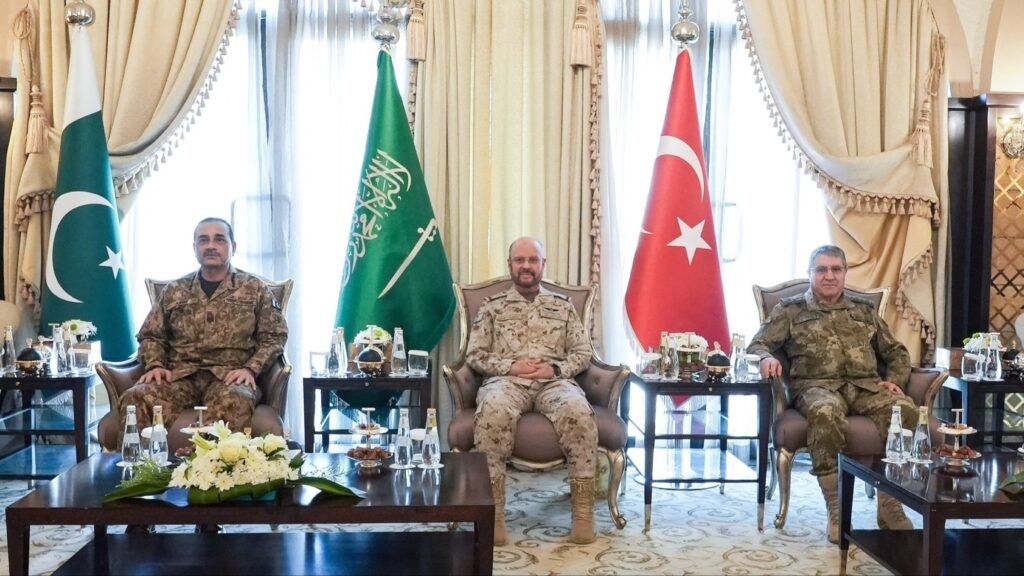
- Mecca Defence Agreement: Pakistan, Saudi Arabia and Turkey are turning the Mecca Joint Defence Agreement into an operational security framework through intelligence sharing, military coordination and capability integration.
- The Riyadh meeting marks the pact’s first major practical test as Saudi Arabia faces escalating Houthi attacks targeting its territory, Mecca and critical civilian and economic infrastructure.
- The trilateral military structure could reshape regional deterrence by combining Saudi strategic geography, Pakistan’s counterterrorism experience and Turkey’s defence capabilities.
The Riyadh meeting of the military chiefs of Pakistan, Saudi Arabia and Turkey marks a significant transition in the Mecca Joint Defence Agreement from a political commitment into an emerging security mechanism. The significance lies less in the ceremony than in who attended, what was discussed and, perhaps most importantly, what the three militaries are now being asked to build together.
Pakistan Chief of Defence Forces and Chief of Army Staff Field Marshal Syed Asim Munir, Saudi Chief of General Staff Gen. Fayyadh bin Hamed Al-Ruwaili and Turkey’s Chief of General Staff Gen. Selçuk Bayraktaroğlu met in Riyadh on September 25 within the framework of the agreement signed in Mecca on August 7. The three sides discussed intelligence sharing, military coordination and the integration of capabilities, while reaffirming collective defence and Saudi Arabia’s security, sovereignty and territorial integrity.
That combination is strategically important. A defence pact becomes meaningful not when leaders sign it, but when military institutions begin connecting intelligence systems, command structures, operational planning, training and capabilities. The Riyadh meeting therefore represents one of the first visible steps towards transforming the Mecca agreement into a functioning security architecture.
READ NEXT: Mecca Defence Alliance: Who Is Lt Gen (R) Nauman Mahmood?
The timing is equally significant. Saudi Arabia is facing an increasingly complex security environment, particularly from Yemen, where Houthi attacks have intensified against Saudi territory and infrastructure. The three military establishments reviewed the threats facing the kingdom and strongly condemned attacks against Mecca and Saudi civilian and economic infrastructure. The official Pakistani account did not publicly name the Houthis, but the meeting took place immediately after the three foreign ministers had discussed preparations for an urgent chiefs-of-staff meeting specifically in the context of supporting Saudi Arabia.
That distinction matters. The Mecca agreement was deliberately designed as a defensive framework rather than an openly declared coalition against a particular state or organisation. Turkey has repeatedly stressed that the pact is not directed against another country. The agreement nevertheless creates a collective deterrence mechanism: an armed attack against one signatory is to be regarded as an attack against all three.
READ NEXT: Pakistani, Saudi, Turkish chiefs discuss closer military ties
The immediate strategic message from Riyadh is consequently broader than Yemen. Potential adversaries now have to calculate that pressure on one member could activate the political, intelligence and military resources of two other major Muslim powers.
This is particularly important because the three countries bring complementary strategic assets. Saudi Arabia provides geography, financial weight, strategic infrastructure and access to the Gulf and Red Sea. Pakistan contributes a large standing military, extensive experience in counterterrorism and asymmetric warfare, and a nuclear deterrent. Turkey contributes a sophisticated defence-industrial base, combat experience and rapidly expanding capabilities in drones, electronic warfare, missiles and precision systems.
The combination creates possibilities that none of the three countries possesses independently.
The most important element may ultimately be intelligence integration. Modern security threats rarely arrive in the form of conventional armies crossing borders. Missiles, drones, cyber operations, maritime disruption, proxy forces, terrorist networks and covert attacks can move across several theatres simultaneously. An effective trilateral intelligence mechanism could therefore become the foundation of the Mecca security structure.
This is where the appointment of retired Lieutenant General Nauman Mahmood as the first secretary-general of the alliance becomes strategically relevant. Mahmood’s military career included senior counterterrorism responsibilities, including command experience in Pakistan’s western theatre. His appointment gives the new secretariat a leadership profile familiar with unconventional threats rather than only conventional military planning. The secretariat is being established in Riyadh, with Pakistan holding the secretary-general position for the first three-year term.
But it would be premature to conclude that the alliance has already developed a formal strategy to eliminate the Houthis, Kurdish armed groups, the Balochistan Liberation Army or other non-state actors. There is no public evidence that the three governments have designated such a list of organisations as collective military targets. What is emerging instead is a framework capable of addressing different categories of threats through intelligence cooperation, deterrence, military coordination and capability integration.
That distinction is crucial for understanding the alliance’s future.
The Houthi crisis is nevertheless becoming the first practical test of the agreement. Saudi Arabia is confronting attacks close to its territory, economic infrastructure and the holy city of Mecca, while the wider conflict has implications for the Red Sea, energy markets and maritime security. Turkey has already expressed readiness to help meet Saudi military requirements under the agreement, while Pakistan has repeatedly signalled its commitment to Saudi security without publicly announcing direct military operations against the Houthis.
The Riyadh meeting therefore sends a message of deterrence without necessarily announcing immediate military intervention. That may be deliberate. Collective defence does not require every crisis to begin with airstrikes or troop deployments. Intelligence, air defence, surveillance, logistics, maritime security, electronic warfare and military-industrial cooperation can all constitute forms of collective defence.
The deeper development is that the three countries are beginning to build institutional muscle around the political promise made in Mecca. The earlier foreign-ministers’ meeting in New York dealt with the alliance’s secretariat, committees and working groups; the military chiefs have now begun translating that political structure into defence coordination.
For Riyadh, the value is strategic diversification. For Islamabad, it creates a formal mechanism for protecting one of its most important strategic partners while strengthening its role in Gulf security. For Ankara, it expands its security footprint into the Arabian Peninsula while linking Turkish defence capabilities with Pakistani military expertise and Saudi strategic geography.
The real test will come when the three countries have to decide how much intelligence to share, which threats trigger consultation, what military capabilities can actually be integrated and how rapidly the alliance can respond to an attack.
The Mecca agreement is therefore moving beyond symbolism. The Riyadh meeting demonstrates that its architects are building the machinery required for collective deterrence. Whether that machinery eventually becomes a standing operational alliance will depend not on declarations, but on the committees, command arrangements, intelligence channels and military capabilities now being constructed.
For potential adversaries, that may already be the central message: Saudi Arabia is no longer discussing its security entirely through bilateral relationships. Pakistan and Turkey are becoming part of a broader trilateral calculation in which an attack on one member carries consequences for the strategic interests of the other two.