


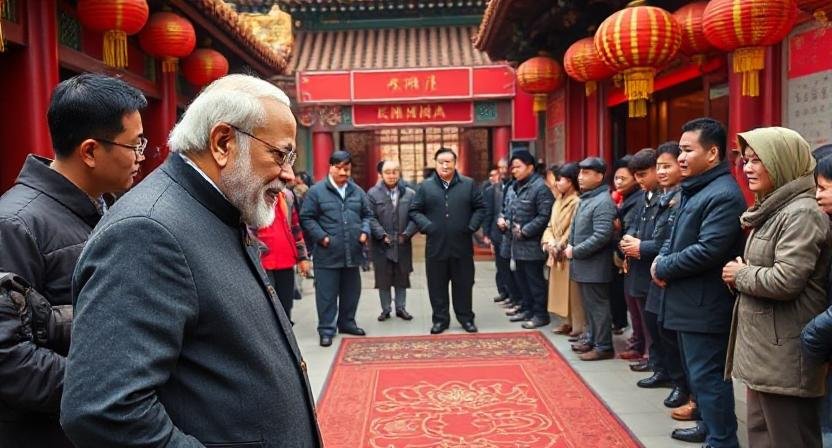
- Modi’s first China visit in 7 years expected at September 2025 SCO summit in Tianjin, signaling a major diplomatic shift.
- India reconsiders foreign policy amid rising tensions with the U.S., including new tariffs and strategic disagreements over Russia.
- Delhi-Beijing relations thawing as Indian ministers resume high-level visits to China after Galwan Valley fallout.
- China and India, representing 1/3 of the world’s population, explore shared interests in trade, security, and regional cooperation beyond U.S. influence.
In a move that could signal a dramatic recalibration of regional alignments, Indian Prime Minister Narendra Modi is expected to visit China for the first time in seven years. The visit, reportedly set to coincide with the upcoming Shanghai Cooperation Organisation (SCO) summit in Tianjin in the first week of September 2025, remains unconfirmed by official channels. However, Indian media outlets and diplomatic sources suggest the groundwork is being laid behind the scenes.
If the visit materializes, it would mark a significant diplomatic thaw between the two Asian giants, whose relationship has been marred by territorial disputes, strategic distrust, and military confrontations — most notably the deadly Galwan Valley clash in 2020, which claimed the lives of over 20 Indian soldiers and plunged relations into deep freeze.
A Diplomatic Reset Amid U.S. Tensions
The timing is telling. Modi’s anticipated outreach to Beijing comes as U.S.-India relations hit a rough patch. The Biden administration, and now President Trump in his second term, have both expressed concerns over India’s continued import of discounted Russian oil and alleged backchannel trade that indirectly supports Moscow’s war in Ukraine. These tensions have culminated in Washington’s recent decision to sharply increase tariffs on Indian goods — a move that stunned New Delhi’s policy elite and rattled Indian markets.
Foreign policy analysts now interpret Modi’s pivot toward China as a strategic hedging maneuver. The Indian establishment may be attempting to diversify its geopolitical options, seeking to restore balance in a multipolar world where over-reliance on a single partner — especially one as transactional as the current U.S. administration — could prove perilous.
But there’s more at stake here than tariffs or trade wars. India and China collectively represent over one-third of the world’s population and are both key players in the evolving architecture of the Global South. The SCO, BRICS+, and various regional formats offer frameworks where these two civilizational powers can cooperate — not only bilaterally, but also in shaping new norms around multipolarity, sovereignty, and development.
The Hindutva Dilemma and India’s International Image
Yet India enters this renewed engagement with baggage. Under Modi’s leadership, the country has undergone a profound ideological shift — from Nehruvian secularism to a Hindutva-driven polity. Over the past decade, the ruling Bharatiya Janata Party (BJP) has faced international criticism for growing authoritarianism, suppression of dissent, attacks on minority rights, and curbs on press freedom.
READ MORE:Black Gold Diplomacy: Trump–Asim Munir Meeting Spurs U.S. Investment in Pakistan
The once-shining narrative of “India as the world’s largest democracy” has dimmed, especially among Western investors and liberal think tanks. Human rights bodies, U.N. rapporteurs, and even former allies in the U.S. Congress have flagged rising intolerance and communal violence. This erosion of India’s soft power has created a trust deficit with global business elites — something China, despite its own authoritarian model, has managed to mitigate through economic consistency and geopolitical discipline.
Despite these internal challenges, India remains a massive consumer market with strategic potential. And Modi knows that any sustainable foreign policy must be grounded in pragmatic economics and multipolar diplomacy — not just ideological posturing.
Realities of Power: The China Factor
While India often aspires to be seen as a peer of China, the reality is stark. On military strength, technological advancement, and economic scale, Beijing is operating on a different level. China’s GDP, foreign exchange reserves, infrastructure dominance, and manufacturing ecosystem far outpace India’s metrics. Militarily, the People’s Liberation Army (PLA) has global expeditionary capabilities that New Delhi can only dream of. Technologically, China’s leap in AI, 5G, EVs, and space exploration remains unmatched in Asia.
ALSO READ:India’s Modi, Brazil’s Lula speak amid Trump tariff blitz
However, both nations understand that perpetual confrontation is unsustainable — especially given their shared interests in counterterrorism, regional stability, energy security, and cultural exchange. It is within forums like the SCO that a constructive bilateral mechanism can be revived, preferably insulated from U.S.-China tensions and Western geopolitical games.
This may explain the recent flurry of Indian high-level visits to China. Since June 2025, India’s National Security Advisor Ajit Doval, Defence Minister Rajnath Singh, and External Affairs Minister Subrahmanyam Jaishankar have all traveled to Beijing. These visits hint at behind-the-scenes diplomacy to restart previously suspended bilateral engagement protocols.
The Dragon and the Elephant: A New Chapter?
If Modi follows through with the visit, it will be seen as a bold signal — not just to Beijing, but to the broader international community — that India is open to reshaping its foreign policy with greater realism. This could mean India yielding to some Chinese conditions in border management, trade access, or regional cooperation frameworks.
From China’s perspective, the engagement is not meant to antagonize any third party, including the U.S. Rather, it reflects a pragmatic recognition that regional peace and prosperity are better served through collaboration than confrontation. China-India ties, if properly managed, could become one of the defining relationships of the 21st century.
A Chinese proverb says, “One generation plants the trees, another gets the shade.” Similarly, a Hindu saying reminds us: “Help your brother’s boat across, and your own will reach the shore.” These timeless philosophies suggest that ancient civilizations need not be adversaries. Instead, their shared cultural depth, demographic weight, and developmental aspirations could be harnessed for mutual benefit.
We hope Prime Minister Modi approaches the China visit not merely as a diplomatic showpiece but as a genuine attempt to reset ties — with concrete proposals, realistic expectations, and regional peace in mind. After years of drift and distrust, it is time for the dragon and the elephant to dance — not for the cameras, but for history.