


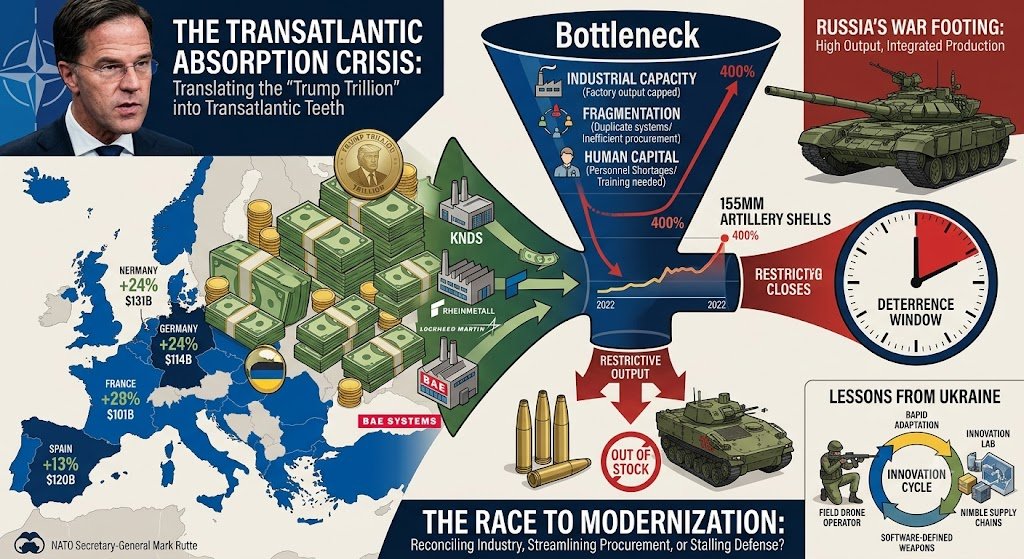
- NATO arms supply shortages are actively driving hyper-inflationary pressures, causing the price of foundational 155mm artillery shells to more than quadruple since 2022.
- While NATO’s non-U.S. defense spending surges by 20%, severe arms supply shortages, fragmented production lines, and skyrocketing costs threaten to stall military modernization.
- The “Trump Trillion” Reality Check: Why NATO Can’t Buy Its Way Out of Weapon Shortages
For years, the defining crisis within the North Atlantic Treaty Organization (NATO) was fiscal inertia. Securing political commitments from European member states to meet the baseline defense expenditure target of 2% of GDP dominated the agenda. Today, that cash flow bottleneck has broken. Driven by a volatile geopolitical landscape, the alliance’s non-U.S. members expanded military spending by a staggering 20% over 2024 baselines, reaching an unprecedented $574 billion. Germany alone lifted its outlays by 24% to $114 billion, charting a trajectory toward $180 billion by 2029.
Yet, as alliance leaders gather for a high-stakes summit in Ankara, Turkey, a more insidious systemic crisis has emerged. The central strategic dilemma is no longer the acquisition of capital, but the physical limits of its absorption. NATO is discovering that in a modern industrial ecosystem, money does not instantly buy security.
The Industrial Absorption Bottleneck
The sudden influx of capital has run headlong into a severely constricted transatlantic defense industrial base. Decades of post-Cold War disinvestment left European production lines optimized for low-volume, peacetime procurement rather than high-rate conventional warfare.
This friction manifests most acutely in hyper-inflationary pressures on basic ordnance. The cost of a standard 155mm artillery shell—the foundational kinetic currency of modern European attrition warfare—has more than quadrupled since 2022. Rather than yielding immediately scalable output, ballooning budgets are chasing highly inelastic supply chains, threatening to convert nominal defense hikes into defense market inflation.
READ MORE: US Troop Withdrawal Europe: Hegseth’s NATO Shock Signals Strategic Shift and Rising Risk for Russia-Ukraine War
According to NATO Secretary-General Mark Rutte, European states have placed roughly $300 billion in weapons orders with U.S. defense firms. However, American assembly lines are facing their own compounding strains. U.S. manufacturing capacities are already heavily taxed by concurrent requirements: supply pipelines to Ukraine, domestic inventory replenishment, and the rapid consumption of precision munitions during recent conflicts involving regional actors like Iran.
Systemic Hurdles: Fragmentation and Human Capital
Beyond raw factory capacity, NATO’s transition to a modernized, high-readiness posture is obstructed by two primary structural hurdles:
1. Market Fragmentation and Protectionism
Rather than integrating procurement to maximize economies of scale, European nations frequently pursue highly localized, protectionist industrial strategies. This results in inefficient duplication. Europe actively fields multiple, competing variants of main battle tanks and armored infantry vehicles. This industrial balkanization dilutes purchasing power and severely complicates battlefield interoperability. Crucially, it redirects finite capital away from high-priority theater enablers, including:
-
Integrated air and missile defense (IAMD)
-
Deep-precision strike capabilities
-
Next-generation intelligence, surveillance, and reconnaissance (ISR) architectures
2. The Human Capital Deficit
Hardware procurement is ultimately bound by human constraints. Expanding conventional combat brigades requires a parallel influx of personnel.
NATO Is Fixing Its Cash Flow Problem. Now It Needs to Turn Money Into Munitions.
Alliance members are struggling universally with recruitment and retention in highly competitive civilian labor markets. Without the structural capacity to recruit, house, and train new cadres of specialized soldiers, additional mechanized hardware risks sitting idle in depots.
The Strategic Threat Landscape
The timeline for resolving these bottlenecks is dictated by a closing strategic window. To the east, the Russian Federation has successfully transitioned its economy onto a comprehensive war footing. Moscow has centralized its industrial policy to prioritize weapon output, ensuring a continuous stream of mass conventional systems despite severe international sanctions.
       NATO 3.0 TRANSITION CHALLENGES
┌──────────────────────────────────────────────┐
│  Capital Surge: +20% Non-U.S. Spending       │
└──────────────────────┬───────────────────────┘
                       │
                       ▼
┌──────────────────────────────────────────────┐
│  Absorption Limits & Structural Bottlenecks   │
└──────────────┬────────────────┬──────────────┘
               │                │
               ▼                ▼
┌────────────────────────┐    ┌────────────────────────┐
│ Industrial Elasticity  │    │ Fragmentation Risk     │
│  • 4x Artillery Costs  │    │  • Duplicated Armored  │
│  • Strained US Supply  │    │    Vehicles            │
│  • Personnel Shortages │    │  • Underfunded IAMD    │
└────────────────────────┘    └────────────────────────┘
Concurrently, NATO faces critical political friction from the West. The current U.S. administration continues to question the asymmetric architecture of the alliance, signaling a potential recalibration or drawdown of long-term U.S. forward-deployed forces in Europe. While Rutte has leveraged the European spending surge—coined the “Trump Trillion”—to validate a “NATO 3.0” framework to American skeptics, the reality remains clear: Europe must build autonomous, credible combat power swiftly.
The Ankara Paradigm Shift
To address these vulnerabilities, the Ankara summit features an unprecedented defense industry forum designed to force structural consolidation. U.S. Ambassador to NATO Matthew Whitaker emphasized the imperative of this shift, noting that success depends on translating currency into tangible, integrated combat capability.
The alliance is also looking closely at tactical innovations emerging from the Ukrainian theater, particularly regarding drone warfare. The lesson from Ukraine is not merely the value of stockpiling specific unmanned aerial vehicles (UAVs), but the necessity of building agile, software-defined production lines capable of adapting to electronic warfare counter-measures that shift every two to three weeks.
For NATO, the strategic mandate is clear. The era of procurement-by-promise has concluded. The alliance’s deterrence capability now hinges on whether its highly fragmented, peacetime commercial model can be reorganized into a cohesive, high-rate production engine before the geopolitical clock runs out.