


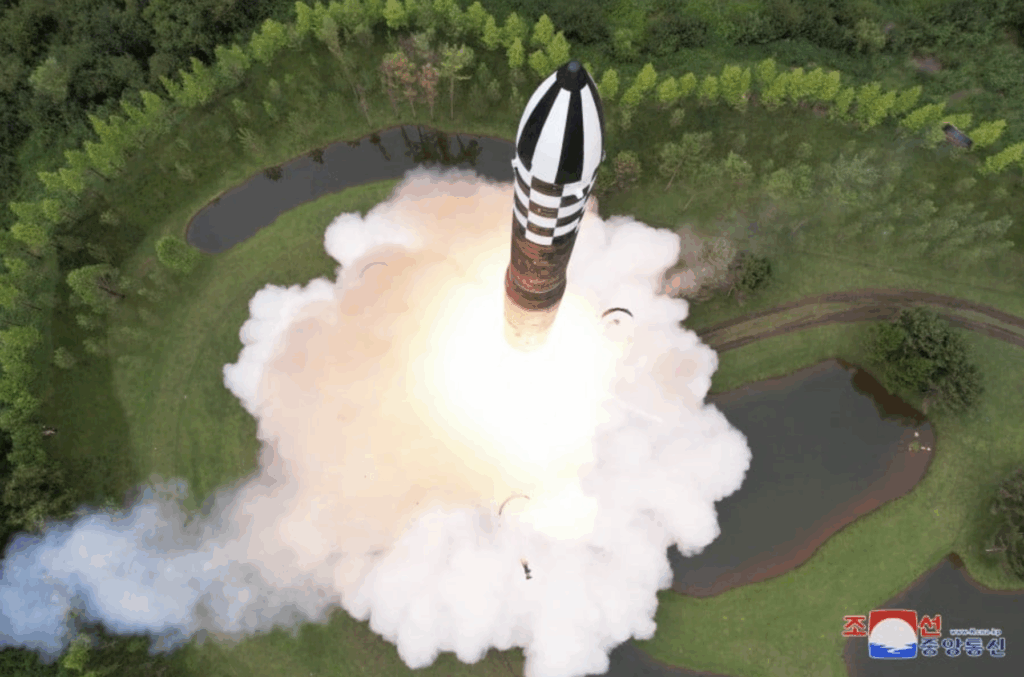
- New nuclear race intensifies as China rapidly expands to challenge U.S. and Russian parity.
- Russia deploys nuclear systems to Belarus, tests exotic weapons, and pressures NATO via nuclear signaling.
- U.S. modernization lags behind: decades-old systems, weak industry, and political uncertainty undermine deterrence.
- Simultaneous crises—Ukraine, Taiwan, Korea—could overwhelm U.S. nuclear planning for the first time in history.
The new nuclear race has begun—louder, faster, and far more unpredictable than anything witnessed during the Cold War. But unlike the era of U.S.–Soviet bipolarity, today’s moment carries a more destabilizing reality: Washington faces two peer nuclear rivals, Russia and China, both modernizing faster than the United States at a time when American industrial primacy has eroded.
For policymakers in Washington, for planners at NATO headquarters in Brussels, and for strategists across Asia, this is the unthinkable strategic nightmare coming true. And yet, it is happening in plain sight.
China, once content with a minimal deterrent, is now racing toward parity. Russia, despite economic constraints, is producing exotic delivery systems designed to outmaneuver American missile defenses. North Korea is testing intercontinental capabilities. Meanwhile, U.S. nuclear warheads age, industrial capacity shrinks, and political divisions widen.
What emerges is not merely an arms race—but a crisis of confidence in American credibility, the cornerstone of the global nuclear order since 1945.
A World Re-Arming: The Return of Atomic Anxiety
There is no ambiguity about the trend: all major nuclear actors are expanding.
Russia has deployed tactical nuclear weapons to Belarus and tested a nuclear-powered cruise missile alongside a nuclear-powered underwater drone—the Burevestnik and Poseidon—systems the Kremlin claims are designed to bypass U.S. defenses and threaten coastal cities. President Vladimir Putin’s nuclear threats, veiled and sometimes explicit, have been effective: they chilled Western support to Ukraine and introduced nuclear risk calculus into every European diplomatic negotiation.
READ MORE: New Nuclear Arms Race Pits U.S. Against Both Russia and China
At the same time, China has broken from decades of slow, conservative nuclear growth. American intelligence now estimates Beijing will reach near-parity with Washington in deployed warheads by the mid-2030s. In September, Xi Jinping showcased China’s full nuclear triad—land-based ICBMs, nuclear submarines, and strategic bombers—parading alongside Putin and North Korea’s Kim Jong Un in a spectacle symbolizing the new axis of atomic cooperation.
What makes China’s buildup even more consequential is that Beijing is unconstrained by any arms-control agreement. Where Washington and Moscow still operate under remnants of New START—set to expire in February—China faces no treaty limits, no cap, no inspections, and seemingly no political interest in entering such frameworks.
The Vulnerability of an Overstretched America
For decades, U.S. deterrence policy rested on three assumptions:
-
Russia would continue reducing its arsenal.
-
China would remain a minor nuclear player.
-
No simultaneous, multi-front nuclear threat would emerge.
All three assumptions have collapsed.
Vipin Narang of MIT, who oversaw U.S. strategic capabilities at the Pentagon, summarized the crisis bluntly: “All those assumptions have turned out to be wrong.”
ALSO READ: Putin’s Defiance and Trump’s Dilemma: Russia’s 9M729 Missile Strikes Reignite the Nuclear Shadow Over Europe
Meanwhile, the United States remains slow, even hesitant, in adapting. The U.S. nuclear modernization program was built for a one-peer world. Its systems—many dating to the 1970s and 1980s—require replacement or refurbishment. Unlike China’s booming industrial base or Russia’s command-driven production, American defense industries operate under budget ceilings, contractor bottlenecks, and political gridlock.
And the nightmare scenario looms: a European conflict triggered by Russia while China simultaneously moves on Taiwan.
U.S. planners call it the simultaneity problem.
In such a case, Washington would be forced to split its nuclear attention—something it has never had to do in the atomic age. NATO commanders already warn that North Korea might seize such an opportunity to strike South Korea, creating a cascade of nuclear-tinged crises exceeding American strategic bandwidth.
China’s Strategic Logic: Win the Conventional War, Prevent the Nuclear One
Beijing’s nuclear expansion is guided by a clear and blunt doctrine: build enough warheads to ensure the United States never considers nuclear escalation in a conflict over Taiwan.
As retired Chinese Senior Colonel Zhou Bo explained, China does not seek parity—it seeks certainty.
Certainty that no American president, faced with the possibility of losing a conventional war in the Western Pacific, will reach for the nuclear option.
China’s military confidence has grown after observing wars across Eurasia. The brief conflict between Pakistan and India this year—where Chinese weapons proved effective—has only strengthened Beijing’s belief that it possesses the manufacturing and technological advantage to outpace the U.S. in any long conflict.
As Tsinghua University’s Tang Xiaoyang put it, “The U.S. doesn’t really have the capacity to engage in a big-scale war in Asia.”
This is not arrogance. It is strategic assessment backed by industrial statistics: China produces more ships, more missiles, more drones, and more warheads annually than the U.S.—by wide margins.
Russia’s Nuclear Theater: Threat as Strategy
While China builds quietly, Russia builds theatrically.
Putin’s strategy is not simply military—it is psychological. His nuclear rhetoric is designed to intimidate, confuse, and paralyze. Russia’s “wonder weapons,” such as the Burevestnik missile and the Poseidon drone, remain largely experimental, but they serve a powerful narrative purpose: forcing Western leaders to constantly second-guess themselves.
Fabian Hoffmann of the University of Oslo notes that many of these systems are less about operational utility and more about fear: “It is eating up their R&D budget… it is a waste of money.”
Yet they succeed in dominating headlines, political debates, and NATO war-gaming scenarios. Fear itself becomes a weapon.
Putin has now instructed his Defense Ministry to consider resuming nuclear testing. The symbolism alone is enough to send tremors through global strategic circles.
Trump’s “Testing Doctrine” and a New Era of Uncertainty
President Donald Trump has revived a highly charged conversation: Should the U.S. resume nuclear testing?
Trump argues that if China and Russia are secretly conducting supercritical tests—an accusation Beijing denies—America cannot remain the only nuclear power not modernizing through real-world testing.
This suggestion creates deep international unease. The U.S. has not conducted an explosive test since 1992. Nevada’s nuclear site would need years of preparation before resuming full-yield testing. Yet Trump’s rhetoric signals a potential shift toward a more aggressive nuclear posture.
The U.S. Energy Department downplays the idea, insisting any tests would be “non-critical”—but global confidence in arms-control norms is already eroding.
Beijing responded sharply, calling on the U.S. to uphold the moratorium that has kept nuclear testing dormant for three decades. Chinese officials insist they remain committed to no-first-use and defensive strategy. Washington remains unconvinced.
The Collapse of Arms Control: A World Without Guardrails
New START expires in 2026. If no successor treaty is negotiated, the world’s two largest nuclear powers will operate for the first time in 50 years without any binding limits on deployed strategic weapons.
And China—the rising third pillar—has shown no interest in joining any such agreement until the U.S. and Russia drastically reduce their own arsenals.
The era of verifiable, enforceable nuclear restraint is ending.
What replaces it is an uncontrolled, competitive cycle driven by fear, suspicion, and worst-case scenario planning.
Background: How We Got Here
The post–Cold War nuclear peace rested on three pillars:
-
U.S.–Russian arms reduction treaties (START I, SORT, New START)
-
Chinese minimal deterrence doctrine
-
American global military dominance
All three pillars cracked in the last decade:
-
Russia invaded Ukraine in 2014, then again in 2022, and began using nuclear threats as diplomatic weapons.
-
China changed course after assessing U.S. Taiwan policy, building missile fields, new silos, and expanding its navy.
-
American credibility took hits from Afghanistan, Syria, and political polarization.
-
North Korea developed ICBMs capable of reaching the U.S. mainland.
-
AI-driven missile and targeting technology accelerated global risk.
The nuclear order was never built to handle this complexity.
Future Outlook: A Dangerous Path, But Not an Inevitable One
1. A Three-Power Nuclear Race Will Define the Coming Decade
The U.S., Russia, and China will expand their arsenals simultaneously. Arms-control architecture may collapse entirely.
2. Deterrence Will Depend on Industrial Capacity
Who can build faster—not who can build smarter—will increasingly determine strategic dominance.
3. Regional Wars Could Trigger Nuclear Shadow Escalation
Events in Taiwan, Ukraine, or Korea may spark simultaneous crises. The simultaneity problem is the single greatest threat to American deterrence.
4. New Testing Will Become Politically Attractive
If Russia or China are suspected of secret tests, pressure within Washington will grow to resume U.S. nuclear tests.
5. Smaller Nuclear States Will Emulate the Giants
North Korea, Pakistan, and potentially Iran could expand their arsenals in response to the big three.
The Responsibility of Restraint
The new nuclear race is not inevitable—but it is real.
The world stands at the edge of a renewed atomic confrontation, with fewer guardrails, deeper mistrust, and more players than ever before.
If Washington, Moscow, and Beijing fail to construct a new framework—whether arms control, transparency measures, or crisis hotlines—the next decade could resemble the most dangerous years of the Cold War, multiplied exponentially.
The real question is no longer whether the race has begun. It has.
The real question is:
Does anyone have the wisdom—and the will—to stop it?