


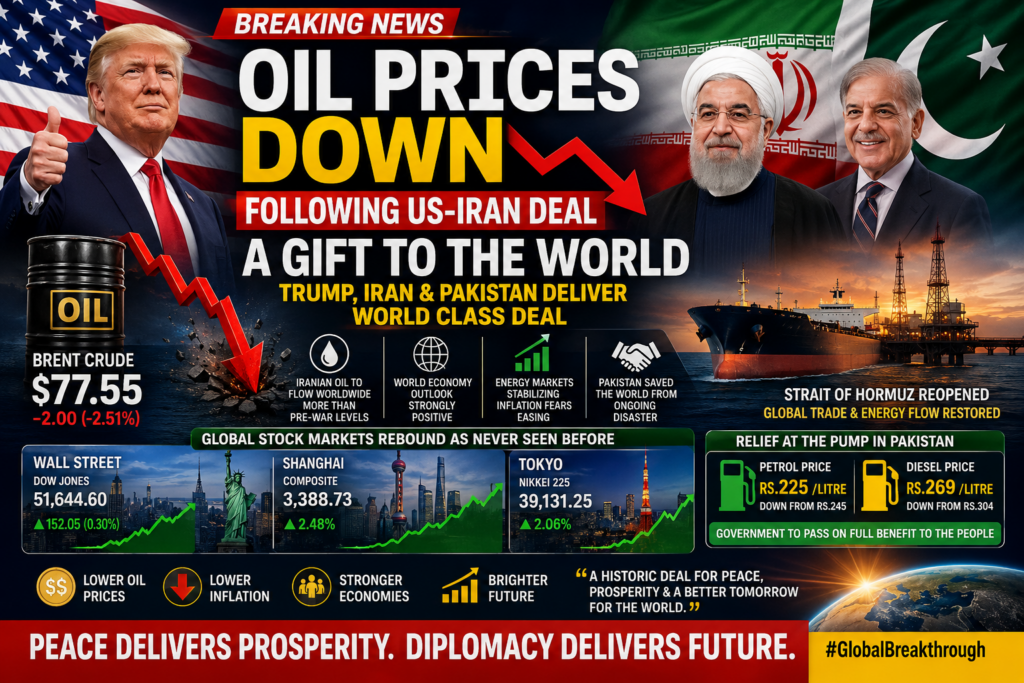
- Oil Prices Down After US Iran Deal as Brent crude drops near pre-war levels, easing global inflation
- Wall Street, Shanghai, and Tokyo stock markets rebound sharply amid renewed investor confidence
- Iranian oil supply expected to exceed pre-war levels, stabilizing global energy markets
- Pakistan credited with brokering a historic agreement that prevented a prolonged global economic crisis
Global oil markets plunged and equities surged Thursday in a dramatic, synchronized reaction to the landmark U.S.–Iran interim agreement—an accord brokered with decisive diplomatic backing from Pakistan that traders and policymakers are already calling a turning point for the global economy.
The deal, signed by Donald Trump and Iranian President Masoud Pezeshkian, sets in motion the reopening of the Strait of Hormuz and the lifting of U.S. naval restrictions on Iranian oil exports—effectively restoring one of the world’s most critical energy arteries after months of war-driven disruption.
Brent crude futures fell sharply, sliding toward $77 per barrel—just a few dollars above pre-war levels of around $72.50. U.S. West Texas Intermediate also dropped below $75, reflecting a rapid repricing of geopolitical risk. The speed of the decline has stunned markets that only weeks ago were pricing in prolonged supply shocks and $100-plus oil scenarios.
The impact is already being felt beyond trading floors. In the United States, gasoline prices dipped below $4 per gallon for the first time in over two months, according to AAA data, offering immediate relief to consumers and easing inflationary pressure on the Federal Reserve.
But the most striking signal came from global equity markets.
The Nasdaq Composite jumped more than 1%, reversing the previous day’s losses, while the S&P 500 rose nearly 0.9% and the Dow Jones Industrial Average added over 150 points. Semiconductor stocks led the rally, with investors pouring back into AI-driven growth plays amid renewed optimism about global demand and supply chain stability.
READ MORE: Pakistan-Brokered US-Iran Deal Reshapes Middle East Power Balance as Markets Surge and Strategic Order Shifts
Across Asia, the rebound echoed with even greater force. Shanghai and Tokyo markets surged as investors priced in the return of stable energy flows and reduced geopolitical uncertainty. Analysts described the rally as “structural,” not merely reactive—suggesting that the deal may mark the beginning of a broader economic upswing.
At the heart of this transformation lies the anticipated flood of Iranian oil back into global markets.
With sanctions relief underway and shipping lanes reopening, Tehran is expected to ramp up exports rapidly—potentially exceeding pre-war volumes as it seeks to reclaim lost market share. Energy analysts forecast a sustained increase in supply that could keep oil prices contained well into 2027, providing a powerful tailwind for industrial economies and emerging markets alike.
RELATED:Stock Market Today: Oil Is Now Close to Prewar Prices, Pushing Gasoline Below $4
Pakistan’s role in brokering the agreement has drawn widespread attention. Prime Minister Shehbaz Sharif confirmed that the “Islamabad MoU” would take immediate effect, ensuring the reopening of the Strait and the cessation of hostilities. Officials in Islamabad framed the breakthrough as a strategic intervention that prevented a deepening global crisis.
Domestically, the benefits are already visible. Pakistan’s petroleum minister announced a sharp drop in ex-refinery fuel costs, with petrol falling from Rs245 to Rs225 per liter and diesel from Rs304 to Rs269. The government has pledged to pass the full benefit to consumers, signaling potential relief for inflation-stricken households.
“This is not just a ceasefire—it is an տնտեսական reset,” said one market strategist, pointing to the alignment of falling energy prices, rising equities, and stabilizing supply chains.
Even as the Federal Reserve maintains a cautious stance—with markets pricing a 65% chance of a rate hike by September—the oil shock reversal has given policymakers breathing room. Lower energy costs could temper inflation without aggressive monetary tightening, a scenario investors have long hoped for.
There are still logistical hurdles ahead. The Strait of Hormuz, which carries roughly a fifth of global oil supply, must be cleared of mines and stranded vessels before full operations resume. Yet markets appear willing to look past short-term constraints, focusing instead on the structural implications of peace.
For now, the verdict from is unmistakable: a war that once threatened to destabilize the global economy has instead ended with a deal that may fuel its next phase of growth.
And at the center of it all stands an unlikely diplomatic axis—Washington, Tehran, and Islamabad—credited with delivering what many are calling a rare geopolitical gift to the world.