


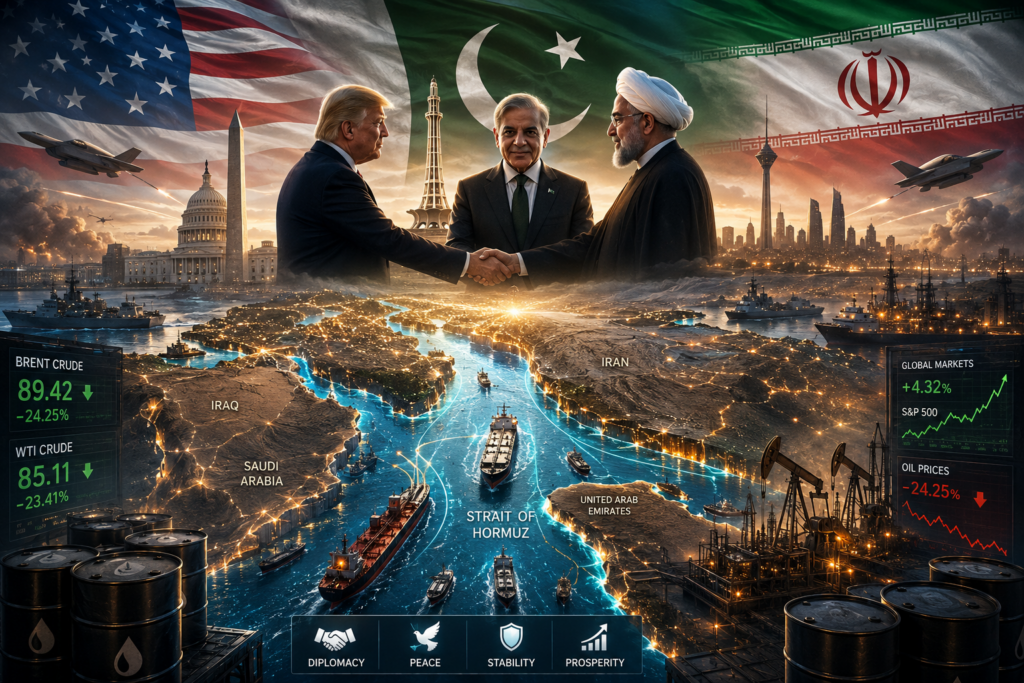
- Pakistan Brokered US Iran Deal marks a turning point in Middle East diplomacy
- Oil prices down from $118 to $89 as markets respond to de-escalation
- Strait of Hormuz reopening restores nearly 20% of global oil flow
- Pakistan emerges as a new geopolitical power broker between Washington and Tehran
For months, the world had been inching toward a wider regional war. What began as a targeted U.S.-Israeli air campaign against Iranian-linked assets metastasized into a multi-front confrontation stretching from the eastern Mediterranean to the Persian Gulf. Lebanon’s southern frontier burned, Israeli missile defenses strained under sustained pressure, and the Strait of Hormuz—the artery through which roughly 21 million barrels of oil per day (nearly 20% of global supply) flows—teetered on the edge of closure.
Markets braced for catastrophe. Brent crude surged past $118 per barrel, insurance premiums for Gulf shipping tripled, and global equities—particularly in Asia—shed nearly $1.8 trillion in market capitalization within three weeks of peak escalation.
And then, unexpectedly, Pakistan stepped in.
A Quiet Diplomatic Offensive
Behind closed doors, Islamabad launched a calibrated diplomatic initiative—one that combined military credibility with political access. Prime Minister Shehbaz Sharif, operating through backchannels in the Gulf and Europe, facilitated a series of indirect communications between Washington and Tehran. Simultaneously, Pakistan’s Field Marshal Asim Munir leveraged longstanding security relationships to assure both sides of enforceability.
Islamabad Memorandum of Understanding Reshapes Global Order as US-Iran Deal Sends Oil Prices Tumbling
The breakthrough, now widely described as a Pakistan-brokered ceasefire framework, represents not just a pause in hostilities—but the beginning of a structured de-escalation mechanism.
At its core, the agreement includes:
- Immediate cessation of cross-border and proxy military operations
- A phased reopening of the Strait of Hormuz
- Restart of nuclear negotiations under a revised monitoring regime
- Security guarantees tied to regional de-escalation benchmarks
Markets Respond with Relief—and Caution
Financial markets reacted almost instantly.
- Brent crude dropped from $118 to $89 per barrel within 72 hours
- The S&P 500 gained 4.2%, led by logistics and aviation stocks
- Gulf shipping insurance costs fell by nearly 35%, according to Lloyd’s estimates
- Gold retreated from safe-haven highs of $2,480/oz to $2,310/oz
Yet beneath the relief rally lies a deeper recalibration.
Iran war live: Pakistan says MoU in effect after Trump, Pezeshkian signing
Defense stocks—particularly U.S. contractors—declined modestly, while emerging market bonds, including Pakistan’s, saw a sharp uptick. Pakistan’s sovereign eurobonds tightened by over 120 basis points, signaling renewed investor confidence in its geopolitical relevance.
The Strategic Context: Why the War Failed to Achieve Its Objectives
The U.S.-Israeli military campaign was designed to force Iran into strategic concessions—particularly on its nuclear program and regional proxy networks. Instead, the outcome diverged sharply from expectations.
Iran absorbed the strikes, consolidated internal control, and demonstrated its ability to disrupt maritime trade through asymmetric tactics. The temporary tightening of the Strait of Hormuz exposed a fundamental vulnerability in global energy security—one that military force alone could not resolve.
This reality forced a recalibration in Washington.
Rather than escalation, the U.S. pivoted toward negotiation—recognizing that the cost of prolonged conflict could exceed $2 trillion in global economic damage, according to early IMF-style projections.
Pakistan’s Emergence as a Strategic Intermediary
Pakistan’s role in this episode marks a significant shift in its international positioning.
Tehran signals Iranian, US presidents could sign interim deal
Traditionally viewed through the lens of regional security or economic fragility, Islamabad has now demonstrated an ability to operate as a credible diplomatic intermediary between adversarial powers.
Three factors explain this emergence:
- Balanced Relationships
Pakistan maintains working ties with the United States, China, Iran, and Gulf states—an increasingly rare diplomatic configuration. - Military Credibility
The presence of a strong military leadership, under Field Marshal Asim Munir, provided assurance that any security guarantees embedded in the agreement would carry weight. - Geostrategic Location
Positioned at the crossroads of South Asia, Central Asia, and the Middle East, Pakistan holds logistical and strategic relevance that extends beyond its borders.
Implications for the Middle East and Beyond
The agreement does not resolve underlying tensions—but it fundamentally alters the trajectory.
For Israel, the deal introduces a pause that may allow for recalibration of its northern strategy. For Iran, it offers breathing space without immediate concessions. For the United States, it provides an off-ramp from a costly and uncertain conflict.
But the broader implications are even more significant.
- Energy Stability: The reopening of Hormuz stabilizes global supply chains, easing inflationary pressures worldwide
- Shift in Diplomacy: Middle powers like Pakistan are increasingly shaping outcomes traditionally dominated by superpowers
- New Negotiation Frameworks: Future nuclear talks are likely to be more multilateral, less U.S.-centric
A Fragile but Transformative Moment
History rarely turns with a single announcement. More often, it shifts quietly—through incremental decisions that only later reveal their magnitude.
The Pakistan-brokered U.S.-Iran agreement may prove to be one of those moments.
It is fragile. It is incomplete. And it could yet unravel.
But for now, it has achieved what months of military escalation could not: a pathway—however narrow—away from a wider war.
And in doing so, it has redrawn not just the contours of conflict in the Middle East, but the architecture of global diplomacy itself.