


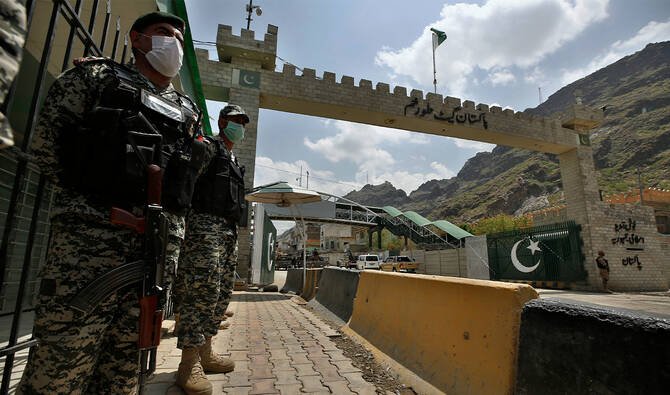
- Pakistan Afghanistan Border Clash 2026 escalates after Taliban’s alleged unprovoked cross-border attack triggers major Pakistani air strikes.
- Pakistan claims 133 Afghan fighters killed and multiple military headquarters destroyed in retaliatory operations.
- Afghan authorities present competing narrative, calling their actions defensive retaliation.
- Washington, Beijing, Moscow, London, Ankara, and Brussels closely monitor risks of wider regional instability.
In a dramatic escalation that has instantly become one of the most consequential security developments in South Asia this year, Pakistan launched a second wave of coordinated air and ground strikes against Afghan Taliban military positions early Friday, following what Islamabad describes as a large-scale, unprovoked cross-border assault by Afghan forces along the volatile Durand Line.
The confrontation — involving sustained artillery exchanges, aerial bombardment, armored engagements, and cross-border offensives — is ongoing at the time of filing this report, transforming an already fragile frontier into a rapidly expanding geopolitical flashpoint now being closely monitored in Washington, Beijing, Moscow, London, Ankara, and Brussels.
Senior diplomatic sources confirm that global security establishments are treating the escalation as a high-risk regional crisis with potential implications for counterterrorism operations, regional stability, and post-U.S. withdrawal security dynamics in Afghanistan.
Pakistan’s Retaliatory Doctrine Activated
The latest fighting erupted in the early hours of Friday after Afghan Taliban forces allegedly launched coordinated attacks across multiple sectors of Pakistan’s northwestern frontier, resulting in the martyrdom of two Pakistan Army soldiers and injuries to three others.
Within hours, Pakistan initiated what officials described as an “immediate, calibrated, and decisive retaliatory operation”, combining precision airpower with synchronized ground maneuvers.
Mosharraf Zaidi, spokesperson for Prime Minister Shehbaz Sharif on foreign media affairs, confirmed extensive battlefield outcomes:
- 133 Afghan Taliban fighters and soldiers killed
- More than 200 wounded
- 27 Taliban military posts destroyed
- Nine forward positions captured
According to Pakistani military sources, the strikes inflicted sweeping structural damage on Afghan military infrastructure, including:
- Two Corps Headquarters
- Three Brigade Headquarters
- Three Battalion Headquarters
- Two ammunition depots
- One logistics base
- Two sector headquarters
-
Over 80 tanks, artillery systems, and armored personnel carriers neutralized
Officials described the operation as a demonstration of Pakistan’s evolving rapid-response deterrence capability, emphasizing that military actions were directed strictly at combat infrastructure involved in cross-border aggression.
Pakistan strikes Afghan cities as cross-border attacks escalate
“Pakistan’s response remains immediate, effective, and proportionate,” a senior security official stated.
Advanced U.S. Military Hardware Fails to Shift Battlefield Momentum
Perhaps the most striking battlefield development — now drawing intense international scrutiny — is the confirmed deployment by Afghan forces of highly sophisticated military equipment left behind by U.S. forces during the 2021 Afghanistan withdrawal.
Pakistani military observers reported Afghan soldiers using advanced artillery platforms, heavy machine guns, armored vehicles, and modern battlefield systems valued at billions of dollars.
Despite the deployment of advanced Western-origin weaponry, officials say the equipment proved ineffective against Pakistan’s coordinated retaliatory strikes, which relied on intelligence-driven targeting, air superiority, and rapid operational execution.
Security analysts say the episode underscores growing global concerns about abandoned military arsenals reshaping regional conflict dynamics long after the U.S. exit from Afghanistan.
Kabul’s Version: Taliban Claims Retaliatory Operations
Afghanistan’s interim Taliban administration has presented a sharply contrasting narrative, insisting its forces acted in retaliation to earlier Pakistani air strikes conducted earlier this week in Nangarhar and Paktia provinces.
Taliban spokesperson Zabihullah Mujahid said “large-scale offensive operations” were launched against Pakistani military installations following what he described as repeated border violations.
Afghan officials claimed Pakistani casualties and alleged the capture of military posts — assertions firmly rejected by Islamabad.
Pakistan maintains that no outposts were lost and Afghan claims are part of wartime disinformation, reiterating that Taliban forces initiated hostilities.
As of publication, Afghan authorities have not officially responded to Pakistan’s reported casualty figures.
Air Strikes Rock Kabul and Southern Afghanistan
Residents in Kabul reported loud explosions accompanied by aircraft activity during the early hours of Friday. Similar reports emerged from Kandahar and Paktia, where Pakistani officials say military targets linked to cross-border operations were engaged.
Pakistan’s Ministry of Information and Broadcasting confirmed heavy retaliatory actions across multiple sectors, including Chitral, Khyber, Mohmand, Kurram, and Bajaur.
Border towns experienced sustained artillery exchanges overnight, forcing civilian evacuations and the temporary suspension of crossings at Torkham.
The TTP Factor: Core Driver of Escalation
At the center of the crisis lies Pakistan’s long-standing accusation that Afghanistan’s Taliban authorities have failed to dismantle safe havens used by Tehreek-e-Taliban Pakistan (TTP) militants.
Islamabad argues that the porous frontier allows militant fighters to regroup across the border, fueling a surge in attacks inside Pakistan.
Conflict monitoring organizations report that militant violence linked to the TTP surged dramatically in 2025, with trends in 2026 showing no signs of decline — reinforcing Islamabad’s increasingly assertive security posture.
Analysts note that ideological and historical ties between Afghan Taliban factions and the TTP complicate enforcement efforts by Kabul.
Ceasefire Collapse and Regional Shockwaves
The escalation marks the effective collapse of a fragile ceasefire reached after deadly clashes in October that killed more than 70 people on both sides.
Diplomatic sources describe the current confrontation as the most serious Pakistan-Afghanistan military crisis since the Taliban’s return to power, raising fears of sustained border militarization.
Global capitals are now assessing potential ripple effects on:
- Counterterrorism cooperation
- Central Asian stability
- Refugee flows
- Regional trade corridors
- China-Pakistan Economic Corridor security dynamics
Western and regional diplomats are reportedly engaging in quiet backchannel communications urging restraint, though no formal mediation initiative has yet emerged.
A Battlefield With Competing Narratives
Both Islamabad and Kabul insist they acted defensively — highlighting the increasingly entrenched mistrust between the two neighbors.
Pakistan asserts Afghan Taliban forces miscalculated by initiating cross-border aggression, while Kabul maintains its operations were retaliatory responses to earlier strikes.
What remains undeniable is the scale of escalation: sustained fighting continues across multiple sectors, aerial activity remains active, and neither side has signaled immediate de-escalation.
For international observers, the events unfolding along the Durand Line now represent more than a border clash — they signal a defining test of post-withdrawal regional security architecture.
As dawn breaks over the rugged frontier, one reality is clear: South Asia’s most sensitive border has re-emerged as a central theater of global strategic concern — and the crisis is far from over.