


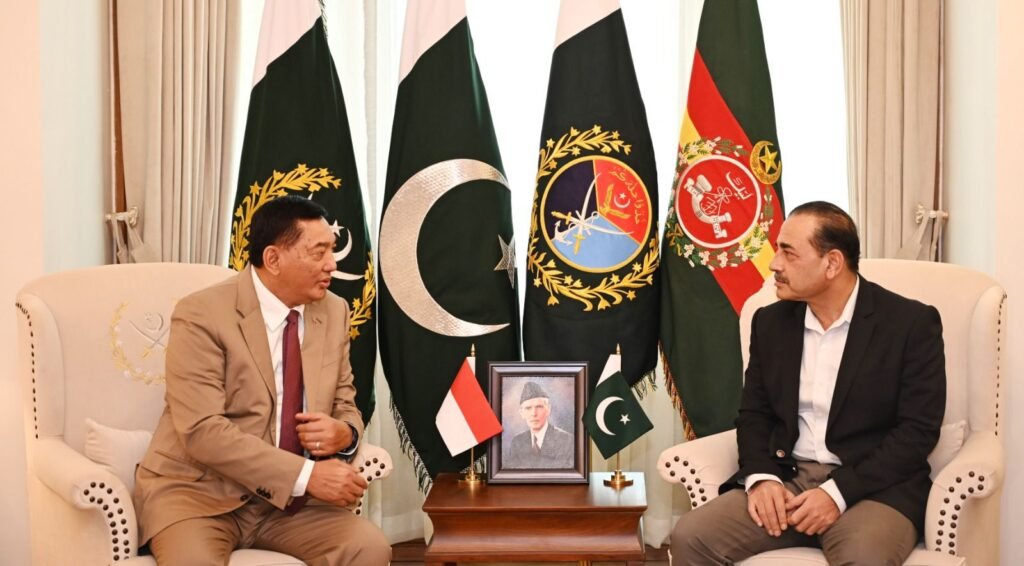
- Pakistan-Indonesia defense ties reached a new peak during the GHQ meeting on January 12, 2026.
- The deal involves the potential sale of over 40 JF-17 Thunder Block-III fighter jets.
- Discussions included the export of Shahpar-II killer drones and Super Mushshak trainers.
- Pakistan is emerging as a top-tier arms exporter for the Middle East and Southeast Asia.
In a move that signals a tectonic shift in Southeast Asian security dynamics, Pakistan and Indonesia have moved to significantly deepen their military-to-military relationship. On Monday, January 12, 2026, Lieutenant General Sjafrie Sjamsoeddin (Retd), the Indonesian Minister of Defence, arrived at the General Headquarters (GHQ) in Rawalpindi for a high-level meeting with Field Marshal Syed Asim Munir, Chief of Army Staff (COAS) and Chief of Defence Forces (CDF).
The visit comes at a time when Pakistan is rapidly emerging as a formidable military-industrial power, moving beyond domestic self-sufficiency to become a key exporter of “battle-tested” hardware to nations across the Global South.
A Convergence of Strategic Interests
The discussions at GHQ were marked by a high degree of mutual trust and a shared vision for regional stability. Field Marshal Asim Munir and Minister Sjamsoeddin focused on “evolving regional and global security dynamics,” emphasizing the need for stronger institutional linkages and training collaboration.
Indonesian defence minister expresses Jakarta’s desire to boost defence ties with Pakistan
Indonesia, which has traditionally balanced its defense procurement between Western and Russian sources, is increasingly looking toward Pakistan as a reliable, high-tech, and cost-effective partner. The visiting dignitary lauded the “professionalism of Pakistan Armed Forces” and acknowledged their immense sacrifices and expertise in counter-terrorism—a domain where Indonesia seeks deeper cooperation.
The JF-17 Thunder: The Crown Jewel of the Deal
Security officials familiar with the discussions confirmed that the center of the talks is a potential multi-billion-dollar deal for the JF-17 Thunder Block-III fighter jets. Jakarta is reportedly eyeing an acquisition of more than 40 units to modernize its aging air force fleet.
A New Muslim Military Alliance? Why Turkiye Wants Into the Pakistan–Saudi Defence Pact
The JF-17, jointly developed by Pakistan and China but manufactured with increasing indigenous components at the Pakistan Aeronautical Complex (PAC), has become a “hot commodity” in the global arms market. Its performance in recent regional skirmishes has proven its ability to contend with Western-origin hardware, making it an attractive option for countries like Indonesia, Malaysia, and Nigeria.
Key Equipment on the Table:
- JF-17 Thunder (Block-III): A 4.5-generation multi-role combat aircraft equipped with advanced AESA radar and long-range BVR (Beyond Visual Range) missiles.
- Shahpar-II Killer Drones: High-altitude, long-endurance (HALE) unmanned aerial vehicles (UAVs) capable of surveillance and precision strikes.
- Super Mushshak Trainers: Primary flight training aircraft already exported to over 10 countries, including Turkey and Saudi Arabia.
- Air Defense Systems: Integrated radar and missile systems for territorial protection.
- Pakistan: The New Arsenal of the Global South
The potential deal with Indonesia is not an isolated event but part of a broader surge in Pakistan’s defense diplomacy. In the first weeks of 2026 alone, Pakistan has finalized or entered advanced negotiations for:
- A $1.5 billion deal with Sudan for K-8 light attack aircraft and drones.
- A $4 billion pact with the Libyan National Army involving JF-17s.
- Ongoing “jets-for-loans” and modernization talks with Saudi Arabia and Bangladesh.
This trend confirms that Pakistan is no longer just a buyer but a major supplier. Nations such as Malaysia, Saudi Arabia, Nigeria, and Turkey are increasingly identifying Pakistan as a strategic source for defense hardware that is not tied to the political strings often attached to Western or Russian exports.
Pakistan-Indonesia Defense Ties: Replacing an Aging Fleet
Jakarta’s urgency stems from the need to replace its aging fleet. While Indonesia recently ordered French Rafales and Turkish KAAN jets, the JF-17 offers a “high-low” mix strategy—providing advanced capabilities at a fraction of the cost of Western jets.
Retired Air Marshal Asim Suleiman noted, “The Indonesia deal is in the pipeline and represents a major milestone. It’s not just about selling aircraft; it’s about establishing a decades-long ecosystem of engineering, training, and maintenance.”
As Pakistan continues to showcase its military-industrial prowess, the meeting at GHQ serves as a clear message: Islamabad is ready to play the role of a sizable regional player, offering the Global South a new, independent path to security and sovereignty.