


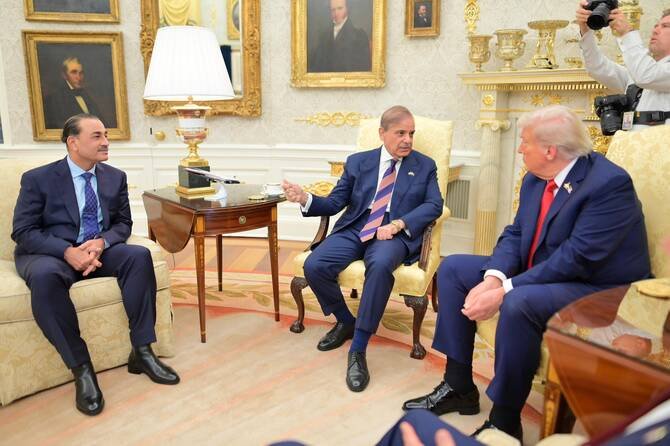
- Pakistan joins Trump’s Gaza Peace Council following high-level civil-military consultations and guidance from religious scholars.
- The move aims to amplify the call for a permanent ceasefire and the unimpeded flow of humanitarian aid to the Palestinian people.
- Islamabad remains committed to a sovereign Palestinian state based on 1967 borders, maintaining its historic “red lines.”
- Participation ensures that Pakistan has a seat at the table to influence regional stability and the reconstruction of Gaza.
Pakistan’s geopolitical position has long carried weight beyond its borders, but today that relevance is sharper and more consequential than ever.
As the world’s only Muslim-majority nuclear power, a pivotal member of the Saudi-aligned strategic bloc, and a state anchored at the crossroads of South, Central, and Western Asia, Pakistan occupies a unique space in the global calculus.
Its decisions resonate across the Islamic community, where Islamabad is consistently expected to balance moral principle with strategic pragmatism.
Nowhere is this expectation more visible than in Pakistan’s stance on Gaza. For decades, Islamabad has maintained an unambiguous policy: it will not establish diplomatic relations with Israel until an independent, sovereign Palestinian state is realized in accordance with international law and United Nations resolutions.
International Force to Police Gaza: Can Muslim Nations Secure the Enclave?
This position is not mere rhetorical posturing; it is a foundational pillar of the state, consistently articulated in parliament and across international forums. On the issue of Gaza, Pakistan’s voice remains firm, moral, and aligned with Palestinian aspirations.
Against this backdrop, the news that Pakistan joins Trump’s Gaza Peace Council must be understood with nuance. Participation in this “Board of Peace” does not signal a compromise on core principles. Rather, it reflects a belief that meaningful engagement is necessary to protect Palestinian rights within a rapidly shifting diplomatic landscape.
Go Tell It on the Mountain: Kathy Kelly World BEYOND War on the Global Silence as Gaza and the West Bank Bleed
This decision followed intensive consultations between Pakistan’s civilian leadership and military command, underscoring the gravity of the move. Significantly, the government also consulted top religious scholars, ensuring the initiative was anchored in both national interest and moral legitimacy.
The Foreign Ministry has made its objectives explicit. Islamabad views this initiative as a potential vehicle for concrete steps toward a permanent ceasefire, the unimpeded flow of humanitarian aid, and the long-term reconstruction of Gaza.
These are not abstract goals; the level of devastation in Gaza demands immediate relief. By joining the council, Pakistan aims to amplify these priorities from within the room rather than shouting from the margins. To those asking if Pakistan has joined the council: the answer is yes—but strictly on its own terms and without abandoning its established “red lines.”
Pakistan to Join Board of Peace to Support Gaza Peace Plan
The invitation from President Trump, alongside the participation of over 20 other nations, highlights Islamabad’s growing diplomatic relevance. The timing is equally telling. Reports of high-level civil-military coordination, including engagements involving the Prime Minister and military leadership, suggest a unified approach to this new era of diplomacy. In Pakistan’s system, such alignment signals a serious, long-term strategic outlook. It reflects an understanding that engagement with Washington remains essential, even when fundamental differences persist.
For Pakistan–U.S. relations, this move offers a potential reset grounded in shared interests. Washington requires credible partners from the Muslim world to lend legitimacy to any regional framework. Pakistan, with its clear pro-Palestine record, provides that credibility. Simultaneously, Islamabad gains a platform to push back against any plan that might sideline Palestinian self-determination.
Ultimately, this participation does not dilute solidarity; it operationalizes it. By entering the debate, Pakistan increases its ability to influence outcomes and advocate for justice. This is the mark of a mature foreign policy: confident enough to engage global power centers, disciplined enough to consult its internal institutions, and principled enough to stand by its historic commitments. In Gaza’s hour of suffering, Pakistan is positioning itself where it can do the most good—for Palestinians, for regional stability, and for a balanced international order.