


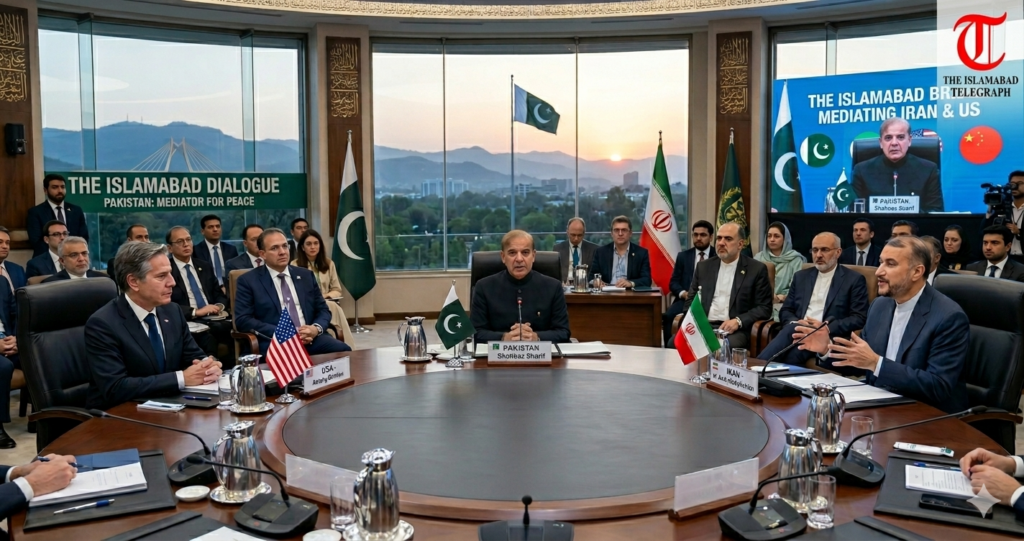
- Pakistan mediation Iran war 2026 positions Islamabad as a key diplomatic bridge between the United States and Iran
- Rising nuclear tensions and uranium disputes drive the core conflict dynamics
- Fragile ceasefire, naval blockade, and Strait of Hormuz incidents escalate risks
- Global economic and legal implications raise urgency for successful mediation
The 2026 Iran war has rapidly evolved into one of the most dangerous geopolitical crises of the modern era. What began as a sudden escalation between the United States, Israel, and Iran has grown into a regional conflict with global consequences, affecting oil markets, international law, and nuclear diplomacy. Amid this chaos, Pakistan has emerged as an unlikely yet crucial diplomatic actor, attempting to serve as an “Islamabad Bridge” between two deeply hostile powers.
Pakistan’s role as a mediator is not only strategic but also symbolic. Positioned between the Muslim world and Western alliances, Pakistan has tried to navigate a path of neutrality, dialogue, and conflict resolution. However, the question remains: can Pakistan truly mediate peace in a conflict driven by nuclear fears, economic warfare, and deep-rooted mistrust?
US Iran Ceasefire Extended as High-Stakes Islamabad Talks Signal Possible Breakthrough
The conflict officially intensified in February 2026, when the United States and Israel launched coordinated airstrikes on Iranian military and nuclear-related facilities. Iran responded with missile and drone attacks across the region, including strikes on U.S. bases and allied countries. By April 2026, the war had entered a volatile phase. A fragile ceasefire was already under strain when the U.S. imposed a naval blockade on Iran, targeting its oil exports and pressuring Tehran to halt its nuclear program.
According to reporting from The Guardian, tensions escalated dramatically when U.S. forces seized an Iranian cargo ship near the Strait of Hormuz—an incident Iran described as “piracy.” This single event highlights how fragile and fast-moving the situation is. Instead of moving toward peace, both sides appear locked in a cycle of provocation and retaliation. Iran has even refused to participate in further peace talks in Pakistan, citing distrust of U.S. intentions.
US Iran talks Islamabad Second Attempt: What the U.S. and Iran Are Bringing Into the Room
At the same time, global economic fears are rising. The IMF warns that the war could increase global debt and destabilize economies due to rising oil prices and disrupted trade routes.
To understand the deeper causes of this war, one must understand uranium. Uranium is a naturally occurring element used primarily for two purposes:
- Nuclear energy production (for electricity)
- Nuclear weapons development
The difference lies in enrichment levels. Low-enriched uranium is used for civilian energy, while highly enriched uranium can be used to build nuclear bombs. The United States and its allies argue that Iran’s nuclear program could potentially lead to weapons development. Iran, however, insists its program is peaceful.
Trump’s Iran Confusion Deepens as Contradictory Statements Shake Washington Ahead of Islamabad Talks
The International Atomic Energy Agency has previously stated that there is no confirmed evidence of an active nuclear weapons program. Despite this, fears of nuclear proliferation have driven aggressive policies such as sanctions, military strikes, and now a full-scale blockade. The U.S. demands that Iran completely halt uranium enrichment, while Iran views this as a violation of its sovereignty. This disagreement is not just technical—it is deeply political. Uranium has become a symbol of power, independence, and survival for Iran, while for the U.S., it represents a potential global security threat.
Amid rising tensions, Pakistan stepped in as a mediator. This was not accidental. Pakistan has diplomatic relations with both Iran and the United States, strategic ties with China, and a history of involvement in regional peace efforts. In March and April 2026, Pakistan facilitated multiple rounds of negotiations, including a 15-point ceasefire proposal delivered to Washington and Tehran.
US and Iran in blockade standoff as Pakistan pushes for talks
Pakistan also worked alongside China to introduce a five-point peace initiative calling for an immediate ceasefire, humanitarian access, respect for sovereignty, and diplomatic negotiations. These efforts positioned Pakistan as a central diplomatic hub. Islamabad became the meeting ground where both sides could engage directly or indirectly.
Despite these efforts, the challenges remain significant. The biggest obstacle is mutual distrust. Iran accuses the United States of shifting positions and acting aggressively, while the U.S. views Iran as unreliable and dangerous. Even when Pakistan arranges talks, one side may refuse to attend, as seen when Iran declined further negotiations.
Pakistan is not a superpower. It cannot enforce agreements or apply economic or military pressure like the United States or China. Its role is limited to facilitation, not enforcement. Recent developments, such as the seizure of Iranian vessels and continued missile threats, undermine diplomatic efforts. Such military actions weaken trust and push peace further away.
Other global players, including Israel, Gulf states, and NATO countries, also influence the conflict. This makes mediation more complex, as Pakistan is not the only actor shaping outcomes.
Despite these challenges, Pakistan’s role should not be underestimated. First, it offers neutral ground—a politically acceptable space for both sides. Unlike Western countries, it is not seen as openly biased against Iran. Second, as a neighboring country, Pakistan has a direct interest in preventing the conflict from spreading instability. Instability in Iran could affect Pakistan’s security, economy, and borders.
Pakistan’s close relationship with China also adds weight to its mediation efforts. China’s involvement increases the chances of broader international support for peace initiatives.
The Iran war also raises serious questions under international law. Many analysts argue that the initial U.S.-Israel strikes may violate Iran’s sovereignty, while the naval blockade could be seen as an act of economic warfare. Iran’s retaliation also raises concerns about proportionality.
Strait of Hormuz Impact on Singapore: Energy Shock Threatens Asia’s Trade Lifeline
Critics have described the war as potentially violating international legal norms, especially regarding the use of force without clear UN authorization. Pakistan’s mediation efforts, therefore, are not just political—they also represent an attempt to restore a rules-based international order.
The future of Pakistan’s mediation depends on several factors: the willingness of both sides to negotiate, a reduction in military escalation, and international support for diplomatic solutions. Right now, the situation remains fragile. The ceasefire is weakening, negotiations are uncertain, and tensions continue to rise.
However, Pakistan’s role offers a rare opportunity in a world increasingly divided by power politics. Islamabad represents a middle ground—a place where dialogue is still possible.
The Islamabad Bridge is more than a diplomatic effort; it is a test of whether smaller powers can influence global peace in an era dominated by superpower rivalry. Pakistan has demonstrated that it can play a meaningful role in international mediation, even in a highly complex conflict like the 2026 Iran war.
However, its success ultimately depends on the willingness of the United States and Iran to move beyond confrontation and toward compromise. At the heart of this conflict lies uranium—but beneath it lies something deeper: a struggle for power, trust, and global order.
Whether Pakistan can bridge that divide remains uncertain. But in a war where every escalation brings the world closer to catastrophe, even the possibility of dialogue is worth holding onto.