


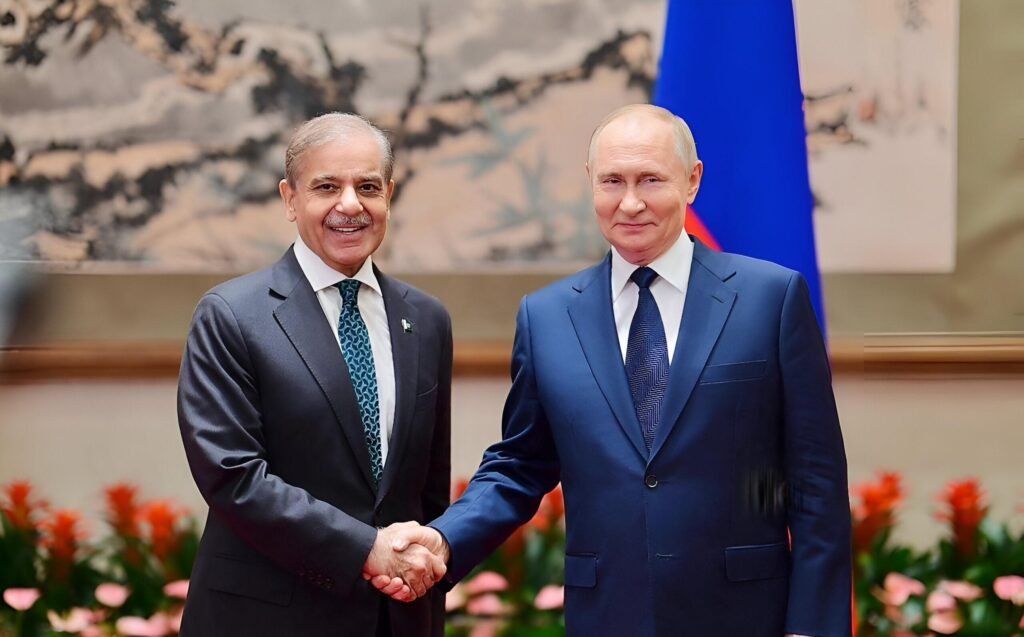
- Pakistan and Russia vowed to deepen cooperation in energy, trade, and connectivity after the Putin-Shehbaz meeting at the SCO summit.
- Islamabad seeks to balance growing ties with Moscow while maintaining strategic relations with Washington amid Trump’s renewed investment interest.
- Potential collaboration areas include oil and gas supplies, regional trade corridors, food security, and technological partnerships.
- Pakistan aims to leverage multipolar diplomacy, using forums like the SCO, to diversify alliances without entering zero-sum rivalries.
When Russian President Vladimir Putin expressed his condolences to Prime Minister Shehbaz Sharif over the devastating floods in Pakistan, the setting of the conversation—on the sidelines of the Shanghai Cooperation Organization (SCO) summit—added a layer of symbolism that went far beyond disaster diplomacy. In that moment, the Russian leader not only showcased Moscow’s empathy but also reaffirmed Russia’s interest in deepening ties with Islamabad—a relationship once frozen in the Cold War era but now thawing amid shifting geopolitical winds.
Both leaders, by pledging to strengthen cooperation across diverse fields, hinted at a new trajectory in Pakistan-Russia relations—one that could redefine Islamabad’s foreign policy choices in an era where multipolarity is rapidly replacing the old unipolar world order.
This meeting did not emerge in isolation. In the past few years, Russia and Pakistan have inched closer diplomatically, economically, and strategically. The 2023 agreement for discounted Russian oil sales to Pakistan, the growing discussions on energy pipelines, and Moscow’s interest in connecting its Eurasian infrastructure projects to Pakistan’s ports are evidence of a pragmatic shift on both sides.
Xi’s ‘Axis of Upheaval’ Moment: A Loud Message to Europe Amid the Ukraine War
The SCO platform itself has become the hub where such alignments emerge. From energy deals to counterterrorism cooperation, the bloc offers Islamabad a rare opportunity to balance its longstanding partnership with the West with new openings in Eurasia—without appearing to take sides overtly. The latest Putin-Shehbaz encounter embodies this balancing act, but the real question is: how far can Pakistan go in cementing ties with Moscow while remaining in the U.S.-led camp?
The Geopolitical Tightrope: U.S. Ties vs. Russia Outreach
Historically, Pakistan’s foreign policy oscillated between Washington and Beijing, with Moscow largely on the sidelines. The Soviet invasion of Afghanistan in 1979 cemented Pakistan as a frontline U.S. ally, leaving Russia (then the USSR) in India’s corner. Decades later, those rigid alignments have blurred.
Washington today views India as a strategic partner against China, while Pakistan—despite being a major non-NATO ally—often feels abandoned, especially after the U.S. withdrawal from Afghanistan. Russia, on the other hand, is looking eastward amid Western sanctions over Ukraine, trying to diversify trade and political partnerships beyond Europe.
This convergence of needs has created diplomatic space for Islamabad and Moscow. But the balancing act remains delicate. Pakistan relies heavily on Western financial institutions like the IMF and World Bank, receives technology and defense cooperation from the U.S., and benefits from trade preferences in Western markets. At the same time, its growing economic ties with China through the China-Pakistan Economic Corridor (CPEC) naturally bring it closer to Russia, which seeks integration with Beijing’s Belt and Road Initiative.
The challenge for Islamabad will be to expand ties with Moscow without triggering strategic anxieties in Washington. For instance, energy deals and infrastructure projects with Russia may be acceptable, but military cooperation or overt alignment on Ukraine could complicate Pakistan’s Western relationships.
Interestingly, former U.S. President Donald Trump’s recent remarks praising Pakistan and offering U.S. investment in oil and mineral sectors show that Washington, too, wants to keep Islamabad from drifting too far toward the Eurasian axis of China, Russia, and Iran. This creates a diplomatic window where Pakistan can court Russian trade and technology while assuring the U.S. that it remains within the Western economic orbit.
Where Pakistan-Russia Cooperation Can Deepen
The Putin-Shehbaz meeting underlined several key areas for future collaboration:
-
Energy and Oil Supplies
Russia’s willingness to sell crude oil to Pakistan at discounted rates last year set the tone for future energy cooperation. Islamabad’s chronic energy shortages and rising import bills make Russian oil and LNG supplies an attractive option. Additionally, projects like the Pakistan Stream Gas Pipeline—long delayed due to sanctions and financing issues—could be revived with creative solutions, potentially involving Chinese or Gulf funding. -
Agriculture and Food Security
Russia is one of the world’s largest wheat exporters, while Pakistan faces recurring food security challenges due to floods and climate change. Bilateral agreements in agricultural technology, irrigation systems, and grain imports could stabilize Pakistan’s food supplies while offering Russia a steady market. -
Connectivity and Trade Corridors
Prime Minister Shehbaz highlighted the strategic corridor linking Russia, Central Asia, Afghanistan, and Pakistan to ports like Gwadar and Karachi. This route, if integrated with CPEC and Eurasian transport networks, could transform Pakistan into a regional trade hub, linking Russian energy fields to Asian markets. -
Technology and Industrial Cooperation
From metallurgy to IT services, Russia possesses technological expertise that Pakistan’s industrial sector can benefit from. Joint ventures in mining—especially given Pakistan’s untapped reserves of rare earth minerals—could attract both Russian investment and Western technology under carefully balanced agreements. -
Education and Cultural Exchanges
Soft diplomacy often cements long-term ties. Scholarships for Pakistani students in Russian universities, cultural festivals, and tourism cooperation can build public goodwill beyond government-level interactions. -
Defense and Counterterrorism (with caution)
While overt military alliances with Russia could irritate Washington, limited cooperation in counterterrorism training, border security, and intelligence-sharing within the SCO framework may be acceptable to all sides, especially given shared concerns over Afghanistan’s stability.
How Pakistan Can Navigate U.S. Sensitivities
The path forward requires strategic subtlety. Here is how Islamabad can strengthen ties with Russia without rupturing its Western relationships:
-
Economic, Not Military, Focus: Prioritize energy, trade, and infrastructure projects over defense deals to avoid signaling a geopolitical shift.
-
Multilateral Cover: Use platforms like SCO, BRICS+, and the United Nations to frame Pakistan-Russia cooperation as regional, not bloc-based, diplomacy.
-
Triangular Engagement: Encourage projects involving U.S., Russian, and even Chinese companies jointly in sectors like mining or renewable energy, creating interdependence rather than rivalry.
-
Humanitarian Diplomacy: Collaborate on climate resilience, disaster management, and food security—issues unlikely to trigger geopolitical backlash.
-
Clear Communication: Assure Washington that Pakistan’s Russia outreach complements rather than replaces its Western partnerships. For example, cheaper Russian oil reduces Pakistan’s economic vulnerabilities, indirectly stabilizing a key U.S. partner in South Asia.
A Moment of Opportunity
The personal chemistry between Putin and Shehbaz Sharif, visible in their meetings from Astana to Beijing, offers a diplomatic opening. Both leaders framed the relationship not as a zero-sum game against other powers but as a mutually beneficial partnership focused on trade, energy, and regional stability.
The timing also favors Pakistan. Russia, facing Western sanctions, needs Asian markets more than ever. Pakistan, grappling with economic crises and energy shortages, needs diversified partners. China’s Belt and Road vision already links both countries through infrastructure dreams waiting to be realized.
If managed wisely, Pakistan can leverage this moment to position itself as a bridge nation—connecting Eurasian economies to the Arabian Sea while staying diplomatically neutral in great-power rivalries.
Walking the Tightrope Toward a Multipolar Future
The Putin-Shehbaz meeting at the SCO summit was more than a diplomatic courtesy; it was a signal of Pakistan’s intent to embrace a multipolar world where alliances are flexible, pragmatic, and interest-based.
By expanding energy, trade, and connectivity projects with Russia—while keeping lines open with Washington—Pakistan can craft a balanced foreign policy suited to the 21st century’s shifting power centers.
The road ahead requires careful navigation, but the destination is clear: a Pakistan that engages Moscow for economic and strategic gains without burning bridges in Washington—a tightrope walk, but one well worth attempting in the emerging global order.