


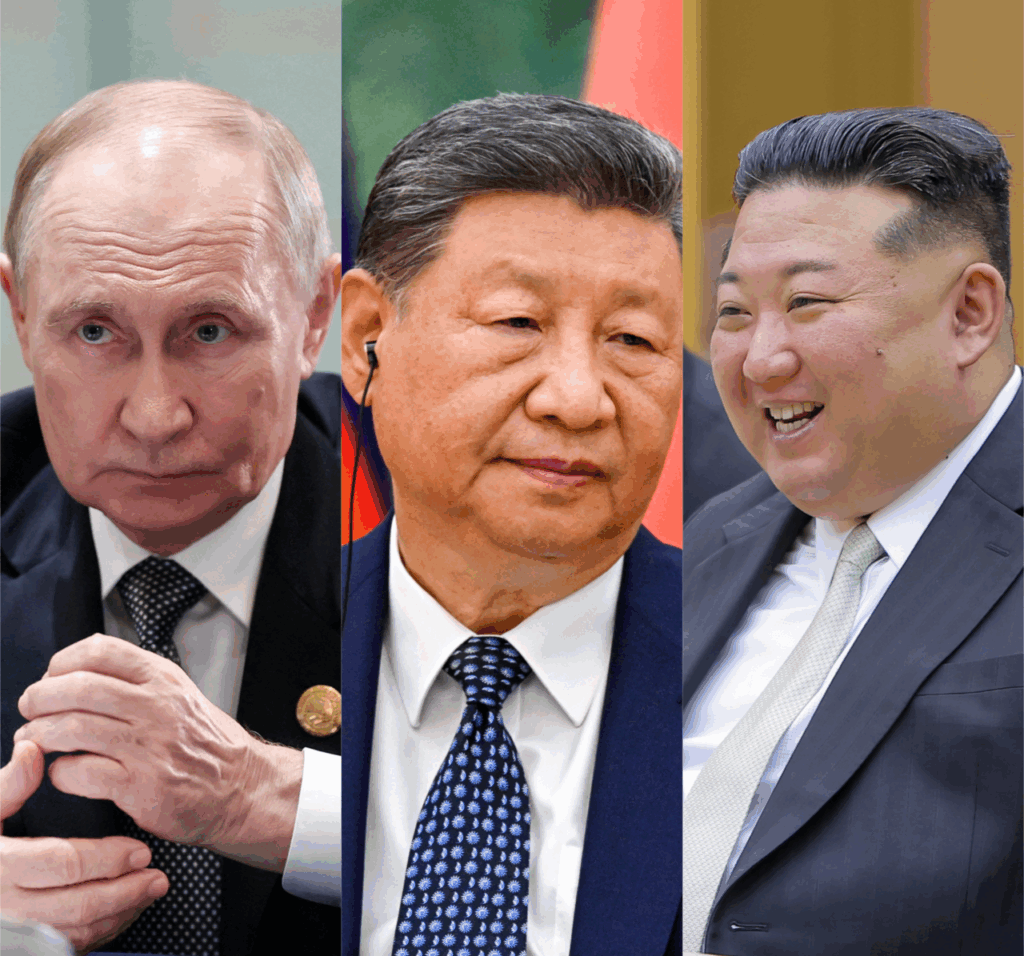
- Xi Jinping hosting Putin and Kim in Beijing signals the rise of a powerful Eastern axis challenging Western dominance amid the Ukraine war.
- Trilateral military and economic cooperation threatens to undermine Western sanctions and NATO’s strategic edge.
- Russia’s energy pivot to Asia deepens as China and North Korea provide lifelines to Moscow despite Western isolation efforts.
- Europe faces a geopolitical dilemma as the Ukraine war accelerates the birth of a multipolar world led by Beijing and its allies.
By hosting Vladimir Putin and Kim Jong Un in Beijing for the first time on the same stage, China’s President Xi Jinping has sent a loud, unmistakable message to Europe and the West: the world order is changing, and Beijing intends to sit at its center. The timing, the optics, and the personalities involved were no coincidence. With Russia bogged down in Ukraine, North Korea supplying troops and ammunition to Moscow, and the United States and its NATO allies doubling down on military support to Kyiv, Xi’s grand “Victory Day” parade has become more than a commemoration of history—it is a declaration of geopolitical intent.
On Tuesday, the world watched as Putin was welcomed with all the trappings of a state visit: talks at the Great Hall of the People, a private dinner at Xi’s personal residence, and public affirmations of friendship. A few hours later, Kim Jong Un’s armored train crossed into Beijing, signaling his arrival at what North Korean state media called a “gathering of equals.” By Wednesday, the three would take center stage at China’s largest-ever military parade—a tableau of power featuring hypersonic missiles, nuclear-capable drones, and 80,000 white doves soaring over Tiananmen Square.
Xi Jinping’s Grand Parade: How China is Recasting Itself as the Center of Global Power
The West cannot mistake this choreography for mere symbolism. At a moment when Europe faces its gravest security crisis since World War II, the alignment of China, Russia, and North Korea represents a calculated countermove to NATO’s expansion, U.S. sanctions, and Western efforts to isolate Moscow over its invasion of Ukraine.
A Blow to the Western Narrative
Xi’s decision to host Putin and Kim together was not born overnight. It fits into Beijing’s long-term strategy of promoting what it calls a “multipolar world” as an alternative to what it sees as America’s era of dominance. In his address to a summit of more than 20 non-Western leaders a day before the parade, Xi criticized “hegemonism and power politics,” a thinly veiled swipe at Washington.
Europe has watched uneasily as this rhetoric morphs into action. China has deepened energy ties with Russia—witness Gazprom’s new 30-year pipeline deal inked in Beijing this week—while refraining from condemning Moscow’s actions in Ukraine. North Korea, for its part, has supplied over 15,000 troops and several million rounds of artillery shells to Russia’s war effort, according to South Korean intelligence. For a continent already rattled by Russian aggression on its doorstep, the sight of Xi, Putin, and Kim shoulder to shoulder in Beijing carries a chilling undertone: the emergence of a Eurasian bloc willing to defy Western sanctions, narratives, and norms.
It also chips away at the West’s claim to moral leadership. For years, Europe positioned itself as the guardian of liberal values against authoritarianism. But the “Axis of Upheaval,” as some commentators have dubbed it, counters this with a story of its own: that of besieged nations resisting Western hypocrisy. The parade commemorating the defeat of fascism in World War II doubles as what analysts call a “memory war,” where China and Russia remind the world of their sacrifices while accusing the West of rewriting history to suit its agenda.
Military Implications: A New Strategic Triangle
Beyond symbolism lies hard power. Analysts believe trilateral military cooperation between China, Russia, and North Korea is no longer unthinkable. Moscow and Pyongyang signed a defense pact in June 2024; Beijing and Pyongyang have hinted at similar arrangements. “Trilateral military exercises between Russia, China, and North Korea seem nearly inevitable,” wrote Youngjun Kim of the U.S.-based National Bureau of Asian Research, warning this could alter the security calculus in the Asia-Pacific.
Such drills would send alarm bells ringing in Brussels and Washington. Until recently, China and Russia helped enforce U.N. sanctions on North Korea over its nuclear program. Today, all three find common cause in countering what they call Western “encirclement.” For Kim Jong Un, the Beijing parade offers implicit recognition of his nuclear arsenal, banned under international law but tolerated by two veto-wielding U.N. Security Council members. For Putin, it signals that Western efforts to isolate him have failed; he still commands the loyalty—or at least the utility—of two nuclear-armed neighbors.
Europe, already struggling to meet NATO defense spending targets, now faces the prospect of a second front of strategic anxiety: a hostile alliance stretching from the Pacific to the Black Sea.
Energy, Economics, and the Ukraine War
The Ukraine war looms large over these developments. Western sanctions aimed at strangling Russia’s economy have pushed Moscow closer to Beijing and Pyongyang. China buys Russian oil at discounted rates, while North Korea provides cheap labor and munitions. Together, they form what one European diplomat privately called “a sanctions evasion ecosystem,” blunting the impact of Western measures.
Tuesday’s signing of a 30-year gas supply deal between Gazprom and China National Petroleum Corporation underscores this reality. As Europe painfully weans itself off Russian energy, Moscow is reorienting its exports eastward, tightening economic bonds with Beijing. For Xi, securing long-term energy supplies at favorable prices supports China’s growth; for Putin, it guarantees revenue to sustain his war machine.
This economic dimension troubles Europe as much as the military one. If Russia can survive Western sanctions with Eastern lifelines, the leverage of Brussels and Washington diminishes. The longer the Ukraine war drags on, the more this alternative bloc gains coherence and purpose.
The Optics: A Personal Triumph for Xi
Hosting Putin and Kim also serves Xi Jinping’s personal ambition to portray himself as the architect of a post-American order. The imagery was striking: three leaders ostracized by the West, standing defiantly in Beijing, reviewing troops and missiles under red banners proclaiming “Victory.”
For Xi, it marks China’s arrival as what analyst Neil Thomas calls “the world’s leading authoritarian power.” The presence of leaders from Central Asia, the Middle East, and even some European countries like Serbia and Slovakia—both critical of sanctions on Russia—adds to the sense of momentum. This year’s parade drew more foreign dignitaries than the last one in 2015, a fact Chinese state media trumpeted as proof of Beijing’s growing clout.
At home, the government spent an estimated $5 billion on the event, mobilizing tens of thousands of security personnel and even encouraging patriotic haircuts. The message to domestic and international audiences alike: China under Xi has the wealth, power, and confidence to challenge U.S. dominance.
Europe’s Dilemma
For Europe, the Beijing spectacle poses uncomfortable questions. Its unity over Ukraine masks deeper divisions on China; countries like Hungary and Slovakia openly court Beijing even as Brussels debates investment restrictions. NATO’s new focus on the Indo-Pacific—driven by U.S. concerns over Taiwan—now seems prescient, given the emerging Moscow-Beijing-Pyongyang axis.
Yet Europe’s options remain limited. Direct confrontation with China risks economic retaliation; ignoring its partnership with Russia undermines sanctions. As one EU diplomat put it after watching the parade footage: “We wanted to isolate Russia. Instead, we may have pushed it into China’s embrace.”
A New World Taking Shape
As the last doves flew over Tiananmen Square and Xi waved alongside Putin and Kim, one thing became clear: this was more than pageantry. It was a rehearsal for a new geopolitical reality taking shape outside Western control.
For Europe, grappling with war on its borders, energy insecurity, and wavering U.S. commitment under Donald Trump, the message from Beijing was loud and clear: the world no longer revolves around the West, and the East is no longer content to play second fiddle.
Whether this axis solidifies into a formal alliance or remains a marriage of convenience, its emergence marks a turning point. The Ukraine war may have united the West, but it has also accelerated the birth of a counter-order—one that marched, quite literally, through the heart of Beijing this week.