


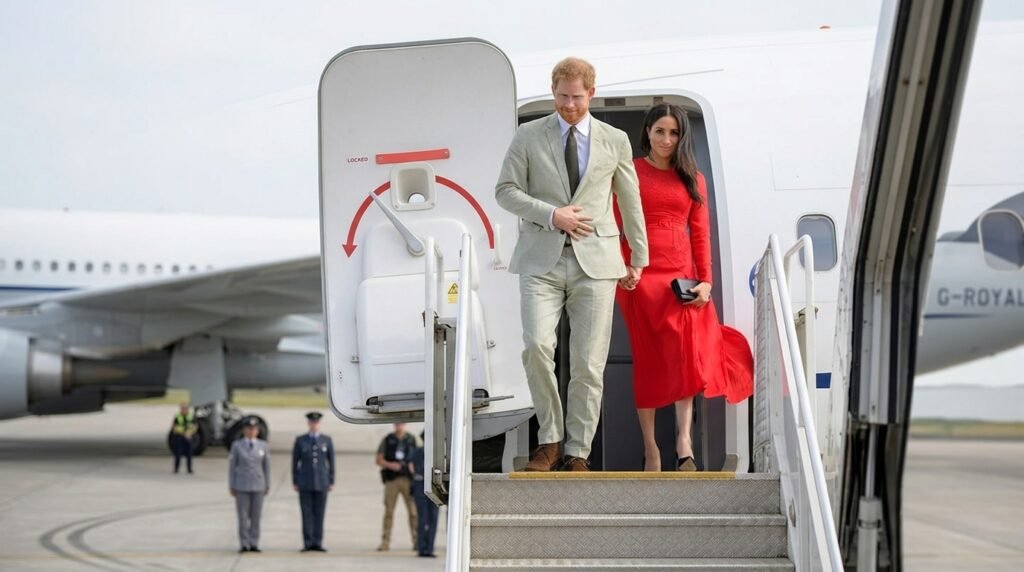
- Prince Harry return to UK comes as Britain faces major questions over its post-Brexit identity, domestic political instability and declining influence on the international stage.
- Harry’s military service in Afghanistan and his leadership of the Invictus Games could give him unusual credibility in veterans’ diplomacy, humanitarian affairs and international soft power.
- While there is no evidence of an official royal or government role, Harry’s return could eventually provide King Charles III with another potentially valuable instrument of Britain’s global influence.
Prince Harry and Meghan Markle are returning to Britain after six years in the United States, bringing their children, Prince Archie and Princess Lilibet, into a country that looks remarkably different from the one they left behind.
The Duke and Duchess of Sussex are reportedly establishing a private, non-royal residence outside London, while their children are expected to attend a British school from September. The family is also expected to retain its California home and property in Portugal, suggesting that the move may be a carefully calibrated return rather than a complete abandonment of their American life.
The return comes after a recent family reunion between Harry and his father, King Charles III. The couple will remain private citizens and are not expected to resume official royal duties.
Yet the political significance of Harry’s return could extend far beyond family relations.
Britain has changed profoundly since Harry and Meghan stepped away from royal life in 2020. Brexit has reshaped Britain’s relationship with Europe. Several prime ministers have occupied Downing Street, while Britain has wrestled with inflation, immigration, political polarization and questions about its place in an increasingly unstable world.
READ NEXT: World Leaders Including Australian Prime Minister Condemn Trump’s “Appalling” NATO Remarks
The country’s political turbulence has also increasingly intersected with debates over the monarchy, the media and the future direction of British democracy. The Islamabad Telegraph has previously examined how London’s political tensions have begun raising questions about the relationship between government power and the country’s wider institutional system in its analysis of the British prime minister’s push to control the media.
And now Britain faces another uncomfortable question: what exactly is its role in the emerging international order?
The question has become particularly acute amid the US-Israel war against Iran and mounting criticism that Britain has not done enough to support Washington’s campaign against what the United States and Israel describe as terrorism and Iranian threats.
For London, this is not simply a military question. It is a question of strategic identity.
READ MORE: Prince Harry and Meghan Markle will return to Britain after six years in U.S.
Britain remains a nuclear power, a permanent member of the UN Security Council and one of Washington’s closest military allies. But its influence no longer automatically carries the weight it did during the height of the British Empire or even during the early decades of the post-Cold War era.
This is where Harry’s return acquires an intriguing geopolitical dimension.
Harry is not simply a member of the royal family. He is a combat veteran who served in Afghanistan and deployed there twice. His military background, international profile and association with wounded veterans through the Invictus Games give him a public identity that is distinctly different from that of a ceremonial royal.
That distinction could become important.
There is no realistic expectation that Harry will suddenly become a government envoy or military policymaker. Britain is a constitutional monarchy, and foreign policy belongs to the elected government. Nor is there any indication that King Charles III intends to place Harry back into an official royal role.
But constitutional limitations do not eliminate the possibility of influence.
Kings can use soft power. So can members of royal families.
Harry has something that many diplomats spend decades attempting to acquire: instant international recognition. His military service provides him with credibility among veterans and security communities, while his marriage to Meghan has given him extraordinary visibility in the United States and across the English-speaking world.
In a period when Britain is searching for influence beyond Brexit, that combination could become useful.
The possibility becomes even more interesting when viewed against Britain’s internal political crisis. The Islamabad Telegraph has previously explored the deepening British political crisis and its implications for the royal family, highlighting how Britain’s political instability has increasingly placed pressure on institutions that were once regarded as largely above day-to-day political conflict.
Harry’s return therefore comes at an unusually sensitive moment.
Consider the broader geopolitical environment. Britain’s traditional alliances are under pressure, the United States is demanding greater contributions from its European partners, and conflicts in the Middle East are forcing London to balance its relationship with Washington against its economic, diplomatic and security interests.
Harry could, at least theoretically, operate in a space that sits between formal diplomacy and public diplomacy.
Imagine him being given a limited role connected to veterans, humanitarian diplomacy, conflict rehabilitation or international sporting initiatives. His involvement in the Invictus Games already places him at the intersection of military service, diplomacy and humanitarian affairs.
The Birmingham Invictus Games in 2027 could therefore become more than a sporting event. They could provide Britain with a global platform at a moment when London is trying to rebuild its international relevance.
This possibility becomes particularly interesting when viewed through Britain’s relationship with the Middle East.
London still possesses diplomatic networks, intelligence capabilities and military partnerships extending from the Gulf to South Asia. Yet its ability to shape events increasingly depends on persuasion rather than dominance.
That is precisely where royal soft power can sometimes matter.
Harry does not need to negotiate a nuclear agreement or command British troops to have an impact. A carefully designed role could allow him to participate in veterans’ diplomacy, humanitarian initiatives and international reconciliation efforts while remaining outside the formal machinery of government.
The larger question is whether Harry can become an asset rather than a liability.
His relationship with the royal family remains complicated. His relations with Prince William have reportedly remained strained. His previous criticism of the monarchy created deep divisions within Britain. Any formal role would therefore require extraordinary political and institutional caution.
But Harry has also demonstrated an ability to operate under intense scrutiny.
That matters in geopolitics.
Britain increasingly needs personalities capable of functioning in politically difficult environments, particularly as its relationship with Washington, Europe, the Gulf and the wider Middle East evolves.
Harry’s return may therefore be much more than a family reunion.
It could mark the beginning of a second chapter in which the former royal exile gradually becomes a useful bridge between Britain’s monarchy, its military tradition and its global soft power.
There is, however, an important caveat: there is currently no evidence that King Charles or the British government is preparing to give Harry such a role. The Sussexes are returning as private citizens, and any future diplomatic or public appointment remains speculation.
But geopolitics is often about identifying possibilities before they become policy.
The return of Harry and Meghan places one of Britain’s most internationally recognizable families back inside Britain at a moment when the country is searching for a new post-Brexit identity and confronting difficult questions about its role in the Middle East and the wider international system.
The King may not need to give his son a title, uniform or constitutional position to make that happen.
Sometimes influence begins simply with opening a door.
And after six years abroad, Prince Harry is once again walking through Britain’s.