


- Putin India Visit: Why Putin’s India visit signals a recalibration of Asian power politics
- How Trump’s tariffs and sanctions have boxed Modi into a dangerous corner
- Why Moscow needs India more than ever as its economy buckles under sanctions
- The future of India’s strategic autonomy as global rivalries intensify
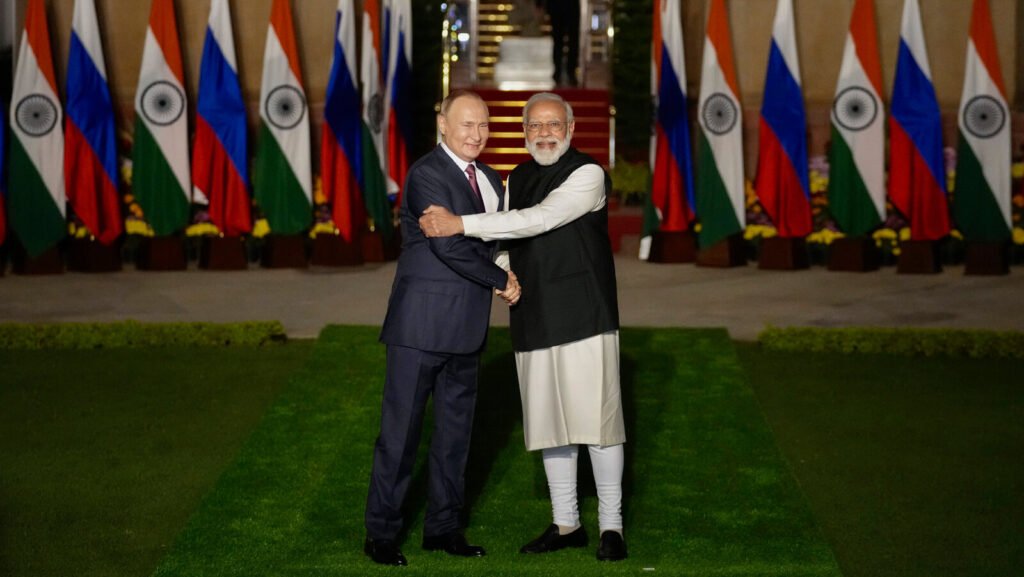
The optics will be warm, the smiles familiar, and the handshakes carefully choreographed. But make no mistake — Putin’s India visit this week is not business as usual. It’s a geopolitical stress test for New Delhi, one that comes with real costs, real risks and real consequences. For Prime Minister Narendra Modi, the challenge is to show Russia that India hasn’t abandoned its old friend — while convincing U.S. President Donald Trump that New Delhi hasn’t strayed too far from Washington’s expectations.
It is precisely the kind of diplomatic trapeze act major powers dread. And India is performing it without a safety net.
A Visit Shadowed by Failed Peace Talks and Tariff Pain
Putin lands in New Delhi just days after yet another inconclusive round of Ukraine peace talks in Moscow with U.S. envoys Steve Witkoff and Jared Kushner. Russia is desperate to avoid additional U.S. hostility. Trump, meanwhile, has made India pay for buying discounted Russian crude, slapping punitive 50% tariffs on Indian exports — a bitter shock for a country that has spent two decades nurturing a strategic partnership with Washington.
This moment reveals a deeper truth:
India’s foreign policy is becoming hostage to decisions made in Washington and Moscow, neither of which place Indian interests at the center.
Modi is trying to change that.
India’s Russian Habit — and America’s Irritation
India’s relationship with Russia is not a casual affair. It is built on decades of military cooperation, intelligence exchanges, and diplomatic alignment. Russia once accounted for nearly 70% of India’s military imports; even today, its defense ties remain a backbone of Indian military capacity. The S-400 deal — delayed but not abandoned — is a reminder that Moscow still supplies capabilities New Delhi cannot easily source elsewhere.
READ MORE: Trump Russia Ukraine peace talks: Russia Welcomes U.S. Delegation as Trump’s Peace Push Enters a Defining Phase
But India of 2025 is not India of 1995. Over two decades, New Delhi shifted decisively toward the United States, driven by shared anxieties over China’s rise. That’s why Trump’s tariff hammer came as a strategic shock to South Block — especially when it was linked so overtly to India’s Russian oil purchases.
Before the Ukraine war, only 2% of India’s crude came from Russia. This year, it hit nearly one-third. Cheap oil matters when you have 1.4 billion people, spiraling demand and political pressure to keep prices down.
READ MORE: Putin and Modi Deepen Relationship That Has Drawn Trump’s Anger
But Trump has decided that India is, in his words, “fueling Putin’s war machine.” The White House’s new sanctions regime on Rosneft and Lukoil, plus the threat of secondary penalties, has already forced India to trim its oil imports from Moscow. Reliance Industries — the country’s refining giant — quietly stopped taking Russian crude for exports.
And yet… the relationship is far from over.
Why India Still Won’t Abandon Moscow
Energy analysts have a simple message: Don’t expect India to walk away from Russian oil. It’s too cheap. Too convenient. Too essential to domestic stability.
New Delhi will adjust, route purchases through non-sanctioned entities, and quietly maintain a significant flow. The reasoning is straightforward:
India refuses to be seen as bending to American pressure.
And this is where Putin sees an opening. For a Russia battered by sanctions, dependent on Chinese imports and desperate for diversification, India is not just a buyer — it is a geopolitical lifeline.
Moscow wants more than oil sales. It wants India to export cars, machinery, electronics and tech goods to offset its overwhelming reliance on Beijing. A more balanced relationship helps Russia push back against becoming China’s junior partner — a fate Putin is increasingly anxious about.
Trump Complicates Everything
India has always prided itself on “strategic autonomy,” but Trump’s punitive instincts have boxed New Delhi into a corner. A U.S. trade deal now hinges on India visibly reducing Russian imports. Yet any public announcement would trigger a nationalist backlash at home and jeopardize India’s credibility with Moscow.
This is why Putin’s India visit is politically radioactive.
If Modi appears too cozy, Trump will escalate tariffs.
If Modi appears too distant, Russia will pivot harder toward China — locking in a dependency New Delhi cannot afford.
Strategic Autonomy: India’s Most Valuable, Most Vulnerable Asset
What we are witnessing is the limits of India’s multi-alignment strategy. For decades, India managed to keep Moscow close, Washington engaged, and Beijing contained. Today, all three are colliding.
Trump demands loyalty.
Putin demands consistency.
China demands attention.
India cannot satisfy all three at once. Something will have to give.
The Road Ahead
Putin’s India visit is not about handshakes or photo ops. It’s a test of whether India can survive in a world where great powers no longer allow middle powers to hedge.
Modi’s challenge is to show that India is not Washington’s proxy, not Moscow’s dependent and not China’s target — but a sovereign power with its own geopolitical playbook.
This week will reveal whether the world believes him.