


- Decades-Long Alliance: The U.S.-Qatar relationship anchors America’s military presence in the Middle East through the massive Al Udeid Air Base, home to over 10,000 U.S. troops.
- MAGA Uproar: Populist conservatives denounced the Idaho training facility as a “foreign base,” linking Qatar to Hamas and Iran.
- Hegseth’s Clarification: The U.S. Secretary of War emphasized Qatar would not control any U.S. base—only participate in training under American command.
- Strategic Reality: Despite domestic backlash, Qatar remains one of Washington’s most valuable allies in the Gulf—vital for energy security, counterterrorism, and regional diplomacy.
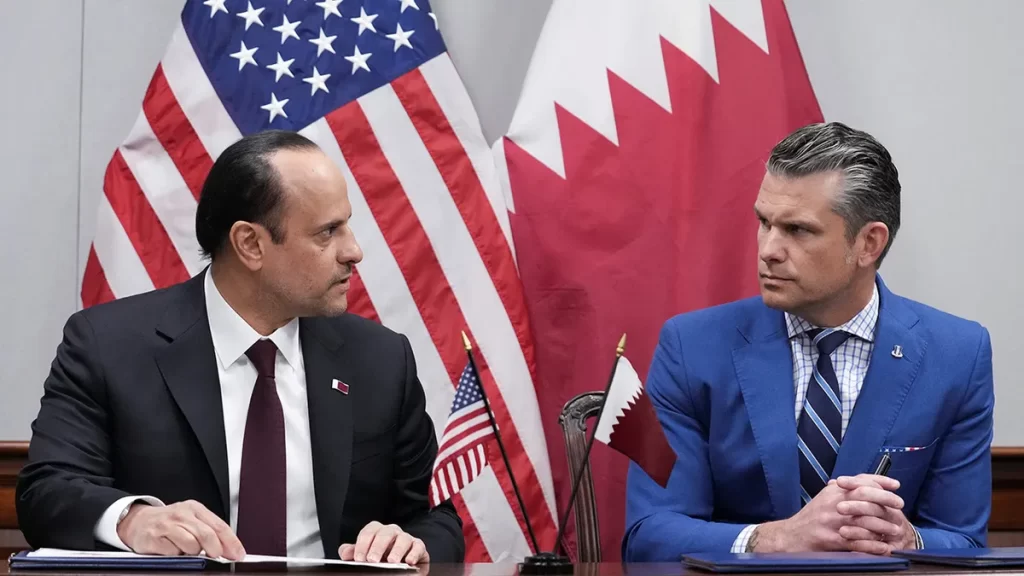
When Secretary of War Pete Hegseth sat beside Qatar’s Minister of Defense Sheikh Saoud bin Abdulrahman Al-Thani on Friday to announce a new Qatari Emiri Air Force facility at the U.S. Mountain Home Air Force Base in Idaho, it was meant to be a simple statement of cooperation. For decades, Washington and Doha have maintained one of the most robust defense partnerships in the Gulf. Yet, within hours, the announcement exploded into a domestic political firestorm, igniting outrage among America’s populist right—the Make America Great Again (MAGA) movement.
The U.S.-Qatar relationship is no minor alliance. Qatar hosts Al Udeid Air Base, the largest American military installation in the Middle East and a central command node for U.S. operations across Iraq, Syria, and Afghanistan. Built in the 1990s, the base has served as the logistical and intelligence hub for U.S. air campaigns, housing over 10,000 American troops and advanced aircraft, including B-52 bombers and F-22 Raptors. For Washington, Qatar is both a vital ally and an indispensable platform for projecting power across the Gulf and into Central Asia.
This strategic intimacy was further cemented in 2022 when the U.S. designated Qatar a Major Non-NATO Ally (MNNA)—a title that underscores the depth of trust and interoperability between the two nations. The small but wealthy Gulf emirate has invested billions in American military hardware, including F-15QA fighter jets, one of the most sophisticated variants of the F-15 ever built. The new facility in Idaho was intended to train Qatari pilots and maintenance crews in partnership with their American counterparts—a technical arrangement, not a sovereign military foothold.
But in an era of populist nationalism, technicalities mean little.
The MAGA Outcry
The MAGA movement, born from Donald Trump’s 2016 campaign slogan “Make America Great Again,” has evolved into a political identity built on economic nationalism, skepticism of foreign entanglements, and an unwavering emphasis on American sovereignty. While Trump himself has maintained cordial relations with Qatar—going as far as to sign a 2025 executive order pledging U.S. defense of the emirate—many within his base view Gulf monarchies through a darker lens, associating them with Islamic extremism and foreign influence.
READ MORE: Trump Faces MAGA Backlash for Plan to Build Qatari Air Force Facility in Idaho
So when Hegseth, a decorated veteran and Fox News alum, announced Qatar’s participation in an Idaho air force facility, the MAGA reaction was swift and brutal. Influencer Laura Loomer called the move “a threat to our national security,” citing Qatar’s alleged ties to Hamas and Iran. Her post went viral, emblematic of a broader distrust that lumps Qatar together with America’s perceived Middle Eastern adversaries.
Former Trump adviser Steve Bannon fanned the flames, telling Newsweek that “there should never be a military base of a foreign power on the sacred soil of America.” The Idaho Freedom Foundation, a conservative policy group aligned with MAGA ideals, issued a statement condemning the decision as “a completely unacceptable overreach,” accusing Washington of “housing and training foreign nationals whose loyalties don’t align with our national interests.”
READ MORE: UNSC Condemns Israeli Strike on Qatar as Trump Struggles to Contain Fallout
For the populist right, the issue wasn’t merely about Qatar. It was about symbolism—the fear that the American homeland was being opened to foreign militaries, even in partnership.
Pete Hegseth’s Damage Control
Realizing the political storm he had unleashed, Secretary Hegseth moved quickly to contain the fallout. Within hours, he took to X (formerly Twitter) to post what he called an “important clarification.”
“The U.S. military has a long-standing partnership with Qatar,” Hegseth wrote, “including today’s announced cooperation with F-15QA aircraft. However, to be clear, Qatar will not have their own base in the United States—nor anything like a base. We control the existing base, like we do with all partners.”
His message was calibrated to reassure MAGA conservatives that American sovereignty remained intact. The Idaho facility, he clarified, would be under full U.S. command, with Qatari personnel merely participating in training programs. Still, the damage had been done. Online, Loomer doubled down, declaring that she could no longer support the Republican Party’s “harboring of jihadis.”
The Broader Stakes
Behind the domestic furor lies a more complicated reality. The U.S.-Qatar partnership is one of Washington’s most valuable strategic relationships in the Middle East. Despite hosting Hamas’ political office in Doha, Qatar has served as a crucial interlocutor between the West and militant groups during hostage negotiations and ceasefire talks. Its close ties to both the U.S. and Iran make it an indispensable diplomatic bridge in a volatile region.
Economically, Qatar remains a key energy ally, exporting liquefied natural gas (LNG) to stabilize global markets—an issue that directly impacts Western energy prices. Militarily, its cooperation with the Pentagon provides Washington with forward deployment capability unmatched elsewhere in the Gulf.
Yet these complexities are often lost in the populist echo chamber of American politics, where foreign partnerships are viewed through the binary lens of friend or foe. MAGA’s outrage over a “Qatari base” speaks less to geopolitics than to a growing unease among Americans about the erosion of national boundaries and the influence of foreign powers.
A Test for Trump’s America
President Trump’s own role in this drama is not without irony. Earlier this year, reports surfaced that the Qatari royal family gifted Trump a $400 million luxury jet, which he described as destined for his presidential library. In September, his administration signed an executive order committing U.S. defense to Qatar in the event of an attack—a move that underscores how strategic necessity can override ideological discomfort.
In the end, the MAGA backlash against Qatar is a mirror reflecting America’s internal struggle—between isolationism and global leadership, between populism and pragmatism. Hegseth’s quick clarification may have prevented a larger rupture, but the episode exposes the fragility of foreign policy consensus in a deeply polarized America.
As Washington continues to balance alliances in an increasingly volatile Middle East, one thing is certain: in Trump’s America, even the most strategic partnerships must now pass the test of populist approval.