


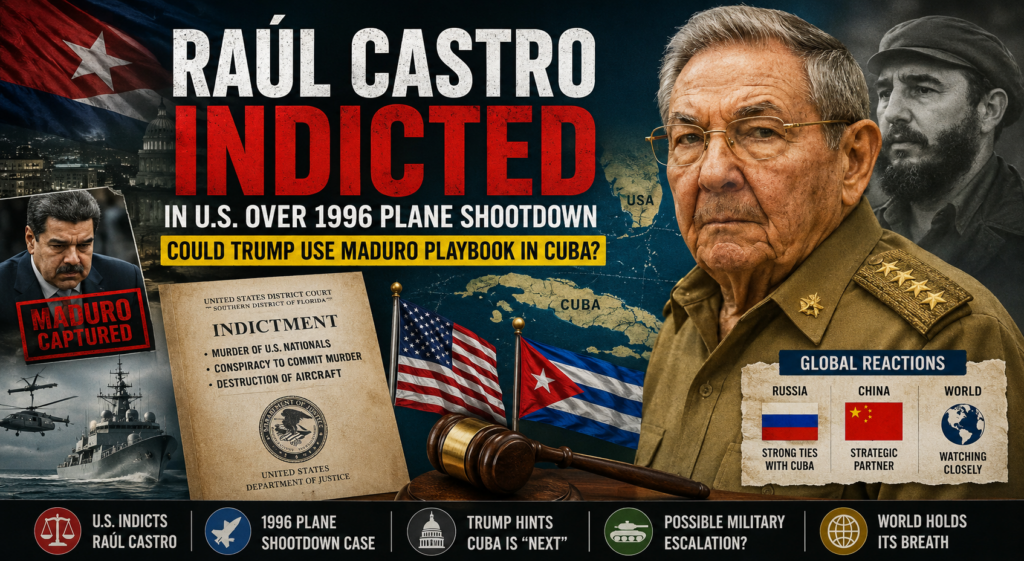
- Raúl Castro indictment linked to the 1996 shootdown of U.S. civilian aircraft killing four people
- U.S. signals potential escalation, drawing comparisons to Maduro’s capture in Venezuela
- Cuba rejects charges, calling them a pretext for military aggression
- Russia, China, and global powers likely to react strongly to any U.S. intervention
MIAMI / HAVANA / WASHINGTON — In a move that fuses law enforcement with geopolitics, the United States has indicted former Cuban president Raúl Castro on charges of murder and conspiracy, reopening one of the Cold War’s most haunting aerial incidents while raising a far more consequential question: is Cuba now on a collision course with the same U.S. playbook that brought down Nicolás Maduro?
The indictment, unsealed by a federal grand jury in Miami, accuses Castro of authorizing the 1996 shootdown of two civilian aircraft flown by members of the “Brothers to the Rescue” group, killing four men—three of them American citizens. Prosecutors allege that Cuban MiG fighter pilots acted under a clear chain of command that led directly to Castro, then defense minister and one of the most powerful figures in Havana.
The Charges: Symbolism or Strategy?
The legal case is sweeping in scope: murder of U.S. nationals, conspiracy to commit homicide, and destruction of civilian aircraft. U.S. officials argue that the passage of time does not diminish accountability. Yet, beneath the legal language lies a more strategic intent.
Historically, such indictments against foreign leaders—especially those unlikely to be extradited—serve as instruments of pressure rather than immediate justice. The United States has used similar tactics before. In 2020, Washington indicted Venezuela’s Maduro on narco-terrorism charges. For years, that indictment appeared symbolic—until it wasn’t.
In early 2026, U.S. forces captured Maduro and transported him to New York to stand trial, in what the Trump administration framed as a law enforcement operation rather than regime change. The precedent has transformed how such indictments are interpreted globally.
Iran, Venezuela, and Cuba: The Authoritarian Collapse We Didn’t See Coming
Now, with Castro in the crosshairs, the question is no longer whether the charges are symbolic—but whether they are preparatory.
Could Trump Deploy the “Maduro Model” in Cuba?
President Donald Trump has already signaled a hardening stance toward Cuba, declaring the island an “extraordinary threat” due to its alignment with U.S. adversaries including Russia, China, and Iran.
Behind the scenes, the administration has escalated pressure through:
- Expanded economic sanctions
- A de facto naval blockade restricting oil shipments
- Threats of secondary sanctions against foreign partners
Within this context, the indictment of Castro appears less like an isolated legal act and more like part of a broader coercive strategy.
U.S. Blockade of Cuba Pushes Island Into Deepening Energy and Humanitarian Crisis
Trump has openly referenced Cuba as “next in line,” hinting that the Venezuelan precedent could be replicated. If so, the implications would be profound. Unlike Venezuela, Cuba sits just 90 miles from U.S. shores, carries deep historical sensitivities, and remains symbolically tied to American foreign policy identity.
Yet, any attempt to “take” Castro—militarily or covertly—would be far riskier. Cuba’s security apparatus remains intact, and unlike Maduro’s Venezuela, Havana has not shown signs of internal fragmentation at the leadership level.
Former Cuban president Raúl Castro indicted in U.S. on murder, conspiracy charges
Havana Pushes Back: “Pretext for Aggression”
Cuban President Miguel Díaz-Canel dismissed the indictment as a “political maneuver” designed to justify potential military aggression.
From Havana’s perspective, the charges are not about justice but about regime destabilization. Cuban officials argue that the 1996 incident occurred within their sovereign airspace—a claim disputed by multiple international investigations at the time.
Trump’s Cuba Comments Signal a New Phase of Hemispheric Tension
The timing of the indictment—coinciding with Cuban Independence Day—has further fueled accusations that Washington is weaponizing legal tools for political messaging.
Russia, China, and the Global Reaction
Any escalation against Cuba would reverberate far beyond the Caribbean. Russia, in particular, has maintained a historically close relationship with Havana dating back to the Cold War.
Moscow’s likely response would be calibrated but firm:
- Diplomatic condemnation of U.S. “extraterritorial overreach”
- Increased economic or energy support to Cuba
- Potential military signaling in the region
China, already engaged in strategic competition with the U.S., could also step in economically, reinforcing Cuba as a node in its broader geopolitical network.
For the Global South, the optics matter deeply. Many countries view such indictments—and especially any follow-up action—as violations of sovereignty, reinforcing narratives of U.S. unilateralism.
European allies, meanwhile, would find themselves in a familiar bind: supportive of accountability in principle, but wary of escalation that could destabilize the region.
Is Raúl Castro Another Maduro?
At first glance, comparisons between Castro and Maduro seem compelling—both socialist leaders targeted by Washington, both accused of grave crimes, both central figures in regimes under economic siege.
But the differences are just as stark.
- Age and Role: Castro, now 94, is a retired revolutionary figure, no longer formally in power. Maduro was an active head of state at the time of his capture.
- Institutional Control: Cuba’s political system remains tightly centralized under the Communist Party, while Venezuela experienced deeper internal fractures.
- Symbolism: Castro represents the legacy of the Cuban Revolution itself—a far more potent ideological symbol than Maduro’s leadership in Venezuela.
If anything, Castro is less a sitting ruler and more a historical pillar. Targeting him carries symbolic weight but limited immediate operational impact—unless the broader goal is to weaken the regime’s ideological foundation.
The Bigger Picture: Lawfare Meets Geopolitics
The indictment underscores a growing trend in international relations: the use of legal systems as instruments of geopolitical strategy. “Lawfare,” as some analysts call it, allows states to frame political conflicts in judicial terms, shaping narratives while applying pressure.
For the Trump administration, the message is clear: time does not erase accountability, and geography does not guarantee immunity.
For Cuba, the stakes are existential. Already grappling with economic collapse, energy shortages, and public discontent, the regime now faces intensified external pressure at a moment of internal vulnerability.
What Comes Next?
Despite the dramatic language from Washington, most analysts believe Castro is unlikely to ever appear in a U.S. courtroom—at least voluntarily. Any attempt to force the issue would mark a significant escalation with unpredictable consequences.
Yet, the precedent of Maduro looms large.
The indictment may remain symbolic. Or it may be the opening move in a far more consequential geopolitical confrontation—one that could redefine U.S. policy toward Cuba and reshape the balance of power in the Western Hemisphere.
For now, the world is watching closely, aware that in the evolving playbook of global power politics, yesterday’s symbolism can quickly become tomorrow’s action.