


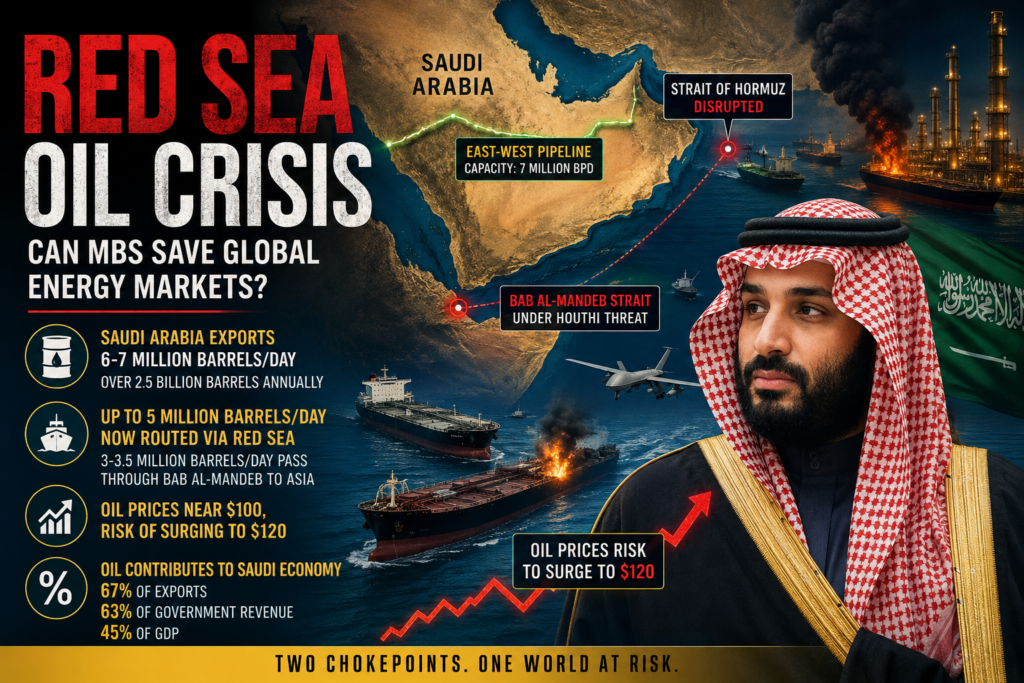
- Red Sea oil crisis threatens Saudi Arabia’s last remaining export route as Houthi attacks intensify
- Saudi Arabia reroutes up to 5 million barrels per day via the Red Sea after Hormuz disruption
- Oil prices risk surging to $120 amid growing threat to global energy supply chains
DUBAI — The global oil system is entering a phase of acute vulnerability. With the Strait of Hormuz—historically carrying close to 20 million barrels per day (mb/d), or roughly one-fifth of global consumption—effectively constrained by war, Saudi Arabia has been forced into a strategic realignment of its export architecture.
As the world’s largest crude exporter, shipping roughly 6–7 mb/d (over 2.5 billion barrels annually), the kingdom underpins global energy stability. Oil is not merely a sector of the Saudi economy; it is its foundation—accounting for approximately 67% of exports, over 60% of government revenue, and close to 45% of GDP.
Before the conflict, the majority of Saudi crude—around 6 mb/d—flowed eastward through Hormuz toward Asian markets. That route is now largely compromised. What has emerged in its place is a rapid westward pivot that has reshaped global oil logistics within months rather than years.
The Red Sea Pivot—and Its Fragility
Saudi Arabia has maximised its East-West pipeline (Petroline)—a 1,200 km strategic artery linking oil fields in the Eastern Province to the Red Sea port of Yanbu. With a capacity of roughly 7 mb/d, it has enabled Riyadh to reroute close to 5 mb/d of crude exports toward the Red Sea. Of that, an estimated 3–3.5 mb/d has been moving south through the Bab al-Mandeb Strait toward Asia.
In effect, 70–80% of Saudi export flows have been reoriented westward, an extraordinary reconfiguration of global supply chains. This shift initially provided markets with a sense of resilience—that even if Hormuz were disrupted, Saudi Arabia retained a viable alternative.
That assumption is now under strain.
Houthi attacks on Saudi-linked vessels in the Red Sea, including missile and drone strikes, have directly targeted this workaround. Tankers have begun rerouting, and insurance premiums have surged. The strategic concern is clear: if Bab al-Mandeb becomes unsafe, the Red Sea ceases to function as a reliable export corridor.
Trump Warning to Iran: Pakistan and MBS Align After Red Sea Attacks on Saudi Tankers
The fallback option—routing oil north via Egypt’s Suez Canal and SUMED pipeline—is operational but structurally inefficient. It adds 20–30 days to Asia-bound journeys, requires partial unloading of very large crude carriers, and significantly increases freight and war-risk insurance costs. In practical terms, Suez is a pressure valve rather than a full substitute.
The consequences are already feeding into markets. Crude prices are hovering near $100 per barrel, with credible forecasts pointing toward $120 if disruptions intensify. For a global economy already facing inflationary pressures, the implications are severe.
Red Sea Oil Crisis: MBS’s Strategic Calculus—and the Global Stakes
For Crown Prince Mohammed bin Salman, the crisis is not simply about rerouting oil—it is about preserving Saudi Arabia’s role as the central stabiliser of global energy markets while protecting domestic transformation under Vision 2030.
READ NEXT: Russia–Sudan Naval Base: Why Sudan Is Handing Russia the Red Sea: A New Front in the Global Power Struggle
Three imperatives define Riyadh’s response.
First is energy dominance. Saudi Arabia’s geopolitical leverage rests on its ability to reliably supply global markets and act as a swing producer. Any sustained disruption to export routes undermines that position.
Second is economic stability. With oil revenues still forming the backbone of state finances, prolonged export disruption risks fiscal strain and could slow the kingdom’s diversification agenda.
Third is strategic leadership. By securing Red Sea routes, Saudi Arabia has the opportunity to expand its influence beyond the Gulf and position itself as the guarantor of a critical global trade corridor.
Yet the risks are intensifying. For the first time in modern energy history, both of the world’s key oil chokepoints—Hormuz and Bab al-Mandeb—face simultaneous threats. If both were to become effectively impassable, the disruption could remove a substantial share of globally traded oil, triggering supply shocks, price spikes, and potentially a wider economic downturn.
READ MORE: Saudi Arabia’s Vast Oil Supplies Now Increasingly Depend on a Single Exit
This is where leadership—and alliances—become decisive. Backing from the United States, particularly through military deterrence, strengthens Saudi Arabia’s ability to secure maritime routes. Regional coordination with Egypt and other stakeholders adds further resilience. Analysts increasingly argue that Saudi Arabia remains the only major exporter with meaningful bypass capacity, even if imperfect.
The question is no longer whether the Red Sea is becoming a crisis zone—it already is. The real issue is whether Riyadh can stabilise it before disruptions cascade into a systemic global shock.
In that sense, the burden on Mohammed bin Salman is historic. If he succeeds, Saudi Arabia will reinforce its position at the centre of global energy security. If he fails, the world may face the most severe oil shock in decades—one driven not by scarcity of supply, but by the collapse of the routes that carry it.