


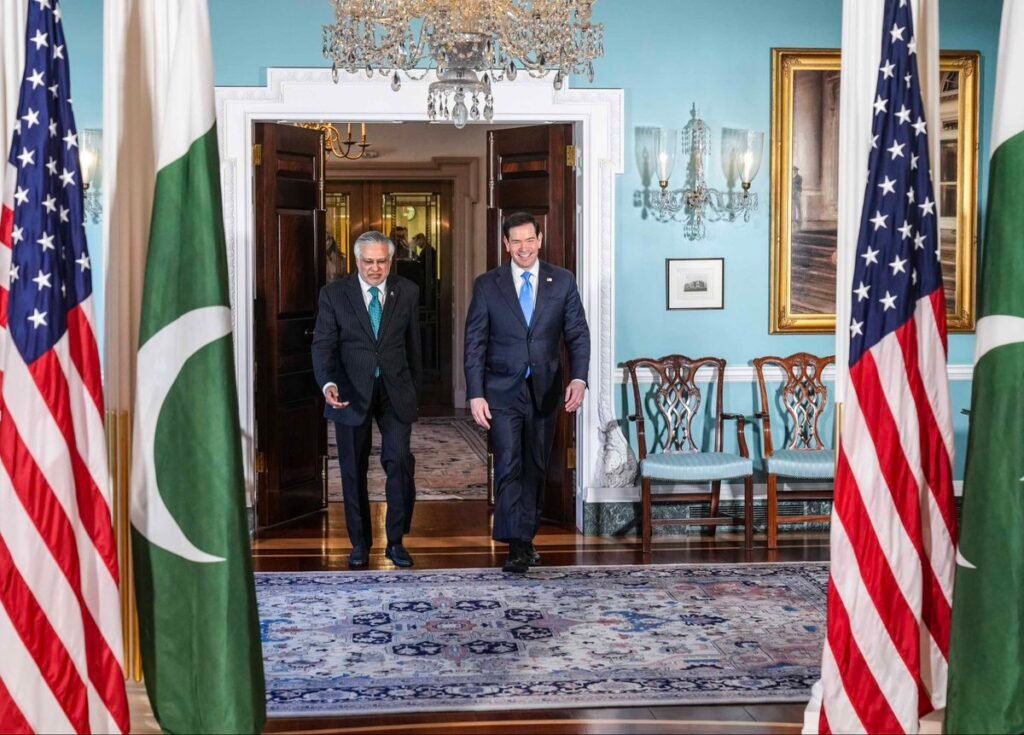
- Rubio Ishaq Dar meeting showcased strong diplomatic alignment between the US and Pakistan
- Both leaders condemned the BLA terrorist attack in Quetta and emphasized counterterrorism cooperation
- Talks focused on Iran-US peace deal and Pakistan’s mediation role
- Pakistan reaffirmed no recognition of Israel without an independent Palestinian state
In a carefully choreographed moment that subtly mirrored the diplomatic alignment both sides sought to project, Marco Rubio and Ishaq Dar emerged side by side in Washington, D.C., their synchronized appearance signaling more than mere protocol. As the two leaders walked forward between the flags of the United States and Pakistan, their near-identical attire—dark suits, crisp white shirts, coordinated ties, and polished black leather shoes—offered a visual metaphor for the tone of the meeting: composed, aligned, and quietly optimistic.
Observers noted that even before formal talks began, the mood had been set. Both men wore deep-toned suits of almost identical shade, paired with ties in closely matching hues, projecting a sense of unity and deliberate symmetry. Their body language reinforced the impression—relaxed shoulders, measured strides, and shared smiles—suggesting comfort and familiarity rather than tension. It was a moment that conveyed, without words, that Washington and Islamabad were entering discussions on the same page.
The meeting itself began on a somber note, as Secretary Rubio expressed condolences over the recent terrorist attack in Quetta claimed by the Balochistan Liberation Army (BLA). Rubio condemned the violence and extended sympathies to the victims and the people of Pakistan, underscoring Washington’s continued support in counterterrorism efforts. Dar acknowledged the gesture, reiterating Pakistan’s long-standing sacrifices as a frontline state in the global war on terror.
United Nations Financial Crisis Deepens as U.S. and China Withhold Billions in Power Struggle
From that shared acknowledgment of security challenges, the dialogue quickly expanded into broader strategic terrain. According to official briefings, both sides emphasized the importance of strengthening Pakistan-U.S. relations, with a focus on regional stability, economic cooperation, and counterterrorism coordination. Yet what stood out most was the remarkable convergence of views on key geopolitical issues.
On the question of the Middle East, both leaders appeared aligned in their approach to the evolving U.S.-Iran dynamic. Rubio thanked Pakistan for its constructive role in facilitating dialogue and easing tensions between Washington and Tehran, recognizing Islamabad’s growing reputation as a mediator. Dar, in turn, highlighted Pakistan’s commitment to global peacebuilding, positioning his country as a bridge between competing powers.
Ships Are Sailing ‘Dark’ to Sneak Out of Strait of Hormuz
Equally significant was the discussion surrounding the Abraham Accords and the broader question of normalization with Israel. While the United States continues to push for expanded participation in the accords, Pakistan maintained its principled stance. Speaking later at a press conference, Dar made it clear that Islamabad’s position remains unchanged: there can be no recognition of Israel without the establishment of an independent Palestinian state.
“Pakistan remains steadfast in its position on Palestine and Gaza,” Dar told reporters, emphasizing that any shift in policy would hinge on meaningful progress toward a two-state solution. Despite this apparent divergence, diplomatic sources suggested that the conversation between Rubio and Dar was marked by mutual respect and understanding, rather than disagreement.
Iran and Russia Absent from UN Peace Summit as US Blocks Visas
Indeed, the meeting reflected a nuanced alignment—where both sides acknowledged each other’s positions while seeking common ground. This was evident in their shared emphasis on humanitarian concerns in Gaza and the urgent need for international efforts to stabilize the region.
Beyond geopolitics, the talks also delved into economic cooperation. Dar highlighted opportunities for collaboration in emerging sectors such as information technology, artificial intelligence, cryptocurrency, and mineral development. Rubio expressed interest in expanding trade and investment ties, signaling Washington’s intent to deepen economic engagement with Pakistan.
The discussion also touched on South Asia, with Dar appreciating the role played by former U.S. President Donald Trump and Secretary Rubio in helping de-escalate tensions between Pakistan and India. He reiterated that the Jammu and Kashmir dispute remains the core issue between the two nuclear-armed neighbors and called for its resolution in line with United Nations resolutions and the aspirations of the Kashmiri people.
Throughout the engagement, the visual symmetry that marked their initial appearance seemed to carry through into the substance of their dialogue. Both leaders spoke of partnership, stability, and shared interests, reinforcing the sense that the meeting was not merely transactional but indicative of a broader alignment.
In diplomatic circles, such symbolism is rarely accidental. The coordinated attire, the mirrored gestures, and the synchronized walk were all part of a carefully constructed narrative—one that suggested two nations moving in step, at least on key global issues.
As the meeting concluded, both sides reaffirmed their commitment to a long-term partnership aimed at fostering security and prosperity for their respective peoples. While challenges remain, particularly on complex issues like the Abraham Accords and Middle East policy, the overall tone was unmistakably positive.
In the end, it was not just what Rubio and Dar said that defined the meeting—but how they appeared together. In their matching suits, aligned body language, and shared smiles, they projected a powerful image of diplomatic harmony, signaling that at this critical juncture, Washington and Islamabad are, at least for now, walking the same path.