


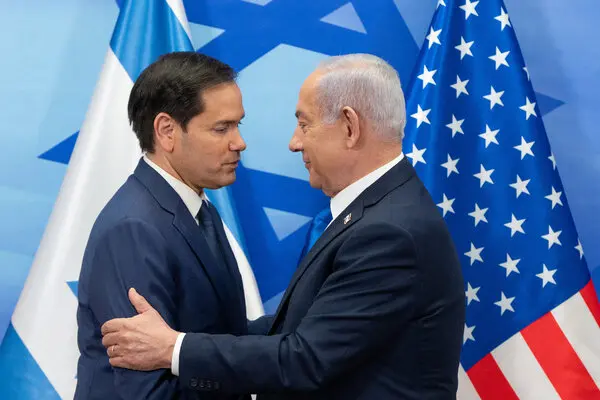
- Marco Rubio heads to Israel as Trump’s top diplomat, tasked with balancing unwavering U.S. support with growing global anger at Israeli strikes.
- Netanyahu insists killing Hamas leaders abroad is the only path to peace, despite risks of further regional escalation.
- Hamas vows to continue its demands for independence, framing Israel’s actions as attempts to derail ceasefire negotiations.
- The U.N. resolution on a two-state solution marks a rare global consensus, paving the way for recognition of Palestinian statehood.
Marco Rubio’s sudden diplomatic mission to Israel is more than a courtesy call; it is a fire-fighting mission in the middle of a fast-spreading blaze. As U.S. Secretary of State under President Donald Trump, Rubio carries the weight of a divided Washington foreign policy — one that insists on backing Israel but grows uneasy with Israel’s recent adventurism, including its unilateral strike on Hamas political leaders in Qatar.
The Biden-era U.S. was accused of abandoning allies in the Middle East; Trump, determined to prove otherwise, has sent Rubio to stabilize the crumbling ground under America’s regional strategy. The immediate agenda is hostage diplomacy — Hamas still holds 48 hostages in Gaza — but the wider stage is chaos: Israel’s expansion of settlements in the West Bank, its brazen strike on a close U.S. ally, and Arab states’ rising anger.
Rubio insists relations with Israel remain “unshakable,” but his words betray unease. Israel’s near two-year war has killed over 64,000 Palestinians and created a humanitarian crisis so severe that even genocide scholars have accused Tel Aviv of crossing red lines. Washington cannot afford another rift with Qatar — a vital mediator — or risk derailing Trump’s broader vision of ending the Gaza war on American terms.
The U.S. House of Representatives Passes $892.6 Billion Defense Bill Amid Deep Partisan Divisions
Rubio’s challenge is Herculean: to remind Israel that U.S. support is not a blank check, while also shielding Trump’s vision of a “post-war Gaza” where hostages are freed, militants disarmed, and reconstruction begins under a cooperative framework. His trip underscores the tension between Trump’s deal-making instinct and Israel’s maximalist impulses. In a Middle East already ablaze, Rubio’s presence is not symbolic — it is America’s last attempt to hold the reins of a conflict slipping beyond control.
Why Netanyahu Believes Killing Hamas Leaders Is the Path to Peace
Israeli Prime Minister Benjamin Netanyahu has long framed the conflict in absolute terms: peace will come not through negotiation, but through the elimination of Hamas’s leadership. His recent declaration that killing Hamas chiefs abroad — especially those based in Qatar — would pave the way to a deal illustrates Israel’s strategy of decapitation rather than dialogue.
READ MORE: Exclusive: Trump and Netanyahu’s Heated Clash: Can Trump Restore His Dignity Among Gulf Allies?
The strike on Doha, however, revealed more than Israel’s operational reach; it exposed Netanyahu’s desperation. By eliminating Hamas’s political command structure, Israel hopes to force a fragmented movement into capitulation, compelling them to release hostages and disarm. Netanyahu framed the exiled leadership as obstructionists, accusing them of sabotaging every ceasefire attempt to prolong the suffering in Gaza.
But this logic is fraught with peril. Killing leaders abroad, especially in a sovereign Arab state like Qatar, risks deepening Israel’s isolation. It complicates American diplomacy, undercuts mediators, and inflames Arab anger. Hamas, in turn, has dismissed the assassinations as Israel’s attempt to derail talks — and vowed not to soften its demands for an independent Palestinian state.
ALSO READ: Rubio heads to Israel amid tensions among US Middle East allies
Netanyahu’s gamble is rooted in political survival. Facing internal criticism, corruption trials, and international isolation, he clings to the narrative that removing Hamas’s top tier will break the deadlock. Yet, history shows otherwise: militant movements often regenerate leadership, and martyrdom can strengthen rather than weaken resolve. Still, Netanyahu pushes forward — convinced that only by “killing the head of the snake” can Israel emerge from a war that has already shattered Gaza and scarred Israel’s global image.
Why the U.N. Two-State Resolution Must Be Applauded
In the shadow of bloodshed, the United Nations General Assembly delivered a rare moment of clarity. By overwhelmingly endorsing a resolution that sets “tangible, timebound, and irreversible steps” toward a two-state solution, the international community signaled that enough is enough. With 142 nations voting in favor, the world has declared that Palestinian statehood is not a bargaining chip but an overdue necessity.
The resolution not only condemns Hamas’s October 7 attacks but also Israel’s devastating campaign in Gaza — the siege, the starvation, the bombings that have killed tens of thousands of civilians. By supporting both accountability and recognition, the U.N. has taken a balanced yet courageous stance. For the first time, Gulf Arab states, European powers, and much of the Global South have spoken in one voice, isolating both Hamas’s militancy and Israel’s expansionism.
This is no symbolic vote. France, Britain, Canada, Australia, and Belgium are poised to formally recognize a Palestinian state. Saudi Arabia and France co-hosted the July conference that fed into this resolution, underscoring that momentum is building. The message is unmistakable: the world will no longer be hostage to Netanyahu’s maximalism or Hamas’s militancy.
Critics in Washington and Tel Aviv have dismissed the resolution as “theater.” But the reality is the opposite: it is the first step toward a political horizon. If enforced with seriousness — including international stabilization forces and recognition of Palestinian sovereignty — it could end the endless cycle of war.
The U.N. has been accused of impotence, but this time, it has risen to the occasion. In an era of escalating conflicts, the courage to chart a path to peace deserves not cynicism, but applause.
Final Word
Rubio’s mission, Netanyahu’s gamble, and the U.N.’s bold step form three interlocking parts of a turbulent drama. America seeks to calm its ally while avoiding another Middle Eastern fracture. Israel doubles down on a military solution, convinced its survival depends on crushing Hamas leadership. And the world, finally, has decided that the only true exit is through two states living side by side.
The road ahead is treacherous, but the U.N.’s resolution offers a compass. If Washington listens, if Tel Aviv recalibrates, and if the Palestinians are granted dignity, then perhaps the blood-soaked soil of Gaza may yet see the first shoots of peace.