


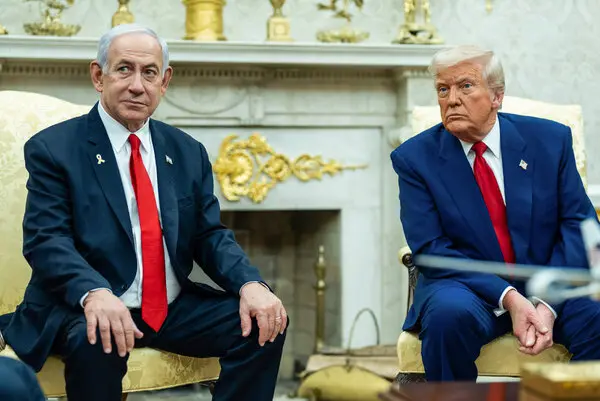
- Trump’s heated clash with Netanyahu exposed deep rifts in U.S.-Israel relations after the surprise strike on Qatar.
- Qatar and Saudi Arabia now question Trump’s credibility as a reliable partner and mediator.
- Netanyahu’s unilateral moves repeatedly box Trump into supporting actions that undermine his peace agenda.
- To restore dignity, Trump must rebalance ties by reaffirming Gulf alliances, imposing political costs on Netanyahu, and reclaiming control of Middle East diplomacy.
The phone call between President Donald Trump and Prime Minister Benjamin Netanyahu this week was more than just a diplomatic spat—it was the moment when two old allies collided head-on. What should have been a carefully coordinated strategy to manage a volatile Middle East turned into an open display of mistrust, betrayal, and bruised egos. Netanyahu’s decision to launch a surprise strike on Hamas representatives in Qatar, without prior notice to Washington, blindsided Trump and set the stage for one of the most tense episodes in U.S.-Israel relations in decades.
For Trump, who has built his Middle East strategy on a personal rapport with Gulf monarchs, particularly the Qataris and Saudis, the damage is real and immediate. Israel’s strike not only killed several Hamas figures but also shattered delicate cease-fire negotiations and humiliated Qatar—a state Trump has courted aggressively with luxury deals, investment pledges, and political symbolism. For Gulf rulers, the question now is not whether they trust Netanyahu—they never did—but whether they can still rely on Trump as a credible guarantor of regional diplomacy.
Poland’s Drone Crisis: How a NATO Alarm Could Reshape the Ukraine War and Trump’s Strategy
Trump’s frustration with Netanyahu was visible, not hidden. Administration officials confirmed that he scolded the Israeli leader for acting recklessly, for disregarding U.S. interests, and, most damningly, for making him look weak before his Arab partners. In international politics, perception is power—and Trump has been made to look like a spectator, informed of an ally’s dramatic military action only after it began.
Netanyahu’s defense was blunt: he had a “brief window” and seized it. In other words, Israel’s interests came first, America’s reputation came second. This is a familiar script for Netanyahu—decades of Israeli leaders have played U.S. presidents like this—but rarely has it been so public, so humiliating, and so disruptive to ongoing U.S. diplomacy.
The deeper problem for Trump is that Netanyahu has maneuvered him into a corner. Trump needs Israel as much as Netanyahu needs Washington. Trump is running a Middle East strategy that relies on Israel’s deterrence power and the Gulf’s financial and political clout. But every time Netanyahu launches a unilateral strike—whether against Hamas in Qatar, nuclear facilities in Iran, or militias in Syria—Trump is forced into the role of reluctant supporter, even if the move contradicts his broader agenda. It is Netanyahu’s aggression, not Trump’s diplomacy, that sets the pace.
Qatar’s fury should not be underestimated. Doha has been one of Trump’s showcase allies, rolling out red carpets, offering investment sweeteners, and even donating a $400 million luxury plane to serve as Air Force One. The Trump-branded golf resort planned in Doha symbolized a unique fusion of diplomacy and personal branding. Now, all that glitz has been overshadowed by Netanyahu’s missiles. For Qatari leaders, Trump looks less like a reliable partner and more like a leader unable—or unwilling—to restrain his closest ally.
Saudi Arabia, too, will be watching closely. Crown Prince Mohammed bin Salman, pragmatic but ruthless, has been hedging between American protection, Chinese markets, and Russian oil diplomacy. Every sign of U.S. weakness pushes Riyadh further into balancing mode. If Trump cannot control Netanyahu, then the Saudis will conclude that U.S. promises of stability are hollow.
So, what options are left for Trump?
First, he must recalibrate his public posture. The perception that Netanyahu dictates American foreign policy is poisonous—not only for Trump’s credibility in the Middle East but also for his standing among European partners and within the U.S. Congress. Trump needs to show, loudly and visibly, that America is not a pawn of Israeli unilateralism. A strong statement reaffirming the sanctity of Qatar’s sovereignty, coupled with a renewed push for cease-fire negotiations, would send a message that Washington’s leadership still matters.
Second, Trump must lean into Gulf relationships with concrete gestures. Symbolic hugs and golf resorts are no longer enough. He needs to deliver tangible security guarantees, expanded defense cooperation, and perhaps even incentives for a broader regional framework that gives the Gulf monarchies a greater role in post-war Gaza reconstruction. By anchoring his diplomacy in Riyadh and Doha, Trump can counter the narrative that Netanyahu holds a monopoly on his Middle East agenda.
Third, Trump must begin imposing costs on Netanyahu—political, not military. He does not need to cut aid or abandon Israel, but he can withhold diplomatic cover at the United Nations, slow down certain weapons deliveries, or hint at broader regional initiatives that bypass Netanyahu. Trump thrives on loyalty tests, but Netanyahu has repeatedly failed his. At some point, even Trump must show that betrayal has a price.
Finally, Trump must remember his ultimate prize: a Nobel Peace Prize. This ambition, openly stated and privately obsessed over, can only be secured if he demonstrates control over events rather than being dragged by them. If he can reset the narrative—positioning himself as the indispensable broker between Israel and the Arabs—he could turn humiliation into opportunity. But if he remains reactive, he risks being remembered not as the president who reshaped the Middle East, but as the one who let Netanyahu write the script.
For now, the Israeli prime minister smiles beside U.S. ambassadors, names seaside promenades after Trump, and proclaims him the “best friend Israel ever had.” But behind that flattery lies a brutal reality: Netanyahu knows Trump cannot afford a rupture. The test is whether Trump can muster the will—and the courage—to remind Netanyahu that even the best friends must respect boundaries.
The damage has been done. Trust has been shaken. But dignity, once lost, can still be clawed back. For Trump, the road to restoring his reputation in the Middle East runs not through Jerusalem, but through Doha and Riyadh. The question is whether he has the discipline to walk it.