


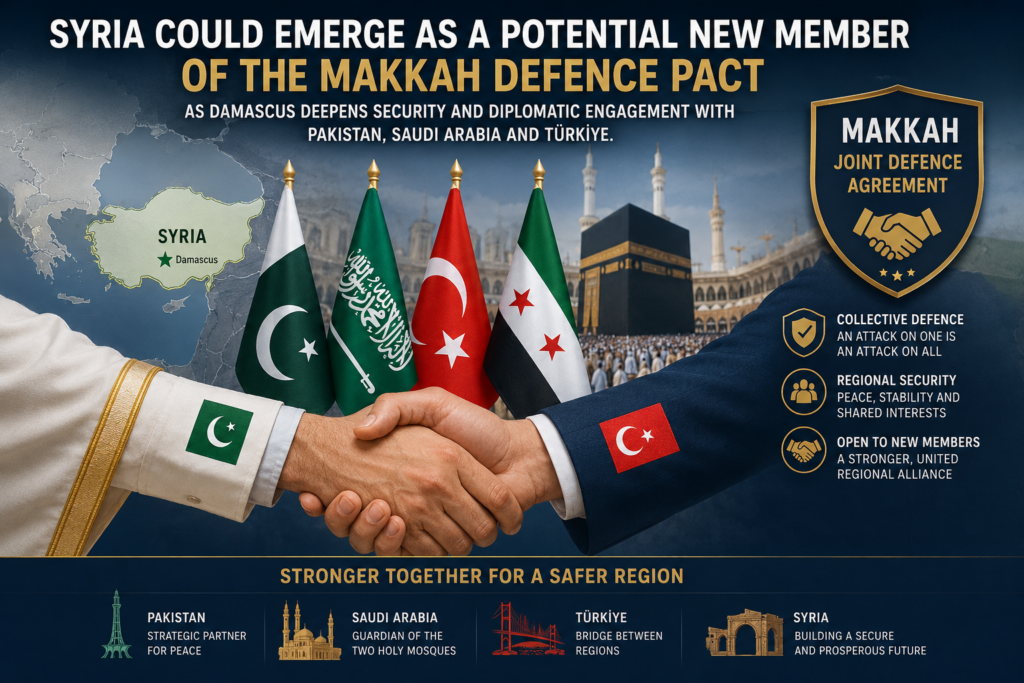
- Syria Makkah Defence Pact: Syria is emerging as a potential future member of the Makkah Joint Defence Agreement as Damascus seeks stronger regional security partnerships.
- Syrian Foreign Minister Asaad Hassan al-Shaibani’s Pakistan visit comes after Israel’s latest strikes on Syria and Islamabad’s strong condemnation of the attacks.
- Egypt is already considering joining the pact, raising the possibility that the Pakistan-Saudi-Türkiye framework could evolve into a broader regional defence architecture.
ISLAMABAD — Syria could emerge as the next major candidate for membership of the Makkah Joint Defence Agreement as Damascus deepens its strategic engagement with Pakistan and regional powers confront mounting security and economic pressures from the wider Middle East war.
Syrian Foreign Minister Asaad Hassan al-Shaibani is due in Islamabad on August 19-20 for his first visit to Pakistan since taking office and the first visit by a Syrian foreign minister to the country since 2007. His high-level delegation is expected to hold discussions with Pakistan’s civilian leadership as well as senior military officials, giving the visit significance well beyond conventional bilateral diplomacy.
Pakistani officials have publicly described the visit as an opportunity to review bilateral relations and regional developments. But diplomatic sources say the timing is particularly significant because the Makkah Joint Defence Agreement is already moving from its original three-member structure toward a potentially broader regional security framework.
READ NEXT: Makkah Defence Pact Signals Strategic Realignment in a Fragmenting Middle East
The agreement, signed in Makkah on August 7 by Pakistan, Saudi Arabia and Türkiye, stipulates that an armed attack against one member will be regarded as an attack against all three. The pact is explicitly described by Pakistan as defensive and designed to strengthen collective deterrence.
The Makkah defence framework has already generated speculation about its next members. Turkish Foreign Minister Hakan Fidan has publicly said Egypt is expected to join after outstanding technical issues are resolved, while President Recep Tayyip Erdogan has indicated that the pact should not remain confined to three countries.
That makes Syria an increasingly interesting possibility.
People familiar with regional diplomatic discussions say Damascus is being viewed as a potential future participant, although there has been no official Syrian or Pakistani announcement that Syria has been invited or that it has decided to join.
The distinction is important. Syria is still rebuilding its institutions and armed forces after years of civil war, while its new leadership under President Ahmed al-Sharaa is attempting to establish relations with regional and international powers. A formal collective-defence commitment would therefore represent a major strategic decision for Damascus.
READ MORE: The New Crescent: Mecca Pact Gives Rise to a Sunni Bloc, Posing New Challenges for Israel
Yet Syria’s circumstances are precisely what could make membership attractive.
The country is increasingly exposed to the consequences of regional conflict. Shipping disruptions through the Strait of Hormuz and the Red Sea have placed additional pressure on Middle Eastern economies, while the wider conflict has created new security risks for countries that were already struggling with damaged infrastructure and weak economies.
For Damascus, regional security cooperation could provide political backing, military coordination, intelligence cooperation and potentially access to defence technology and training.
Pakistan is particularly well positioned to play a role in that process. Islamabad has maintained historic ties with Arab states while also cultivating close strategic relations with Türkiye and Saudi Arabia. The Makkah agreement gives Pakistan a new institutional platform through which it can engage countries seeking greater regional security cooperation.
The Islamabad Telegraph’s geopolitical coverage has closely followed Pakistan’s expanding diplomatic and security role in the Middle East.
The timing of Shaibani’s visit is also difficult to separate from Israel’s latest military action inside Syria.
On August 18, Israel carried out eight airstrikes against the Abu al-Duhur airbase in northwestern Syria, hitting the runway and storage facilities. No casualties were reported. Israel defended the operation on security grounds, while Syria and Türkiye condemned it as a violation of Syrian sovereignty. The United States also described the strike as an unnecessary escalation.
Pakistan responded with unusually strong language, condemning what it called an “unprovoked” Israeli attack and warning that such actions could further undermine regional peace and stability. Islamabad also reaffirmed its support for Syria’s sovereignty and territorial integrity.
That diplomatic alignment matters.
Shaibani’s meetings in Islamabad are likely to include discussion of the Israeli strikes, Syria’s security requirements and the broader transformation of regional security architecture. The presence of Pakistan’s senior military leadership would be especially significant if defence cooperation forms part of the discussions.
Syria’s possible entry into the Makkah framework would also carry a powerful political message. The agreement was not created in isolation from the regional crisis. Its emergence followed months of conflict, missile attacks, disruption to maritime trade and growing concern among regional states that traditional security arrangements are no longer sufficient.
The Makkah pact is already being institutionalised beyond its original signing ceremony. Türkiye has said the three countries plan to establish senior political and military coordination mechanisms, conduct joint exercises and deepen cooperation in defence industries, including unmanned systems, electronic warfare and artificial intelligence.
If Egypt joins, the framework would acquire a substantially broader Arab dimension. If Syria follows, its strategic weight would increase further because Damascus sits at the intersection of the Levant, Türkiye, Iraq, Israel and the eastern Mediterranean.
But Syria is unlikely to rush into membership.
Damascus will have to balance its relations with Türkiye, Saudi Arabia, the United States and other regional actors while avoiding being drawn into a confrontation that could undermine its fragile transition. Membership would therefore probably come through a gradual process of political and defence cooperation before any formal accession.
The most immediate significance of Shaibani’s Islamabad visit may consequently be less about a signing ceremony and more about testing the possibilities.
If discussions produce agreement on expanded defence cooperation, intelligence sharing, military training or coordinated responses to external aggression, Syria could become a serious candidate for the next phase of Makkah’s expansion.
For now, the prudent conclusion is that Syria is a potential future member, not yet a confirmed one.
But the direction of travel is becoming clearer. Egypt appears to be under active consideration. Türkiye wants the framework expanded. Pakistan says the agreement remains open to other regional countries. And Syria, facing renewed Israeli pressure while suffering the economic consequences of disrupted regional trade routes, has increasingly strong incentives to seek new security partnerships.
Shaibani’s Islamabad visit may therefore become an early indicator of whether the Makkah agreement evolves from a three-country defence pact into the nucleus of a much broader regional security architecture.