


-
Hassan’s 97.6% win ensures continuity but exposes Tanzania’s fragile democracy.
-
Opposition leaders were barred, sparking deadly protests and international concern.
-
Foreign partners welcome the predictability her re-election offers for investment.
-
The future hinges on whether she can balance stability with democratic openness.
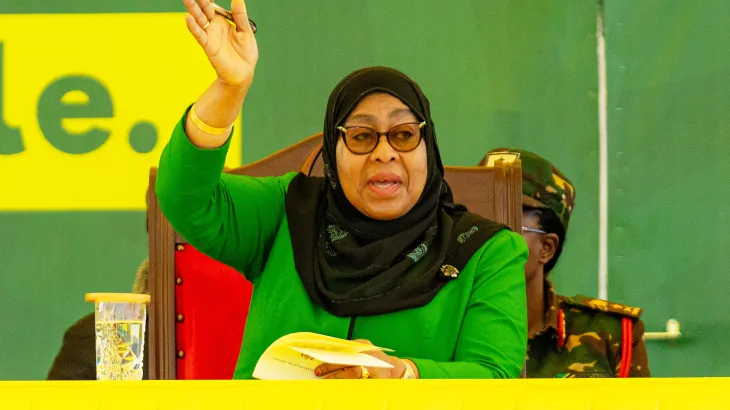
Tanzania’s Samia Suluhu Hassan’s Contested Victory has ignited jubilation among her supporters but also fury across much of the country, where thousands have poured onto the streets in protest. While the Independent National Electoral Commission (INEC) declared her re-elected with an overwhelming 97.6% of the vote, the political cost of that victory has left Tanzania deeply divided and its democratic promise under strain.
The election outcome has become one of the most polarizing moments in Tanzania’s modern history — hailed by foreign partners as a symbol of continuity but condemned by opposition parties and rights groups as a “pre-determined coronation.”
A Victory of Numbers, a Defeat of Trust
Tanzania’s Samia Suluhu Hassan’s Contested Victory rests on an electoral process that opposition parties say was designed to suppress dissent.
Her two most credible challengers — Tundu Lissu of the Chadema party and Luhaga Mpina of ACT-Wazalendo — were barred from running. Lissu, charged with treason, remains imprisoned, while Mpina was disqualified over “technical” errors.
“This was an election without competition,” said Oryem Nyeko of Human Rights Watch. “Locking out the opposition was calculated, ensuring a controlled outcome.”
ALSO READ: Tanzania’s President Hassan wins disputed election amid deadly protests
Despite the lack of real rivals, Hassan’s campaign slogan — “Mama anaweza” (Mother Can Do It) — failed to ignite the same emotional connection as her historic 2021 ascension. Her approval among younger voters plunged, as many accused her of prioritizing power consolidation over political reform.
Yet for investors, donors, and Tanzania’s allies, Tanzania’s Samia Suluhu Hassan’s Contested Victory provides stability. It guarantees continuity in infrastructure projects, trade relations, and regional diplomacy — a win-win for global partners seeking predictability in East Africa.
ALSO READ: Taiwan Challenges China: Island’s Defiance of “One Country, Two Systems” Sparks New Geopolitical Tensions
Foreign Partners Welcome Predictability
For China, Tanzania’s Samia Suluhu Hassan’s Contested Victory secures the continuation of Belt and Road infrastructure projects, including the Bagamoyo port and new railway lines. The European Union and World Bank also favor Hassan’s leadership for her ability to maintain macroeconomic stability and attract foreign direct investment.
“Tanzania is a critical economic hub for East Africa,” said Nicodemus Minde, a regional analyst. “Her re-election offers calm and continuity, particularly to Kenya and Uganda, who rely on Tanzanian ports for trade and transit.”
The United States has adopted a cautious tone, congratulating Hassan while urging her to uphold democratic principles and investigate violence against protesters. In contrast, China and Russia quickly endorsed her victory as a “triumph of leadership and unity.”
Protests, Bloodshed, and Internet Blackouts
At home, however, Tanzania’s Samia Suluhu Hassan’s Contested Victory has plunged the nation into turmoil. Demonstrations in Dar es Salaam, Arusha, and Dodoma have entered their fourth day, with independent activists reporting more than 100 casualties.
Police used tear gas and live ammunition to disperse protesters after imposing a 6 p.m. curfew and cutting off the internet. “We have been oppressed for too long,” said Janet Mavura, a protester in Dar es Salaam. “This is our moment to demand a better life and real democracy.”
Human rights lawyer Tito Magoti said public hospitals were treating gunshot victims. “The figures are grim,” he said. “What we see is a government willing to use bullets to secure ballots.”
General Jacob John Mkunda, Tanzania’s army chief, labeled the protests “criminal acts,” but international observers have warned of escalating violence and state overreach.
Supporters Hail a “Mother of Stability”
Despite unrest, Hassan’s loyal base — particularly in rural areas and within the ruling Chama Cha Mapinduzi (CCM) party — continues to view her as a stabilizing force.
“Tanzania’s Samia Suluhu Hassan’s Contested Victory is proof that leadership is about continuity and peace,” said Abel Mwakyembe, a CCM spokesperson. “She has restored investor confidence and reconnected Tanzania with the world.”
Under her tenure, Tanzania’s economy grew by 5.2% in 2024, buoyed by mining, tourism, and energy projects. Her administration has been praised for reviving diplomatic ties and welcoming back journalists previously banned under the late President John Magufuli.
However, critics argue that her democratic reforms have been replaced by tighter political control. “She started as a reformer,” said activist Maria Sarungi, “but now she’s using the same tactics she once condemned.”
What Lies Ahead for Tanzania
The question after Tanzania’s Samia Suluhu Hassan’s Contested Victory is whether she can restore legitimacy at home while maintaining global credibility. Analysts believe her next steps — managing protests, opening dialogue with opposition groups, and allowing greater political freedom — will define her second term.
Diplomatic observers warn that if she fails to address growing repression, Tanzania risks losing its image as a democratic success story. Yet her firm grip on power means that the international community is likely to keep engaging with her for the sake of stability.
“She has the opportunity to turn this contested victory into a mandate for reform,” said Minde. “But if she ignores the people’s anger, Tanzania may face deeper unrest.”