


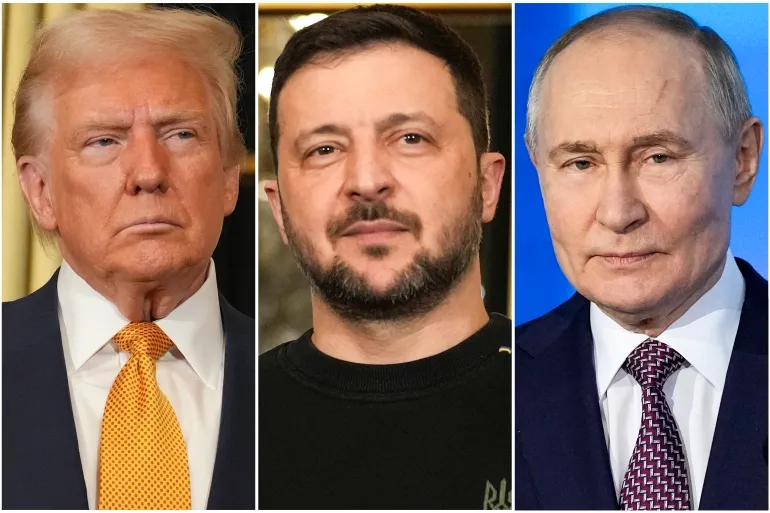
- Trump is caught between Europe’s demands for a fair cease-fire and Russia’s push for sweeping territorial concessions in Ukraine.
- Putin’s proposal would see Kyiv surrender Donetsk, Luhansk, and recognize Crimea in exchange for halting the war.
- European allies warn the deal could freeze the conflict in Russia’s favor, undermining NATO and Ukraine’s sovereignty.
- The Alaska summit offers Trump a high-stakes chance to deliver a “master stroke” that could end the war—or reshape Europe’s security map.
As the world’s gaze fixes firmly on Alaska ahead of Friday’s meeting between U.S. President Donald Trump and Russian President Vladimir Putin, the diplomatic battlefield is no less charged than the one in Ukraine.
Trump now finds himself in the tightest position of his presidency—wedged between European allies urging restraint and Ukrainian sovereignty on one side, and a Kremlin pushing for sweeping territorial concessions on the other. The stakes could not be higher: an end to Europe’s bloodiest conflict in decades, or a settlement that could redraw borders and rewrite international norms.
At the heart of the drama lies Putin’s bold cease-fire proposal—one that would see Ukraine surrender the entirety of the Donetsk and Luhansk regions, along with formal recognition of Crimea as Russian territory. In exchange, Moscow offers to halt its offensive and, on paper, pledge not to attack Ukraine or Europe.
Putin’s Calculated Push: How Russian Gains in Ukraine Could Tilt the Table Before the Alaska Summit
Ukrainian President Volodymyr Zelensky has dismissed the idea outright, warning that “any decisions without Ukraine are decisions against peace.” European leaders, too, are wary—viewing the offer as a trap to freeze the war while consolidating Russia’s territorial gains.
READ MORE: When Trump Meets Putin, Anything Could Happen
Yet Trump, who built his political brand on breaking deadlocks others deemed impossible, has not dismissed the overture. Instead, he has seized on it as a potential starting point for direct talks with Putin—his first such engagement since returning to the White House. For a president who relishes the role of the ultimate dealmaker, the Alaska summit offers an opportunity to craft what he might see as a “master stroke” in ending the war.
A Diplomatic Squeeze
Trump’s challenge is stark. Europe’s counterproposal demands a cease-fire before any territorial discussion, reciprocal withdrawals by both sides, and security guarantees for Kyiv—potentially including NATO membership. This would be an anathema to Moscow. On the other hand, rejecting Putin’s offer outright could risk losing a rare opening for dialogue, especially when Russia’s battlefield calculus still favors continued aggression over compromise.
ALSO READ: Europe Scrambles to Define ‘Red Lines’ Before Trump–Putin Alaska Summit Amid Fears of Ukraine Sell-Out
The optics are just as sensitive. In Europe, any hint that Trump might entertain Russian territorial claims risks deepening fears that Washington is ready to trade Ukrainian land for peace on paper. In Moscow, Putin will arrive with the confidence of a man who believes time—and perhaps Trump’s eagerness for a quick diplomatic win—is on his side.
History and the Trump Factor
Critics of Trump’s Russia policy point to his 2018 Helsinki press conference, where he sided with Putin over U.S. intelligence assessments, as a warning of what could go wrong. But history also shows Trump’s resilience in moments of geopolitical strain. Whether in his hard-nosed dealings with North Korea’s Kim Jong-un or his trade brinkmanship with China, he has consistently sought to turn personal diplomacy into leverage—often disregarding conventional diplomatic channels in the process.
In Alaska, that approach could prove decisive. If Trump can frame a deal that satisfies at least some European demands while coaxing Putin into concessions beyond Donetsk, Luhansk, and Crimea, he could claim the mantle of peacemaker. If he fails—or appears to capitulate to Moscow—the fallout would be immediate and severe, both in European capitals and in Kyiv.
Ukraine War: The Military Reality
On the ground, neither side is in a position of decisive dominance. Russia’s gains in Donetsk remain incomplete, with key Ukrainian-held cities like Slovyansk and Kramatorsk still resisting. Ukraine’s southern front in Zaporizhzhia and Kherson remains contested, despite heavy Russian bombardment. A poorly constructed cease-fire risks locking these front lines in place, cementing Russia’s hold without forcing any real concessions.
European defence planners warn that such a frozen conflict could be more dangerous than an outright loss—it would grant Russia breathing space to rebuild its forces, undermine NATO’s credibility, and keep Ukraine in a permanent state of vulnerability.
The Alaska Gamble
This is why Alaska matters. For Putin, it is a chance to bypass European negotiators and deal directly with a U.S. president who prides himself on cutting bold, unconventional deals. For Trump, it is an opportunity to prove that he can do what neither his predecessor nor America’s allies could: stop the war.
But the risks are real. Should Trump emerge from the summit with a deal that is perceived as giving away too much, he would face fierce backlash at home and abroad. Conversely, if he rejects Putin’s overture without extracting meaningful concessions, the war will grind on—and with it, the political cost of inaction.
For now, the world waits. The only certainty is that when Trump and Putin step onto Alaskan soil, they will not just be discussing the fate of Ukraine—they will be deciding the balance of power in Europe for a generation. And if history is any guide, Trump will relish the chance to stake his legacy on one of the most high-risk diplomatic gambles of the 21st century.