


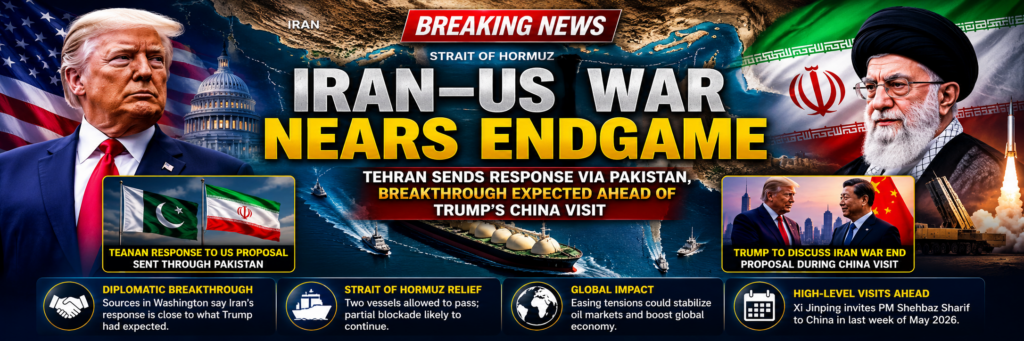
- Iran US War End appears imminent after Tehran sends response to Washington via Pakistan
- Sources say Iran’s reply aligns closely with expectations of Donald Trump
- Strait of Hormuz tensions may ease, though partial blockade likely to continue
- Trump to discuss deal during historic China visit with Xi Jinping
A major diplomatic breakthrough appears to be taking shape in the month-long Iran–United States war, as Tehran has formally transmitted its response to Washington’s proposal for ending hostilities—through Pakistan, which has emerged as a pivotal mediator in the high-stakes conflict.
According to Iran’s state news agency IRNA, the response was delivered via Islamabad on Sunday, signaling the most serious step yet toward a negotiated settlement. While the contents of Iran’s reply remain undisclosed, multiple sources in Washington suggest that the response is “remarkably close” to what U.S. President Donald Trump had anticipated, raising expectations that a framework agreement could be imminent.
Senior officials familiar with the matter indicated that the contours of a deal—centered initially on ending active hostilities before tackling more contentious issues such as Iran’s nuclear program—are now within reach. “This is the closest we’ve come to a logical end of the war,” a Washington-based source said, echoing recent remarks by Trump himself, who publicly stated days ago that the conflict was nearing its “logical conclusion.”
Pakistan’s role in this process has been central and increasingly visible. Acting as a discreet but effective intermediary, Islamabad facilitated the exchange at a time when direct communication channels between Tehran and Washington remain politically sensitive. Diplomatic observers note that Pakistan’s balancing act—maintaining ties with both sides while coordinating closely with regional players like Qatar—has elevated its standing as a credible peacemaker in a volatile region.
US-Iran Deal Nears Breakthrough as Trump Eyes Historic Islamabad Visit to Seal Regional Peace
The timing of Iran’s response is particularly significant, coming just days before Trump is set to embark on a historic visit to China, where he is expected to meet Chinese President Xi Jinping. Sources say the Iran war—and Tehran’s latest communication—will feature prominently in discussions, with Beijing seen as a key stakeholder given its economic interests in Gulf energy routes and its broader geopolitical alignment.
Iran war live: Iran sends to Pakistan response to US proposal to end war
In a parallel development underscoring the shifting diplomatic landscape, Xi has also extended an invitation to Pakistan’s Prime Minister Shehbaz Sharif for an official visit in the last week of May 2026. Analysts suggest this trilateral diplomatic momentum—Washington, Beijing, and Islamabad—could play a decisive role in shaping the final contours of any peace agreement.
The Iran War’s Aftershocks: Hormuz Chokepoint, Fragile Ceasefire, and the Road to America’s Midterms
On the ground, tentative signs of de-escalation are emerging, though the situation remains fragile. After 48 hours of relative calm, two commercial vessels successfully transited the strategically vital Strait of Hormuz—one of the world’s most critical energy chokepoints—under Iranian oversight. Among them was the QatarEnergy-operated LNG carrier Al Kharaitiyat, which safely crossed the strait en route to Pakistan’s Port Qasim, marking the first such passage since the war erupted on February 28.
The move is being interpreted as a confidence-building measure by Tehran, particularly toward Pakistan and Qatar, both of whom have played mediating roles. Energy analysts say the partial reopening of maritime routes could provide much-needed relief to global markets, which have been rattled by supply disruptions and soaring prices.
Trump China Visit 2026: High-Stakes Summit Faces Taiwan, Trade, and Security Flashpoints
However, sources caution that the Strait of Hormuz will not be fully reopened immediately. While some controlled transit may resume, a partial blockade is expected to remain in place as a form of strategic leverage. Iran has already signaled its intent to formalize new rules governing passage through the strait, including potential restrictions on vessels from what it terms “hostile states.”
Despite the diplomatic progress, the security environment across the Gulf remains tense. On Sunday, several Gulf countries reported hostile drone activity, highlighting the persistent risks even amid ceasefire conditions. The United Arab Emirates said it intercepted two drones allegedly originating from Iran, while Qatar condemned an attack on a cargo vessel in its waters. Kuwait also reported engaging aerial threats in its airspace.
These incidents underscore the delicate nature of the current moment: a war that appears to be winding down diplomatically, yet retains the capacity for sudden escalation on the ground.
In Washington, pressure has been mounting on the Trump administration to secure a resolution before the China visit. The conflict has not only strained global energy markets but has also become increasingly unpopular domestically, with rising fuel prices weighing heavily on American voters. U.S. allies, meanwhile, have shown reluctance to deepen their involvement, with NATO partners hesitant to deploy naval assets without a comprehensive peace framework.
Secretary of State Marco Rubio has openly criticized allied inaction, warning that allowing Iran to exert prolonged control over an international waterway like the Strait of Hormuz could set a dangerous precedent. Yet diplomatic sources suggest that Washington now sees negotiation—not escalation—as the most viable path forward.
Regional actors are also intensifying their engagement. Qatar’s Prime Minister Sheikh Mohammed bin Abdulrahman Al-Thani has urged Tehran to avoid using the strait as a “pressure tool,” while Turkey has maintained open channels with Iranian leadership. These parallel efforts appear to be converging toward a shared objective: stabilizing one of the world’s most volatile flashpoints before it spirals further.
For now, all eyes are on the next 72 hours. If Iran’s response is formally accepted and translated into actionable steps, the Iran–U.S. war—one that has threatened global economic stability and regional security—could finally be approaching its endgame.