


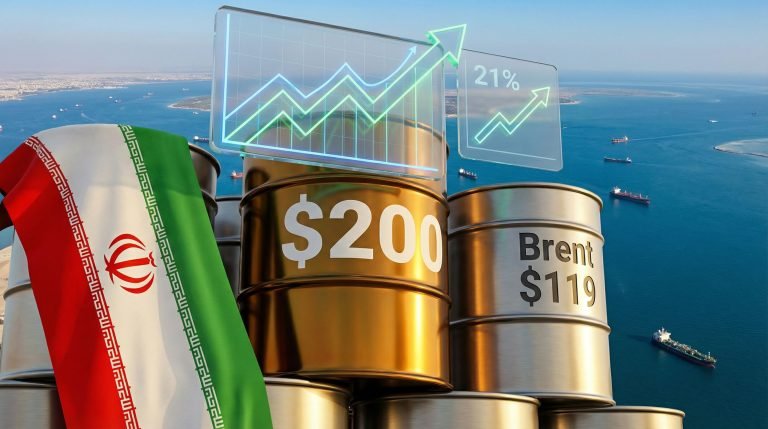
- Oil at $200: Iran warns of $200 oil: Iran’s military command says global oil prices could surge to $200 per barrel if the war continues and energy routes remain disrupted.
- Strait of Hormuz under threat: Iranian forces claim to have mined the Strait of Hormuz, the vital maritime corridor carrying nearly 20% of global oil supply.
- Shipping already hit: At least three additional merchant ships were damaged in the Gulf, raising the total number of vessels struck during the conflict to fourteen.
- Global economic shock risk: A prolonged disruption would hit emerging economies hardest, but developed nations could also face inflation, recession risks, and severe energy shortages.
The warning from Tehran was blunt and chilling. “Get ready for oil at $200 a barrel,” declared Iranian military spokesman Ebrahim Zolfaqari, addressing Washington and its allies as the war across the Middle East intensifies. This is not a rhetorical flourish or a hollow threat. The world is now confronting the very real possibility that the global energy lifeline running through the Strait of Hormuz may be slipping into paralysis.
Iranian commanders claim their forces have already begun mining the narrow waterway, the maritime artery through which roughly one-fifth of the world’s oil supply passes each day. According to maritime security agencies, three more merchant ships were damaged in the Gulf on Wednesday, pushing the total number of vessels hit since the war began to fourteen. Iranian officials have openly boasted that mines laid across the strait have begun to disrupt commercial traffic.
For the global economy, this is a shocking development. Both emerging and developed economies depend heavily on energy flows that pass through the Persian Gulf. If the Strait of Hormuz is effectively closed or rendered unsafe, the consequences will reverberate far beyond the Middle East. The world has not faced a comparable disruption to oil shipments since the oil crises of the 1970s.
Markets have so far responded with surprising calm. Oil prices surged earlier in the week but have since retreated to around $90 a barrel as investors bet that Donald Trump will soon engineer a ceasefire in the war he launched alongside Israel nearly two weeks ago. Yet the situation on the ground suggests that such optimism may be misplaced.
Iran continues to demonstrate its ability to retaliate. Missiles have been fired at Israeli targets and at U.S. military positions across the region, including bases in Bahrain and northern Iraq. Explosions have rattled Gulf cities, while drones have crashed near the airport in Dubai. Meanwhile, Israel has expanded its campaign with strikes not only inside Iran but also against Hezbollah positions in Beirut.
Iran tells world ‘get ready for $200 a barrel’
In Tehran itself, nightly airstrikes have driven hundreds of thousands of residents to flee the capital. Thick black smoke from burning oil facilities has reportedly produced what locals describe as “black rain.” Yet despite the devastation, Iranian leaders appear determined to escalate the economic pressure on the West.
The strategy is clear: weaponize geography.
Iran sits astride the northern coastline of the Strait of Hormuz, giving it the ability—at least temporarily—to disrupt shipping through mines, drones, missiles, and small naval craft. Even the perception that the strait is unsafe could force insurers to suspend coverage and shipping companies to reroute vessels, effectively choking off the flow of crude oil from Saudi Arabia, United Arab Emirates, Kuwait, and Iraq.
If oil truly reaches $200 per barrel, the consequences would be staggering.
Emerging economies—particularly in Asia, Africa, and Latin America—would face crippling inflation and balance-of-payments crises. Countries already struggling with debt and energy shortages could experience economic shocks severe enough to trigger political instability. But developed economies would not be spared either. A sustained oil shock at that level could ignite global inflation, derail central bank policies, and push fragile economies toward recession.
Pakistan Petrol Price Hike Signals Deep Energy Vulnerability as Iran War Reshapes Global Oil Markets
The International Energy Agency is reportedly considering releasing as much as 400 million barrels from strategic reserves, a record intervention designed to stabilize markets. Yet even such a dramatic move would only replace about three weeks of oil flows through the strait.
In other words, the world’s emergency stockpiles are no substitute for reopening the waterway.
This raises the central geopolitical question: Will the world allow Iran to close the Strait of Hormuz?
For Washington, the answer has traditionally been no. For decades, the United States has treated freedom of navigation through the strait as a red line. The U.S. Navy’s Fifth Fleet, headquartered in Bahrain, exists largely to guarantee that passage. Yet the current war complicates the equation. Directly attacking Iranian mining operations or coastal defenses could dramatically widen the conflict.
At the same time, failing to act would allow Tehran to establish a precedent that a regional power can choke off a fifth of the world’s oil supply.
That scenario would be unacceptable not only to the United States but also to major energy importers such as China, India, Japan, and the European Union.
For now, the strait sits at the center of a dangerous standoff. Iran has signaled that no oil will pass until U.S.-Israeli attacks cease. Washington has warned that any blockade would trigger severe retaliation.
History suggests the standoff cannot last long. Either diplomacy will reopen the waterway—or military confrontation will.
But one fact is already clear: the world’s most important energy corridor has become the central battlefield of the war. And if oil truly climbs toward $200 a barrel, the economic shock will not remain confined to the Middle East.
It will shake the entire global order.