


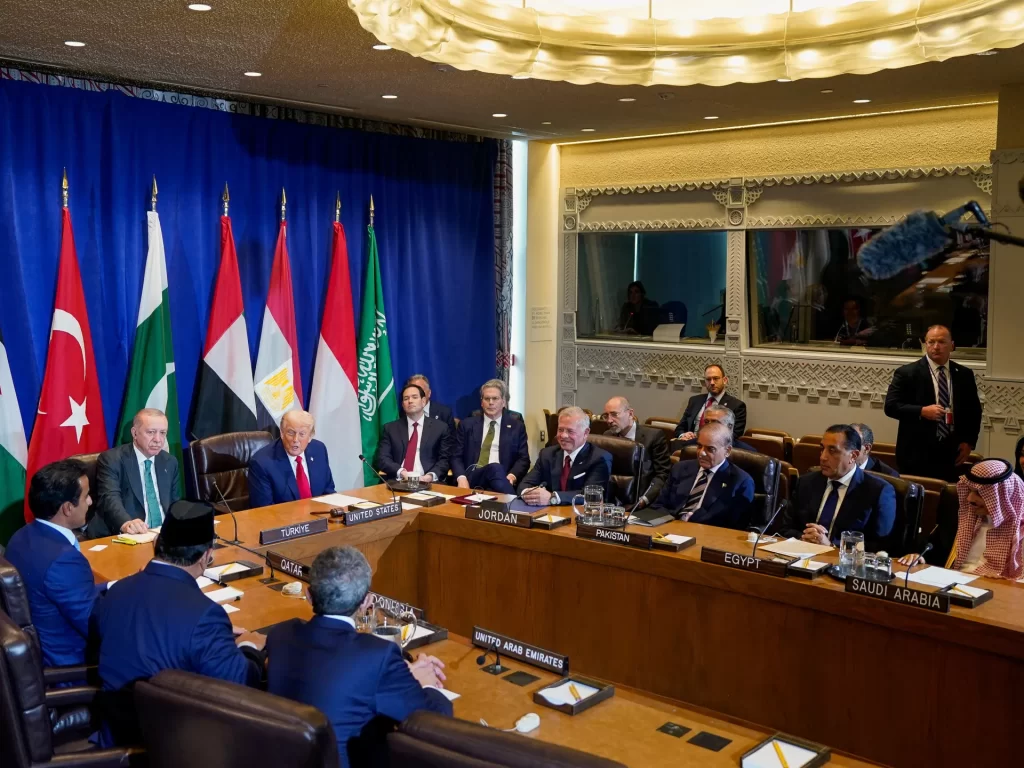
- Trump’s Gaza Plan: Countries expected to contribute troops to Trump’s Gaza Plan are now retreating, fearing clashes with Palestinians.
- Pakistan and Egypt play rising diplomatic roles, but neither is ready to risk boots on the ground.
- Hamas’ ambiguous disarmament stance complicates the International Stabilization Force (ISF) mandate.
- Public activism — from Bella Hadid to global artists — adds new moral pressure as Israel maintains military operations.
The Trump Gaza Plan, once promoted as the most ambitious American blueprint to stabilize the besieged enclave in decades, is finding itself trapped between military uncertainty, diplomatic hesitancy and political exhaustion across the Middle East. New revelations accessed by The Islamabad Telegraph show that the International Stabilization Force (ISF) — the central pillar of Trump’s strategy — is nowhere near deployment, despite the U.N. Security Council’s endorsement earlier in November.
From Jakarta to Baku, and from Rome to Islamabad, commitments that seemed solid just weeks ago are evaporating as governments reassess the risks of sending troops into a territory still reeling from Israel’s airstrikes, Hamas’ hardened militancy and a humanitarian collapse widely described as genocidal by rights groups.
Trump Gaza Plan: A Plan Losing Momentum
The ISF, initially presented as a 15,000–20,000 strong multinational force mandated to “demilitarize Gaza,” secure borders and protect civilians, is now facing a logistical and political deadlock. Senior Indonesian, Azerbaijani and Gulf officials — many of whom had shown interest early on — have since stepped back.
A regional diplomat involved in coordination put it starkly:
“A month ago, things were in a better place. Now everyone is nervous.”
Indonesia, once touted as the main contributor with a potential 20,000-strong presence, has quietly reduced its planned deployment to around 1,200 troops, with senior military officers warning they do not want to be put “in a position to fire on Palestinians.”
READ MORE: International force at heart of Trump’s Gaza plan struggles to find takers
Similarly, Azerbaijan has now conditioned participation on a complete halt to hostilities — something neither Israel nor Hamas seems willing to commit to fully.
The Gulf states, particularly the UAE, Bahrain and Qatar — once expected to anchor the ISF politically — have developed sudden “cold feet,” with Abu Dhabi openly questioning the absence of a credible framework.
Pakistan and Egypt: Diplomacy, Not Deployment
Pakistan’s name has circulated frequently in Washington’s private conversations, but Islamabad has refrained from any formal troop commitment. With its security forces overstretched due to internal counterterrorism operations, Pakistan is unwilling to enter a conflict zone that risks direct confrontation with Israeli forces or Palestinian fighters.
ALSO READ: A New Middle East? Why Islamic Nations Are Quietly Backing Trump’s Gaza Peace Plan
During Egyptian Prime Minister Badr Abdelatty’s visit to Islamabad this week, Pakistan’s Deputy Prime Minister Ishaq Dar highlighted “positive momentum” in bilateral dialogue, particularly concerning regional conflicts including Gaza. Both sides reiterated solidarity with Palestinians, but neither hinted at contributing to the ISF.
Egypt — the keystone of Gaza diplomacy for decades — also refuses to place its soldiers at risk so long as Israel maintains military operations inside the Strip.
An Egyptian diplomat put it bluntly to the Telegraph’s correspondent:
“If Israel kills Egyptian soldiers in Gaza — intentionally or unintentionally — the entire region will explode.”
Hamas’ Shifting Stance and Trump’s Silence
Compounding the uncertainty, Hamas has begun walking back earlier verbal concessions on disarmament. While negotiators previously acknowledged the possibility of surrendering heavy weapons, senior figures now suggest that only partial disarmament may be negotiable — and only if tied to clearer guarantees on Gaza’s political future.
Trump’s “Board of Peace,” a two-year transitional authority that he plans to chair personally, remains a concept on paper. No member states have been officially announced, and even U.S. officials privately admit that neither the Board nor the ISF is anywhere close to activation.
Meanwhile, Israeli Prime Minister Benjamin Netanyahu has dismissed the feasibility of foreign troops disarming Hamas altogether, saying:
“If they want to try, they can try. We know eventually Israel will have to do it.”
Such remarks further erode confidence in the mission’s viability.
Civil Society and Cultural Pushback
As governments waver, global civil society is growing louder. Palestinian-American supermodel Bella Hadid, alongside actor Pedro Pascal, is leading a large-scale benefit event in Los Angeles to raise funds for Palestinian and Sudanese victims. Artists like Daniel Caesar, Lucy Dacus, and Faye Webster have joined the lineup, illustrating how Gaza’s suffering has galvanized cultural activism across continents.
For many Palestinians, these acts of solidarity feel more reliable than international politics. While Hamas and Israel’s ceasefire of October brought temporary relief, the destruction across the Strip — with more than 68,000 Palestinians killed — leaves little trust that foreign military forces, especially those under a U.S.-centered plan, will act impartially.
Why Trump’s Strategy Faces Collapse
Several structural challenges haunt the Trump Gaza Plan:
- Unclear rules of engagement: No country wants to shoulder the moral burden of firing on Palestinians.
- Israeli military presence: Israel continues to control over half of Gaza despite the ceasefire, making any foreign deployment dangerously complicated.
- Hamas’ survival: The group retains significant firepower and underground networks; disarmament can take “years,” as Egyptian diplomats acknowledge.
- Political fragmentation: Palestinians distrust foreign-imposed governance structures, especially ones chaired by Trump.
- Regional fatigue: Arab states are unwilling to risk being seen as enforcers of U.S. dictates or Israeli objectives.
The Road Ahead
U.S. officials still insist on an “early 2026” ISF deployment, but behind closed doors, planners admit the timeline is slipping. Without Arab political buy-in, troop commitments, or clear rules of engagement, the Trump Gaza Plan may remain stuck in the realm of diplomatic ambition rather than execution.
For Pakistan and Egypt, the priority remains humanitarian aid, political mediation and moral support for Palestinians — not military entanglements.
For Washington, the challenge is existential: how to implement a plan when nearly every partner is too afraid of its consequences to participate?
For Gaza, the question is whether the world will deliver peace — or another cycle of broken promises.