


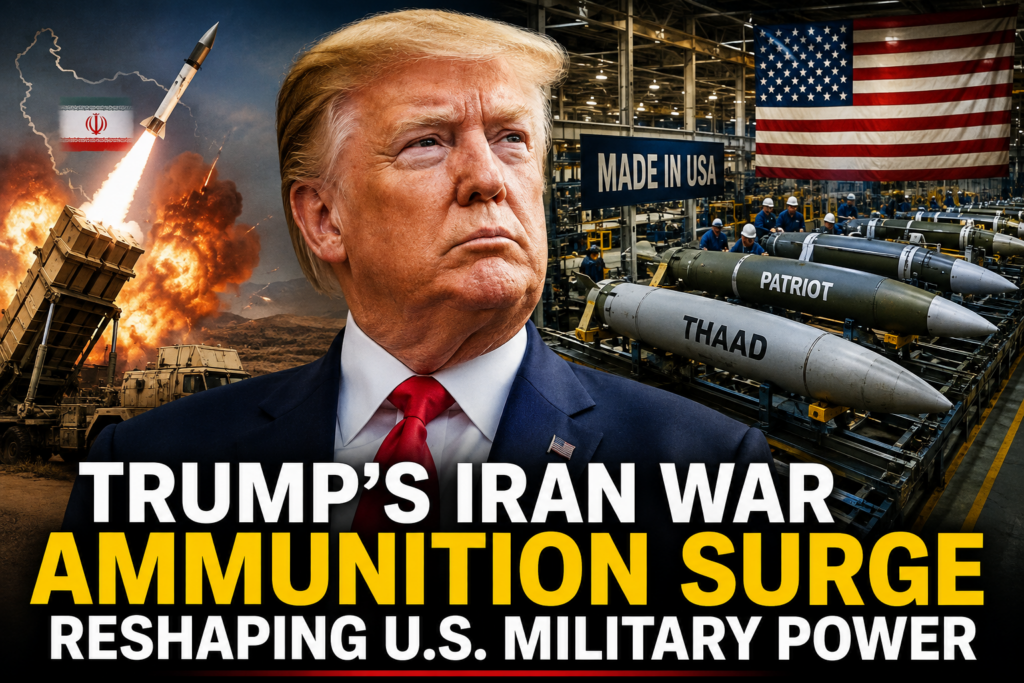
- Trump Iran war ammunition shortages have exposed critical gaps in U.S. military readiness.
- The Pentagon is forcing rapid defense production, reshaping the military-industrial complex.
- The Iran conflict is acting as a catalyst for long-term U.S. strategic and industrial reform.
WASHINGTON — The Trump administration has launched an urgent and far-reaching push to accelerate weapons production, as the ongoing Iran war exposes critical vulnerabilities in America’s military stockpiles and defense industrial base. What began as a battlefield necessity is rapidly transforming into a structural overhaul of how the United States prepares for and sustains modern warfare.
At the center of this shift is a stark reality: the Iran conflict has depleted key U.S. munitions at a pace not seen in decades. In response, the Pentagon is now pressing defense contractors to dramatically increase output, compress delivery timelines, and adopt a wartime production mindset—marking a decisive break from the slow, bureaucratic procurement systems of the past.
A recently disclosed Pentagon directive has given industry leaders just 21 days to submit plans to accelerate weapons manufacturing, signaling both urgency and strategic recalibration. Deputy Defense Secretary Steve Feinberg made it clear that “years-long development cycles are not acceptable,” underscoring the administration’s demand for immediate scalability.
War as a Strategic Stress Test
The Iran war has effectively become a real-time stress test for the United States’ military readiness. In the opening weeks alone, American forces reportedly expended hundreds of Tomahawk cruise missiles, over a thousand Patriot and THAAD interceptors, and large quantities of tactical ballistic systems. Such consumption levels have exposed the fragility of existing supply chains and revealed a mismatch between peacetime production capacity and wartime demand.
READ NEXT: US General Dropped Bombshell! US Can Not Protect Israel From Iran’s Missiles
While critics have pointed to these shortages as a sign of strategic overextension, a growing school of thought within Washington sees the crisis differently. For the Trump administration, the conflict has provided a rare opportunity to evaluate the performance of every major component of the national security apparatus under real combat conditions.
From procurement inefficiencies to industrial bottlenecks, the war has illuminated systemic weaknesses that might otherwise have remained hidden. In that sense, the Iran conflict—despite its risks—has become a catalyst for reform.
Trump Iran war ammunition shortages: A ‘Blessing in Disguise’ for Military Reform
Paradoxically, the very pressures created by the Iran war are now being framed by some policymakers as a “blessing in disguise” for the world’s leading superpower. The conflict has forced Washington to confront uncomfortable truths about its preparedness for sustained, high-intensity warfare against a capable adversary.
READ MORE: Pentagon presses defense firms to build weapons as Iran war depletes stocks
The Trump administration is leveraging this moment to push for a fundamental restructuring of the defense industrial base. The emphasis is no longer solely on technological superiority, but on production volume, speed, and resilience—factors that define success in prolonged conflicts.
This shift is already visible in the Pentagon’s deepening engagement with both traditional defense giants and emerging technology firms. Companies such as Lockheed Martin, Northrop Grumman, and Boeing are being joined by Silicon Valley players like Anduril and Palantir in a new ecosystem designed to deliver both high-end and low-cost weapon systems at scale.
The message from Washington is clear: innovation must now be matched by industrial capacity.
Industry Mobilization and Political Pressure
The administration has gone beyond policy directives to actively mobilize the defense sector. In a rare move, top executives from major defense firms and tech startups were summoned to the White House and encouraged to lobby Congress for increased defense spending.
This reflects a broader recognition that industrial expansion cannot occur without political alignment. A proposed $1.15 trillion defense budget remains stalled amid congressional divisions, creating uncertainty for long-term procurement contracts.
Yet even in the face of legislative gridlock, the Pentagon has moved forward with “framework agreements” aimed at boosting production of critical systems such as Patriot interceptors and THAAD missile defenses. While these agreements stop short of binding contracts, they signal intent and provide a roadmap for future expansion.
Some companies have already begun investing their own capital to scale production, a move that underscores both confidence in future demand and the high stakes involved.
Transforming the Rules of Warfare
Beyond immediate supply concerns, the Trump administration’s approach is reshaping the broader philosophy of military preparedness. The traditional model—characterized by lengthy development cycles and limited production runs—is being replaced by a more agile, industry-driven framework.
Defense Secretary Pete Hegseth has emphasized the need to “unleash” American industry, arguing that excessive regulation has slowed innovation and hindered responsiveness. The integration of private-sector efficiency with military requirements is now seen as essential for maintaining strategic advantage.
This transformation extends to next-generation systems, including advanced missile defenses, space-based tracking technologies, and autonomous weapons platforms. The goal is not only to replenish depleted stocks but to build a more adaptable and scalable force for future conflicts.
Strategic Implications for Global Power
The implications of this shift extend far beyond the United States. As Washington ramps up production and retools its defense industry, it is effectively redefining the global military balance.
For allies, increased U.S. output could translate into stronger security guarantees and faster access to advanced systems. For adversaries, it signals a renewed American commitment to long-term military dominance.
At the same time, the Iran war has demonstrated that even the world’s most powerful military is not immune to logistical strain. This realization may encourage other nations to reassess their own defense capabilities, potentially triggering a broader global arms buildup.
A Turning Point in U.S. Military Strategy
Ultimately, the Trump administration’s response to the Iran war represents more than a tactical adjustment—it marks a turning point in U.S. military strategy.
By forcing a confrontation with its own limitations, the conflict has driven Washington to rethink how it prepares for war in the 21st century. The focus on speed, scale, and industrial resilience reflects a recognition that future conflicts will be defined not only by technological sophistication but by the ability to sustain operations over time.
In this context, the current push for ammunition and weapons production is not merely a reaction to immediate shortages. It is part of a broader effort to “set the house in order,” ensuring that the United States remains capable of projecting power in an increasingly volatile world.
If successful, this transformation could leave a lasting imprint on the global defense landscape—cementing the Trump administration’s legacy as one that fundamentally reshaped the American military-industrial complex.
For now, the Iran war continues to test the limits of U.S. capacity. But in doing so, it may also be forging a more resilient and prepared superpower for the conflicts yet to come.