


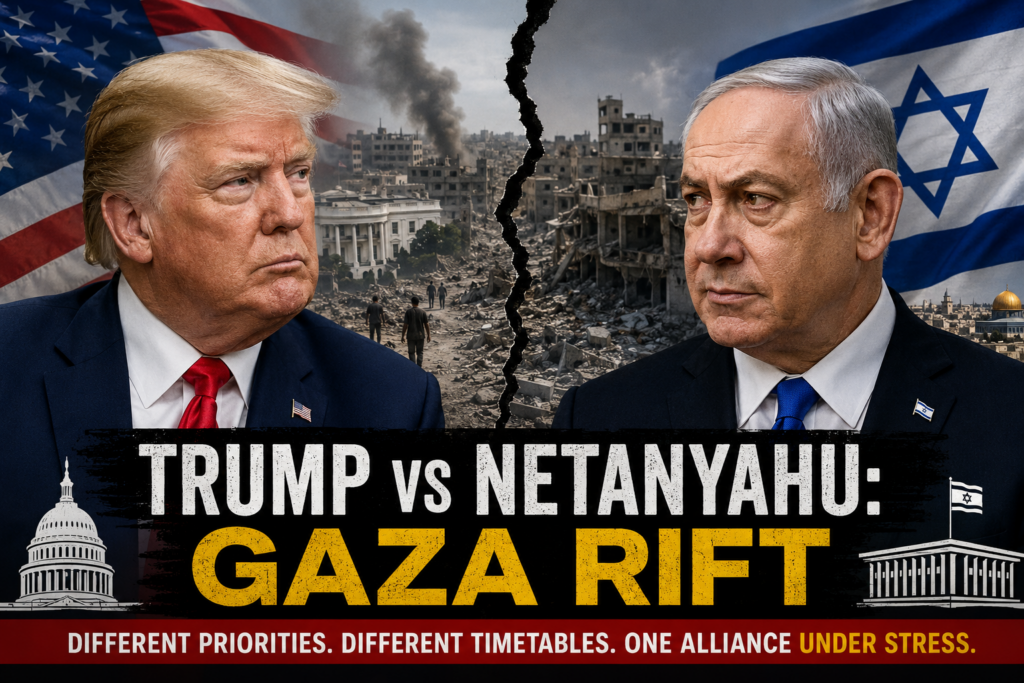
- Trump Netanyahu Gaza tensions are exposing a growing divergence between Washington’s push for de-escalation and Jerusalem’s demand for complete militant disarmament.
- Netanyahu’s political survival depends heavily on maintaining support from Israel’s right-wing coalition, limiting his ability to accept an American timetable for Gaza.
- The dispute could test the future of the US-Israel alliance and encourage Gulf states to pursue more independent regional security arrangements.
The strategic alliance between the United States and Israel remains strong, but their political priorities are increasingly diverging over Gaza.
President Donald Trump wants to demonstrate that American diplomacy can end conflicts, stabilize the Middle East, and produce tangible results. Israeli Prime Minister Benjamin Netanyahu faces a different reality. His political survival depends on convincing Israeli voters—and the right-wing coalition that keeps him in power—that Israel’s security cannot be compromised for the sake of a diplomatic timetable.
The disagreement became public after Netanyahu rejected key elements of a U.S.-backed roadmap for Gaza’s future. Washington reportedly favors a phased process in which Palestinian militant groups surrender heavy weapons and dismantle military infrastructure while Israel gradually withdraws from parts of Gaza.
Netanyahu has rejected that sequencing. His position is simple: Israeli forces should not withdraw until militant groups are fully disarmed and underground tunnel networks destroyed.
READ NEXT: Netanyahu’s Calculated Defiance: Why Israel Rejected Trump’s Gaza Plan—and What Comes Next
This is more than a procedural dispute. It reflects two different definitions of peace.
For Washington, peace increasingly means de-escalation, reconstruction, and a political framework that can be supported by Arab partners and sold to American voters. For Netanyahu, peace means ensuring that Hamas and other militant groups can never again threaten Israeli communities as they did on October 7.
The conflict between these objectives is becoming increasingly difficult to manage.
Trump’s Need for a Diplomatic Success
The Trump administration has strong incentives to move the Gaza war toward a conclusion.
Trump’s political brand has long been built around reducing America’s involvement in prolonged overseas conflicts. A continuing Gaza war risks drawing Washington deeper into a regional crisis that already involves Iran, Israel, and several Gulf states.
For the White House, Gaza is not simply an Israeli-Palestinian issue. It is part of a broader regional equation involving energy security, regional stability, and U.S. relations with Arab partners.
READ MORE: The Arab-Islamic Formula for ‘Peace’: Ignore Hamas, Blame Israel
A ceasefire followed by reconstruction and political stabilization would allow Trump to argue that American leadership achieved what military force alone could not. A prolonged conflict, however, would strengthen critics who argue that Washington remains trapped in Middle Eastern disputes despite promises to focus on domestic priorities.
With economic concerns, inflation, and energy prices remaining important political issues for American voters, Trump has every reason to reduce the number of foreign-policy crises competing for Washington’s attention.
Netanyahu’s Different Political Reality
Netanyahu faces a very different political calculation.
The Israeli right views the October 7 attacks as proof that armed groups cannot be allowed to retain military infrastructure near Israeli population centers. Any withdrawal before Hamas is fully dismantled could be portrayed as repeating past security mistakes.
For Netanyahu, accepting a U.S. timetable that requires Israeli withdrawals before complete disarmament risks alienating the political forces that sustain his government. Rejecting Washington’s approach may create friction with the White House, but challenging his coalition could threaten his political survival.
That is why Netanyahu’s public messaging matters. By insisting that Israel alone will determine when its troops leave Gaza, he is speaking not only to Washington but also to Israeli voters who demand security guarantees before any political settlement.
Trump Netanyahu Gaza Rift: The Real Battle Is Over Sequencing
At its core, the dispute is about sequencing.
Washington favors a reciprocal process in which disarmament, Israeli withdrawals, reconstruction, and political stabilization advance together.
Netanyahu’s preferred approach is different: complete disarmament first, destruction of military infrastructure second, verification third, and only then Israeli withdrawal.
The distinction may sound technical, but it is strategically significant.
If Israel withdraws before militant groups surrender their capabilities, Israeli leaders fear Hamas could claim victory and eventually rebuild. If Israel remains indefinitely, however, the diplomatic process could collapse, reconstruction could stall, and Arab governments could lose confidence in any political pathway forward.
Washington wants movement. Jerusalem wants guarantees before movement.
That is the essence of the disagreement.
The Gulf States Are Watching Closely
The dispute also has implications beyond Washington and Jerusalem.
Saudi Arabia and other Gulf states want the Gaza war to end, but they also have little interest in seeing Hamas emerge from the conflict with intact military capabilities. As a result, many Arab governments support both reconstruction and meaningful demilitarization.
A prolonged U.S.-Israeli disagreement could encourage regional powers to pursue greater strategic autonomy and develop diplomatic arrangements that are less dependent on complete American-Israeli alignment.
Such a shift would not produce an immediate rupture in regional security architecture, but it could gradually create parallel diplomatic tracks that reduce Washington’s influence over future regional negotiations.
The Alliance Is Not Breaking
Despite public disagreements, it would be premature to describe the situation as a strategic rupture.
The United States and Israel continue to share intelligence, military cooperation, and broad regional security interests. Washington remains deeply committed to Israel’s security.
The challenge is that Trump and Netanyahu are operating under different political pressures.
Trump wants a diplomatic achievement that demonstrates the effectiveness of American leadership. Netanyahu needs an agreement that his coalition can survive politically.
Both leaders are therefore pursuing objectives that are compatible in principle but increasingly difficult to reconcile in practice.
The most likely short-term outcome is continued cooperation alongside public disagreement. Trump will continue pressing for progress, while Netanyahu will continue demanding stronger security guarantees.
The greater danger lies in the future. Strategic fractures rarely begin with dramatic confrontations. They emerge gradually through disagreements over priorities, sequencing, and long-term objectives.
The Gaza debate is becoming a test not only of Trump’s diplomatic ambitions or Netanyahu’s political survival, but also of whether the U.S.-Israeli partnership can adapt to a Middle East where military victories alone no longer guarantee political solutions.
Trump wants Gaza to demonstrate American diplomatic power. Netanyahu wants it to demonstrate Israeli deterrence.
Unless both leaders can agree on what comes first—disarmament, withdrawal, or political stabilization—their alliance may face its most significant challenge not from an external adversary, but from diverging strategic priorities within the partnership itself.