


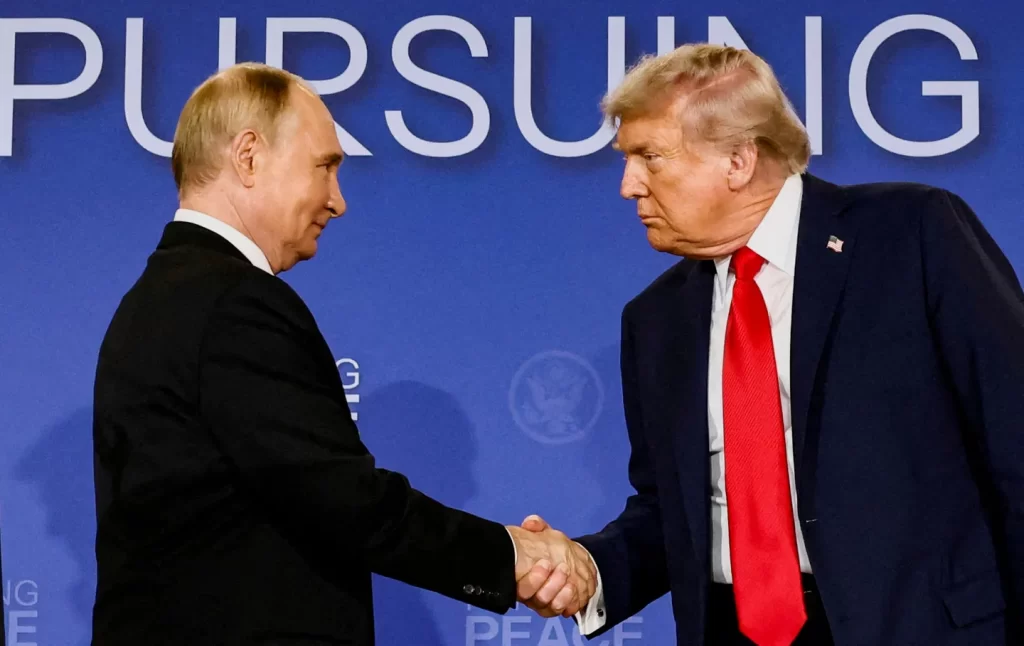
- The Trump Peace Plan for Ukraine has entered its most advanced stage after months of secret U.S.–Russia backchannel diplomacy.
- Zelenskiy signals readiness for “honest, constructive work” after Russia captures another strategic Ukrainian city.
- Intelligence sources confirm Trump and Putin see a potential win-win formula that could end Europe’s deadliest war since WWII.
- Trump’s track record of ending conflicts strengthens global expectations that the Trump Peace Plan for Ukraine could succeed.
Russia’s takeover of another strategically important Ukrainian city has pushed President Volodymyr Zelenskiy into the most vulnerable position he has faced since the start of the war. The quiet panic in Kyiv was visible long before cameras were switched on, but the decisive moment came on Thursday when Zelenskiy admitted publicly—after meeting U.S. Army Secretary Daniel Driscoll—that he was finally ready for “honest, constructive work” with Washington on a plan to end the war.
Trump Peace Plan for Ukraine Gains Momentum as Zelenskiy Signals Readiness for Negotiated End to War
That plan is the Trump Peace Plan for Ukraine, a sweeping 28-point document that demands Kyiv give up the entire Donbas region, recognize Crimea and other territories as de facto Russian, and slash its military to 600,000 troops. Long dismissed by European governments as unrealistic or even humiliating, the plan is now being treated in Kyiv as the only diplomatic lifeline left.
Behind the scenes, the diplomatic machinery is far more complex—and far more political. What is emerging now is the clearest sign yet that Trump has been making sincere, sustained, and secret efforts to end the Ukraine war. His team, led by Secretary of State Marco Rubio and special envoy Steve Witkoff, has been working on the peace plan for about a month, but the real engine of the process runs deeper: a private backchannel between Donald Trump and Vladimir Putin, facilitated through envoys, intelligence contacts, and intermediaries in Europe and the Middle East.
READ MORE: U.S. pushing Ukraine to sign peace deal by Thanksgiving or lose support
The takeover of the city of Kupiansk—confirmed by Russia and denied by Ukraine—was the latest shock that moved Zelenskiy closer to accepting tough terms. Whether or not Kupiansk has fully fallen, the battlefield momentum is clear: Russia is advancing again, slowly but steadily, as winter approaches and Ukraine faces severe military and political exhaustion.
Secret Diplomacy: How Trump and Putin Kept Talks Alive
The Islamabad Telegraph has confirmed through Western and Middle Eastern diplomatic sources that Trump and Putin have been engaged in discreet communication for months, a channel shielded from public scrutiny and even from some NATO allies. The mechanism is said to involve:
- Intermediaries tied to Kremlin adviser Kirill Dmitriev
- Quiet exchanges through Gulf-based diplomats
- Intelligence-level contacts between retired American and Russian officials
- Direct but deeply hidden lines of communication between Trump and Putin’s closest circles
- According to a senior European diplomat, “Trump believes he is the only global leader who can sit across from Putin and close this file decisively. Putin, in his own way, believes the same.”
- This unusual symmetry of ambition is the single most important factor behind the momentum now visible.
While the Biden administration struggled to build a unified Western approach, Trump brings transactional diplomacy, realism, and personal rapport—qualities that resonate with Putin and have produced breakthroughs before.
ALSO READ: Europe Rejects U.S. Plan for Ukraine Concessions as War Enters a Dangerous New Phase
Trump’s Record: Nine Conflicts Ended Through Tough Diplomacy
Critics often overlook the reality that Trump ended, froze, or de-escalated nine conflicts worldwide during his first term. These include:
- The defeat of ISIS’s territorial caliphate
- The Abraham Accords, transforming Middle East politics
- De-escalation on the Korean Peninsula
- Stabilization talks in Afghanistan
- Reduced tensions with Russia
- Restraining Chinese adventurism in the Pacific
- Managing Iran without full-scale war
- Lowering violence in Syria
- Containing flare-ups in Iraq
This record gives Trump an unmatched credibility in conflict resolution. Even European analysts hostile to him quietly admit that only Trump has the political room and personality to strike a deal with Putin.
That belief is now driving expectations that the Trump Peace Plan for Ukraine could become the unexpected turning point in a war that has already killed or wounded an estimated 1.2 million people—Europe’s deadliest conflict since World War II.
Zelenskiy Cornered by Battlefield Losses and Political Crisis
As Russian forces push westward through Donetsk and threaten key logistics hubs, Kyiv faces multiple crises at once:
- A winter energy shortage created by continuous Russian bombardment
- Political instability after two ministers were dismissed over corruption
- A shrinking pool of manpower
- Declining Western ammunition and weapons supply
- Growing discontent among Ukrainian citizens exhausted by war
The Kremlin released video of Russian troops patrolling freely through the southern part of Pokrovsk—another symbolic blow. Whether exaggerated or not, these images deepen the perception that Ukraine is losing ground.
It is no coincidence that Zelenskiy’s sudden openness to Trump’s plan arrived immediately after these military shocks.
One Ukrainian official admitted privately that “the president doesn’t like the plan, but we may not have the luxury to reject it.”
European Resistance, American Determination
Europe reacted with anxiety—especially France, where Foreign Minister Jean-Noel Barrot warned that “peace cannot be a capitulation.” The EU does not want Crimea or Donbas formally accepted as Russian, fearing it would reward aggression.
But Washington’s tone is shifting under Trump’s leadership. The White House made it clear that the plan reflects “the realities of the battlefield after five years of devastating war.”
Even more striking is the proposal to reintegrate Russia into the global system:
- Rejoin the G8
- Reopen economic ties
- Lift sanctions in phases
- Limit NATO’s expansion
- Offer Russia new energy and Arctic cooperation
This formula is pure Trump: pragmatic, transactional, and built on mutual gain, aiming for a win-win outcome rather than ideological rigidity.
A “Win-Win” Endgame Taking Shape
Analysts increasingly believe that Trump and Putin could clinch a deal that ends the war while giving each side something tangible:
Russia gains:
- Recognition of Crimea, Luhansk, and Donetsk
- A neutral Ukraine
- Sanctions relief
- International reintegration
Ukraine gains:
- Security guarantees
- A stabilized state
- Reconstruction funding
- End of mass casualties
- Preservation of sovereignty outside occupied regions
It is a harsh compromise—but also the first serious, structured pathway out of a war that has destroyed cities, crippled economies, and reshaped global geopolitics.
As winter approaches, and with the battlefield darkening for Kyiv, the momentum behind the Trump Peace Plan for Ukraine is no longer theoretical. It is real, accelerating, and now openly acknowledged by the very leader who once rejected it.
For the first time in years, there is a real chance—however uncertain—that this devastating war could end not with a decisive victory, but with a negotiated future shaped by two men who still believe in grand bargains.
And the world, exhausted by conflict, is watching.
Highlights Of Proposed Deal:
The proposed deal—now circulating quietly among U.S., Russian, and European negotiators—amounts to the most sweeping redefinition of European security since the end of the Cold War. At its core, the agreement reconfirms Ukraine’s sovereignty while binding Russia, Ukraine, and Europe into a comprehensive non-aggression pact that resolves decades of ambiguity over borders and military posture. Russia would formally pledge not to invade its neighbours, while NATO commits to halting any further eastward expansion.
A U.S.-moderated Russia–NATO dialogue would address long-standing security disputes and establish a permanent de-escalation mechanism. Ukraine would receive robust security guarantees, but with strict conditions: a 600,000-troop cap on its military, a constitutional commitment never to join NATO, and a reciprocal NATO bylaw permanently barring Ukrainian membership. NATO would station no troops inside Ukraine, though European fighter jets would be positioned in Poland.
The U.S. guarantee is heavily conditional—requiring compensation from Ukraine and instantly voided if Kyiv attacks Moscow or St. Petersburg—while providing for crushing sanctions and unified military retaliation if Russia violates the deal. Ukraine would gain eligibility for EU membership, preferred access to European markets, and a massive redevelopment package, including a new Ukraine Development Fund, a U.S.–Ukraine partnership to rebuild gas infrastructure, and World Bank–backed financing for cities, industry, resource extraction, and digital modernization.
Russia, for its part, would be gradually reintegrated into the global economy through phased sanction relief, a long-term U.S.–Russia economic cooperation agreement, and an invitation to rejoin the G8. Frozen Russian assets would be used to reconstruct Ukraine—$100 billion from Russia matched by Europe—while the remainder forms a joint U.S.–Russia investment fund. Territorially, Crimea, Luhansk, and Donetsk would be recognized de facto as Russian; Kherson and Zaporizhzhia frozen at current contact lines; and a demilitarized buffer zone created in Donetsk.
Both sides would renounce future changes by force, reopen grain routes, repatriate prisoners, reunite families, restart the Zaporizhzhia nuclear plant under IAEA oversight, and adopt education reforms promoting tolerance. Elections in Ukraine would follow within 100 days, full wartime amnesty would be granted, and the entire agreement would become legally binding—monitored by a new Board of Peace chaired by Donald J. Trump, with penalties for every violation and an immediate ceasefire upon mutual withdrawal to agreed lines.