


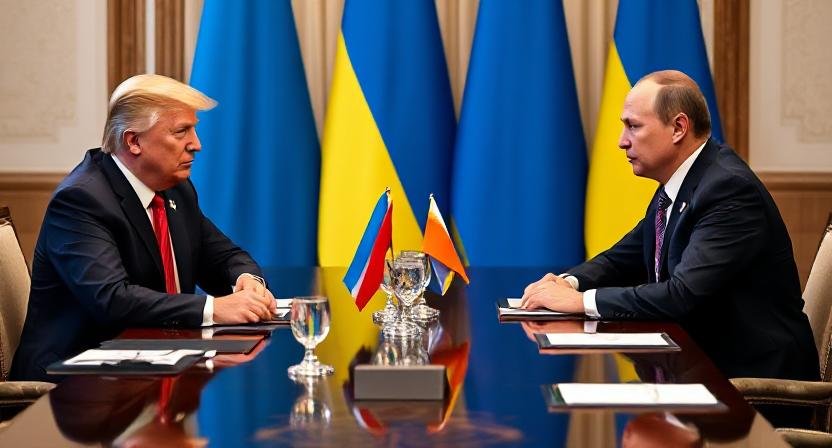
- President Trump meets Vladimir Putin in Alaska in a high-voltage summit that could reshape Ukraine’s fate and the world order.
- Putin arrives weakened as U.S. economic, energy, and diplomatic pressure puts Moscow on the defensive.
- Ukraine warns against territorial concessions as Trump signals readiness to escalate pressure if peace talks stall.
- The Alaska meeting could redefine U.S.-Russia relations and alter global power balances for years to come.
The world’s geopolitical compass may be about to shift. On Friday, U.S. President Donald J. Trump will sit across the table from Russian President Vladimir V. Putin at Joint Base Elmendorf-Richardson in Alaska for a summit shrouded in secrecy, urgency, and extraordinary stakes. Arranged in barely a week, the meeting is not just about ending a war — it’s about redefining the global order.
For months, Washington and Moscow circled each other with suspicion. Since Russia’s 2022 invasion of Ukraine, successive U.S. administrations have treated Putin as a global pariah. The fact that Trump is willing to meet him at all is seen by Moscow as a breakthrough — but the real story may be that Trump, more than Putin, holds the leverage this time.
Exclusive: Alaska Air Base Becomes Nerve Center for Trump–Putin Confrontation
The former real estate mogul, who campaigned on the promise of ending the Ukraine war “within 24 hours” of taking office, is positioning himself to do what neither Biden nor Europe could achieve: force Putin into concessions under the glare of world attention. The White House insists this is a “listening exercise,” but few doubt that Trump is arriving in Alaska with a dealmaker’s playbook — and a clear awareness that the balance of power has shifted in America’s favor.
Why Now — and Why Trump Holds the Cards
Putin comes to Alaska weakened. His battlefield gains have stalled, his economy is under strain despite energy revenues, and his hopes of dividing the West have been dashed by renewed NATO cohesion. Even close partners like India are facing U.S. tariff pressure for buying Russian oil, while China has quietly signaled it will not underwrite Moscow’s war indefinitely.
READ MORE: What’s at Stake at the Trump-Putin Summit in Alaska
Trump has tightened the noose: threatening sweeping new sanctions, raising tariffs on Indian imports, and openly questioning whether Russia can survive another year of war at current oil prices. Just last week, he told CNBC, “Putin will stop killing people if you get energy down another $10 a barrel” — a pointed reminder of America’s ability to weaponize global markets.
ALSO READ: From Standoff to Handshake: New Dawn in India–China Relations
And unlike past U.S. presidents, Trump thrives in unpredictable, high-pressure environments. His abrupt decision to move forward with this summit caught European capitals off guard, but it also forced Putin into a reactive position. The Kremlin requested the meeting, not the other way around — a telling sign of where the urgency lies.
What’s at Stake — Ukraine, Europe, and the World Order
This is not just another diplomatic photo-op. The Alaska talks are set against a backdrop of exhausted armies, collapsing infrastructure, and a Europe increasingly alarmed at the prospect of a long war on its borders.
European leaders joined a Trump-hosted call with Ukrainian President Volodymyr Zelensky this week, hammering out five core principles: a cease-fire first, no land swaps before peace talks, security guarantees for Kyiv, NATO membership left open for the future, and harsher sanctions if Russia drags its feet. But Ukraine will not be at the table in Alaska — a fact that has left Kyiv scrambling to ensure it isn’t sidelined.
Zelensky has been blunt: “Talks about us without us will not work.” But privately, officials in Kyiv know Trump’s personal diplomacy could be their best chance to break the deadlock, provided he resists Putin’s demands for territorial concessions.
The Russian offer on the table — freezing current frontlines and forcing Ukraine to cede all of Donbas — is a nonstarter for Kyiv and a potential trap for Washington. Trump, aware of this, has hinted that any deal must come with ironclad enforcement mechanisms. Sources close to the White House say he has prepared “multiple contingencies” to pressure Moscow, including sanctions escalation and targeted energy price manipulation.
The High-Voltage Optics
The summit setting itself is symbolic. Anchorage is halfway between Washington and Moscow, but also a forward base of U.S. military power in the Arctic — a region where Russia has sought dominance. The two leaders will begin with a private, interpreter-only session, followed by delegation-level talks and a working breakfast. The choreography echoes the 1945 Yalta Conference in its ambition — but this time, it is America, not Russia, dictating the tempo.
Karoline Leavitt, the White House press secretary, called the meeting a “chance for President Trump to assess President Putin’s seriousness.” But officials close to Trump say he is already thinking beyond Ukraine — to rebalancing U.S.-Russia relations in a way that could weaken Beijing’s grip on Moscow and reshape global alliances.
The Risks and the Rewards
If Trump emerges with a credible path to cease-fire, he could claim a historic diplomatic win — one that would resonate in capitals from Brussels to Beijing. It would also bolster his domestic image as a president who delivers results where others failed.
If Putin resists, Trump has made clear there will be “very severe consequences” — signaling that he is prepared to escalate economic, diplomatic, and even military pressure. Either way, the Alaska summit will be a defining moment in Trump’s second term, with ripple effects that could outlast both leaders.
In the end, this is more than a meeting. It’s a contest of willpower, strategy, and narrative. For Putin, it’s about breaking isolation. For Trump, it’s about proving that America can still bend history — and perhaps win a Nobel Prize along the way.
The world will watch, minute by minute, as two of the most unpredictable figures in modern politics face off. By Saturday morning, Ukraine’s fate, Europe’s security, and the architecture of the post-Cold War order could look very different.
And if Trump has his way, it will be Washington — not Moscow — setting the terms.