


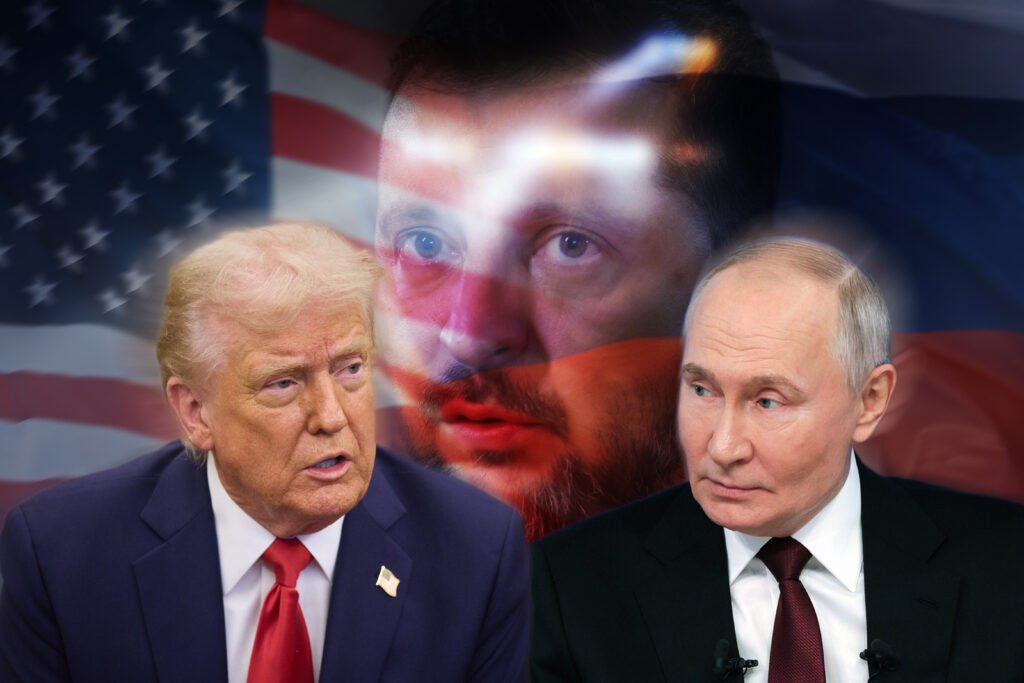
- Trump and Putin’s August summit in Alaska rekindled hopes of U.S.–Russia rapprochement despite diplomatic setbacks.
- Both leaders have strong incentives: Trump seeks legacy, Putin seeks relief from sanctions and attrition.
- Russian signals of compromise, including nuclear arms control offers, show the “Spirit of Alaska” is alive.
- The war’s fate may hinge on whether Trump and Putin seize this fleeting moment for peace.
On a crisp August morning, at Joint Base Elmendorf-Richardson in Anchorage, Donald Trump stepped onto the tarmac with the swagger of a man who thrives on spectacle. Waiting for him, surrounded by an entourage of aides in dark overcoats, was Vladimir Putin, whose expression was more controlled but no less deliberate. They shook hands—firm, lingering, almost theatrical—and in that brief clasp, cameras captured something that both men seemed intent on projecting: the possibility of a thaw.
Behind them, American fighter jets lined the runway, a display of military muscle in a place where geography itself speaks to the intimacy of proximity. Just across the Bering Strait, Russia’s eastern coast stretches toward Alaska like a reminder that, for all their differences, Washington and Moscow remain neighbors. The symbolism was not lost on either side. A Russian aide, later speaking to Kommersant, described it as “a handshake at the edge of the world.” American officials were less poetic, but no less aware of its resonance.
The summit, quickly branded the “Spirit of Alaska,” was meant to signal a break from years of deterioration. Trump, now returned to power, sought to redefine himself as a peacemaker, not merely the disruptor of old. Putin, locked in a grinding war in Ukraine, needed to show his people—and the watching world—that dialogue with America was still possible. For a few hours, under the glare of cameras and the scrutiny of translators, they did just that.
A War Waiting for Peace
The timing was brutal. In Ukraine, the war showed no sign of relenting. Whole neighborhoods in Kyiv were darkened after Russian missiles pounded energy grids. Ukrainian forces, bolstered by Western aid, dug in along defensive lines that stretched across the country’s battered east. Russia, battered by sanctions, leaned on Iran and North Korea for weapons, while Europe fretted over gas supplies and inflation. The war was no longer just a regional conflict; it was a wound that infected the entire global system.
For Trump, the war was an opportunity and a liability. He had campaigned on promises to end America’s “forever wars” and claimed he could stop the fighting in Ukraine “within 24 hours” if given the chance. Now in office, the promise haunted him. His base expected boldness; his critics expected failure. Ending the war—or even nudging it toward resolution—would secure his place in history. Fumbling it could leave him remembered as the man who presided over Europe’s unravelling.
READ MORE: With flattery and warnings, Russia tries to revive ‘spirit of Alaska’ with US
Putin’s calculus was equally stark. Russia had failed to take Kyiv, failed to force a quick capitulation, and now found itself entangled in a war of attrition. Casualties mounted, and while propaganda papered over the losses, the reality was clear: Moscow needed a way out that did not look like surrender. If Trump could deliver a settlement—neutrality for Ukraine, limits on NATO’s reach, perhaps the easing of sanctions—Putin could frame it as a strategic victory.
Mixed Messages
In the weeks after Alaska, the rhetoric wavered. Sergei Ryabkov, Russia’s deputy foreign minister, declared the momentum lost, warning that “the cracks have reached the foundation” of U.S.–Russia relations. His tone was bleak, almost fatalistic, as if the summit had been a mirage. Yet Putin himself struck a more nuanced note. “These are complex issues that require further study,” he said. “But we remain on the basis of the discussion that took place in Anchorage.”
ALSO READ: Historic but Familiar: How Takaichi’s Ascent Could Reshape Japan’s Balancing Act Between Washington and Beijing
For seasoned Kremlin-watchers, this divergence was telling. Moscow often plays good cop, bad cop—bluster from diplomats paired with measured pragmatism from Putin. The message was less about despair than about leverage: Russia was ready to talk, but only if Trump reciprocated.
Trump, true to form, responded with contradictions of his own. One moment he dismissed Russia as “a paper tiger,” another he urged Zelenskiy and Putin to meet face to face. He floated the idea of sending Tomahawk missiles to Ukraine, provoking fury in Moscow, only to pivot days later to talk of peace. To diplomats accustomed to precision, the inconsistency was maddening. To Trump’s supporters, it was simply his style—the art of the unpredictable.
History’s Ghosts
Every U.S.–Russia summit lives in the shadow of history. Reykjavik, 1986, when Ronald Reagan and Mikhail Gorbachev nearly abolished nuclear weapons but faltered at the brink. Malta, 1989, when George H.W. Bush and Gorbachev declared the Cold War ended, only to watch mistrust creep back. Helsinki, 2018, where Trump and Putin sat together, their camaraderie so obvious it sparked outrage in Washington.
The Spirit of Alaska, then, was less an invention than a continuation—a reminder that great powers, even when locked in enmity, occasionally stumble upon moments when peace feels possible. The question is whether they seize them.
The Calculus of Convergence
Both men have reasons to try. Trump, despite his bluster, is transactional. He wants results he can claim as victories, and nothing would be bigger than ending the most devastating European war since 1945. Putin, despite his ruthlessness, is pragmatic. He knows Russia cannot sustain endless attrition, nor can it afford total isolation from the West.
Their incentives, oddly, align. Trump wants legacy. Putin wants relief. Europe wants stability. Ukraine wants survival. The alignment does not guarantee peace, but it creates conditions in which peace is no longer unthinkable.
Already, there are hints of compromise. Russian officials have whispered about concessions agreed in Alaska, contingent on U.S. pressure on Kyiv and Europe. Putin has offered to maintain nuclear arms limits if Washington reciprocates. Kremlin aides, in overt gestures, have praised Trump’s allies in the U.S., suggesting a cultural kinship that transcends politics.
The Obstacles
And yet, obstacles remain daunting. Trump’s musings about arming Ukraine with Tomahawks provoked immediate threats from Moscow. Putin warned it would “destroy what is left of U.S.–Russia ties,” while Russian lawmakers vowed to strike U.S. launch sites. Ryabkov hinted Russia could return to nuclear testing if America did. These warnings are not idle; they reflect the fragility of a dialogue balanced on the edge of escalation.
Domestic politics, too, pose risks. In Washington, Trump faces hawks who view any concession to Russia as betrayal. In Moscow, Putin must navigate hardliners who see compromise as weakness. Diplomacy, in such climates, requires not only boldness but a tolerance for domestic backlash.
The Window of Opportunity
Still, the possibility lingers. “History rarely gives leaders the luxury of perfect timing,” a former American diplomat told me. “It gives them moments—messy, imperfect, fleeting. Alaska was one of those.”
The Spirit of Alaska has not vanished; it flickers in cautious words from Putin, in Trump’s unpredictable calls for talks, in the simple fact that neither leader has closed the door. Wars often end not when sides are ready but when leaders decide they must.
If Trump and Putin summon the will, Ukraine’s war could end sooner than anyone dares imagine. It would not be neat, nor universally celebrated. But it would mean lives saved, Europe steadied, and a reminder that even in an age of cynicism, diplomacy can still surprise.
The handshake in Alaska was more than theater. It was a signal that two men, so often dismissed as enemies of peace, might yet write themselves into history as its authors. Whether they choose to do so remains, as always, in their hands.