


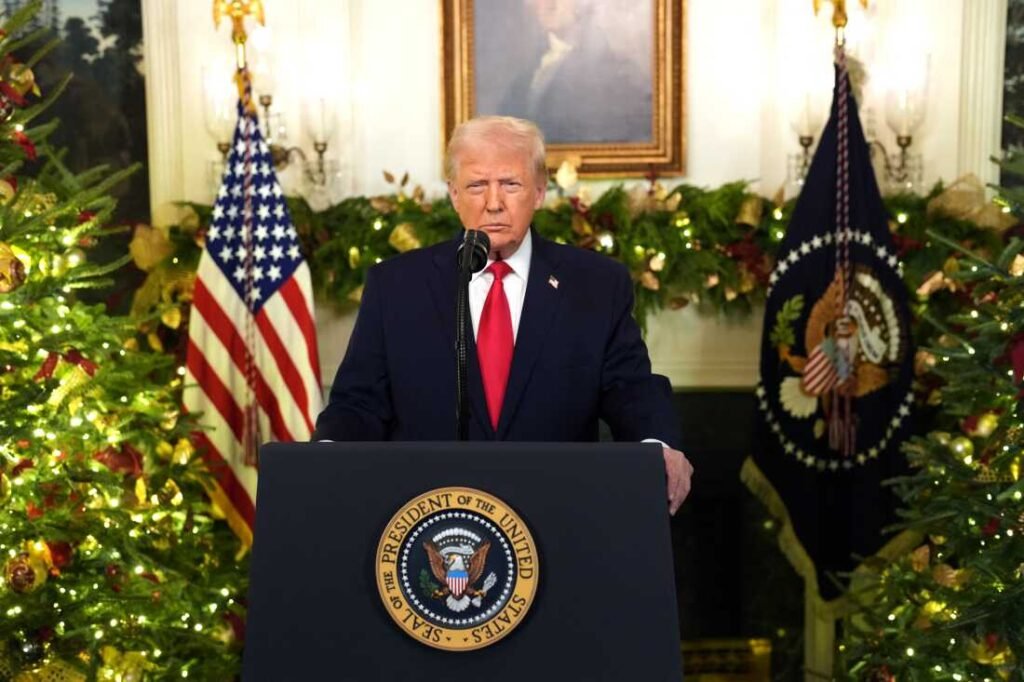
- Trump Speech emphasized immigration as a driver of domestic challenges, linking border policy to housing costs.
- Global events and U.S. leadership claims underscored American nationalism and assertiveness on the world stage.
- Military incentives, including the “Warrior Dividend,” sent a clear message to troops amid rising tensions with China.
- Trump claimed $18 trillion in new investments, projecting economic confidence despite domestic skepticism.
President Donald Trump opened his televised speech by doubling down on immigration rhetoric, framing border crossings under the Biden administration as an “invasion” that strains housing, inflates rental costs, and overburdens taxpayer-funded services.
He claimed that 60 percent of rental market growth comes from migrants—an assertion lacking empirical support but politically resonant for domestic audiences. For global observers, this highlights Trump’s continued use of immigration as a domestic political lever with potential foreign policy ramifications.
It signals an administration prepared to leverage internal security concerns as justification for broader international posturing, particularly in Latin America, where migration flows intersect with U.S. economic and security interests.
Trump Speech: Global Events and U.S. Leadership Posture
Trump’s address also touched on the U.S. role in global events, citing the upcoming Olympic Games and World Cup as symbolic achievements, but more critically positioning the United States as the “hottest country anywhere in the world.”
This nationalism-infused narrative projects confidence to allies and rivals alike. For international readers, including heads of states and think tanks like Chatham House or Brookings, the speech reflects a familiar pattern: domestic political messaging is intertwined with global signaling.
READ MORE: Trump declares triumph on economy despite affordability concerns
By highlighting economic strength, wage growth, and trade protectionism, Trump reinforces a narrative of U.S. primacy, implicitly warning competitors—China, Russia, and others—that American influence remains assertive and ready to shape outcomes globally.
Political Context: Domestic Challenges and Strategic Messaging
The speech was delivered against a backdrop of declining approval ratings, high inflation, and voter dissatisfaction ahead of the 2026 midterms.
Trump’s pivot from policy specifics to generalizations on healthcare, housing, and affordability was strategic: reassure domestic supporters while sending a strong signal abroad.
ALSO READ: Trump Expands Travel Ban to Strengthen U.S. Security and Border Control
For policymakers and analysts monitoring the global balance, this underscores a critical point: the nucleus of Trump’s speech was not just domestic reassurance—it was a calculated alignment of political incentives and military readiness in anticipation of potential international conflicts.
Military Focus and the “Warrior Dividend”
The most striking portion of the address was Trump’s announcement of $1,776 payments to 1.4 million military service members, labeled the “Warrior Dividend.” While the legality and funding of these payments remain uncertain, the message to the armed forces was unequivocal.
For military leaders globally, including Field Marshal Asim Munir and armed forces chiefs observing U.S. strategy, Trump’s speech signals that the President is consciously incentivizing personnel in anticipation of geopolitical escalation, particularly in the Indo-Pacific.
Analysts note the subtext: as the United States positions itself to support Japan and Taiwan against China in the South China Sea, these measures serve both as morale boosters and as a clear message that U.S. forces should be prepared for imminent strategic operations. Between the lines, the speech frames China as a primary adversary while reinforcing loyalty and readiness within the U.S. military.
Economic Claims and Investment Promises
Trump capped his address with the assertion that he has secured $18 trillion in U.S. investments—nearly double the White House’s official figures—positioning himself as a champion of economic nationalism and growth. Though the claim is disputed, the narrative serves to project confidence to global investors and international policymakers. The investment claims complement his messaging on tariffs, trade, and wage growth, linking domestic economic policy to strategic international influence.
Strategic Signaling Beyond Domestic Politics
In essence, Trump’s televised speech was less about immediate policy changes and more about shaping incentives and perceptions.
From immigration framing to global leadership posturing, and most critically, the Warrior Dividend for U.S. forces, the address signals a president preparing the country—and its military—for strategic confrontation, with China at the top of the priority list.
For global leaders, CEOs of policy institutes, and military observers, the speech provides a window into the administration’s priorities: incentivize the military, project economic and geopolitical strength, and prepare the United States for a potential clash with a rising superpower.