


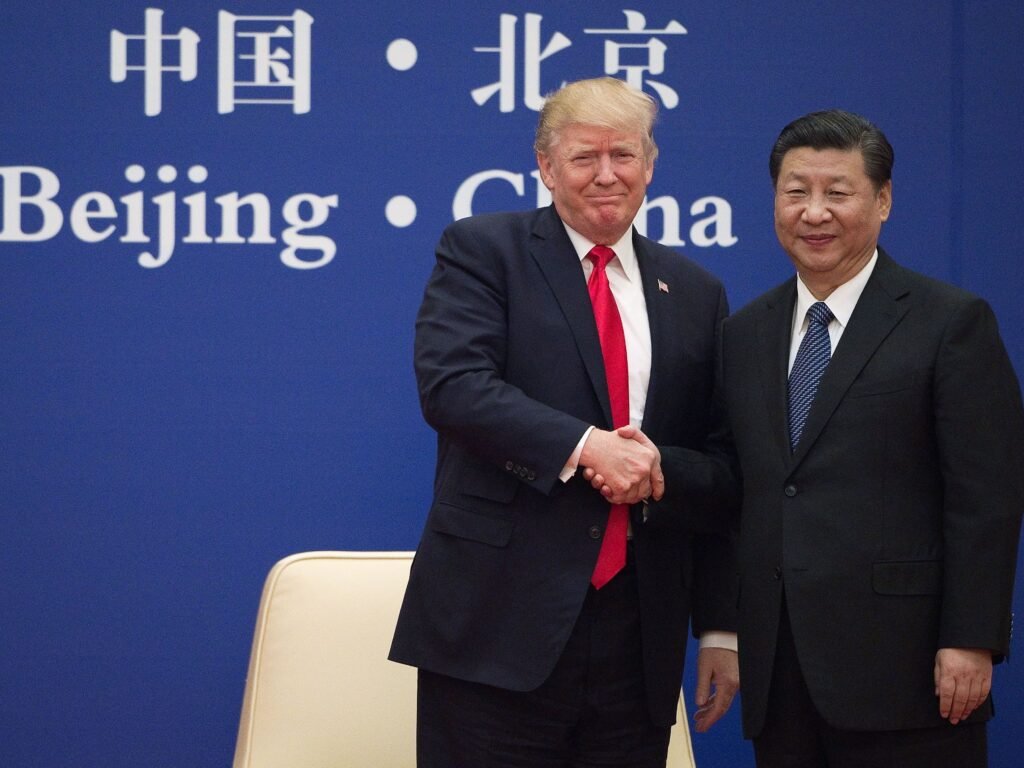
- Trump and Xi will meet amid surging U.S.–China tensions over rare-earth restrictions and new tariffs.
- Xi’s team has crafted a “Trump 2.0” strategy — mixing personal flattery with hard economic leverage.
- The Seoul meeting tests whether transactional diplomacy can avert a trade rupture.
- Both leaders need a symbolic win — but their definitions of victory differ dramatically.
When Donald Trump and Xi Jinping sit face-to-face next week in Seoul, the world’s most powerful autocrat and its most unpredictable populist will test whether their competing visions can coexist — or collide.
The meeting, to be held on the sidelines of the Asia-Pacific Economic Cooperation summit, is no routine photo opportunity. It comes after weeks of trade escalation, tit-for-tat sanctions, and new export bans that have left markets uneasy and diplomats scrambling. The political choreography of the encounter — Trump’s first with Xi since reclaiming the White House — has been engineered with precision in both capitals. Yet beneath the ceremonial handshakes lies a duel over who writes the rules of global commerce in the twenty-first century.
The trigger for the latest rupture was China’s October decision to tighten curbs on exports of rare-earth minerals — the irreplaceable elements used in everything from iPhones and electric vehicles to fighter jets. With Beijing refining nearly 90 percent of the world’s supply, the move landed like a geopolitical thunderclap. It was retaliation, Beijing said, for Washington’s new restrictions on tech exports to companies tied to Chinese state firms. But the timing was unmistakable: a calculated show of leverage before the leaders’ meeting.
Is Trump Mending Ties with China? Ice Melts as Xi Jinping Receives Unprecedented Invitation
Trump, who has never shied away from brinkmanship, immediately threatened 100-percent tariffs on Chinese goods. Yet in the same breath, he declared confidence that he and Xi would “come out very well, and everyone’s going to be happy.” The contradiction defines the Trumpian approach to diplomacy — intimidation laced with an open invitation to deal.
China’s Trump Strategy 2.0
Inside Zhongnanhai, Xi’s top advisers have spent months designing a bespoke playbook for handling Trump’s second term. The first rule: flatter the man, not the system. The second: hit harder when hit, but keep the door to negotiation ajar. It is a strategy drawn from Trump’s own “maximum pressure” diplomacy — a mix of charm and coercion designed to keep opponents guessing.
READ MORE: Trump to meet Xi in South Korea as part of Asia swing
During Trump’s first presidency, China was often caught off balance by his unpredictable tariff announcements and Twitter-driven policymaking. This time, Xi intends to project the same volatility Trump once weaponized. His rare-earth restrictions, Beijing insiders say, were meant to remind Washington that China still holds powerful economic chokepoints. At the same time, Xi offered a symbolic concession: a willingness to discuss the future of TikTok, the video-sharing app Trump once targeted, portraying the move as a goodwill gesture.
The objective is psychological as much as economic — to appeal to Trump’s self-image as a dealmaker who responds to respect and strength in equal measure. “Xi believes Trump admires toughness,” said a former senior U.S. diplomat familiar with Chinese policymaking. “So Beijing is giving him toughness — but calculated toughness.”
Fentanyl, Tariffs, and the Politics of Pain
For Trump, domestic politics drive the agenda. His team sees China both as a convenient adversary and a potential stage for demonstrating control. The White House has blamed Beijing for failing to curb exports of fentanyl precursors that feed America’s opioid crisis, and Trump says it will be the first question he asks Xi. Yet, as officials quietly admit, the fentanyl issue is also a tariff issue: Washington is using it to justify higher duties on Chinese imports under the banner of national security.
ALSO READ: The Trump-Xi Call: A Tactical Thaw in a Strategic Freeze
Behind this public posture lies a deeper concern — that Beijing’s rare-earth stranglehold could cripple key U.S. industries. That’s why Washington recently announced a $3 billion joint venture with Australia to secure alternative sources of critical minerals. But even with such moves, decoupling remains elusive. The U.S. still depends on Chinese supply chains, while China remains reliant on American semiconductors and jet engines. Mutual vulnerability has become the new balance of power.
Xi’s Leverage and Its Limits
Yet Beijing’s heavy-handed tactics carry risks. By weaponizing trade, Xi has alarmed not just Washington but also allies in Tokyo, Brussels, and Canberra. Japan and South Korea — both key APEC participants — are quietly accelerating their efforts to diversify rare-earth imports, while the European Union is crafting a “critical minerals act” aimed at ending dependence on China. What Beijing sees as leverage, others see as coercion.
Trump’s advisers are exploiting that perception. Treasury Secretary Scott Bessent and National Security Council officials have argued that Beijing’s export controls prove the need for a united Western response. Even hawks sidelined during Trump’s first term, such as Peter Navarro, now find their warnings vindicated.
Still, the president himself resists any strategy that boxes him in. His foreign policy thrives on spectacle and surprise, not bureaucratic process. “Deals are made between leaders, not ministries,” Trump reportedly told aides this month — a statement that perfectly captures his instinctive belief that diplomacy is personal theater.
The Seoul Test
In Seoul, both leaders arrive with different clocks ticking. Trump wants to deliver economic calm before the 2026 midterms; Xi seeks to show his domestic audience that he can stare down the United States and still command respect. The chemistry between them — the blend of ego, calculation, and mutual suspicion — will determine whether this meeting softens the rhetoric or triggers another round of retaliation.
Even a small breakthrough — perhaps an agreement to pause new tariffs or open new talks on tech exports — could stabilize markets and buy time. But the structural rivalry remains. Trump’s “America First” economics and Xi’s vision of a self-reliant, China-centric order are ideologically irreconcilable.
If the Seoul summit ends with smiles and vague promises, don’t mistake it for détente. It will more likely mark a tactical pause in a long-term struggle — a cold peace born of exhaustion rather than trust.
In an age when the world’s balance of power hinges on rare earths, fentanyl precursors, and semiconductor chips, the Trump–Xi handshake will symbolize less the end of conflict than the start of a new, more sophisticated competition. Whether the ice melts or merely hardens into glass will depend not on what is said in Seoul — but on what each leader decides the morning after.