


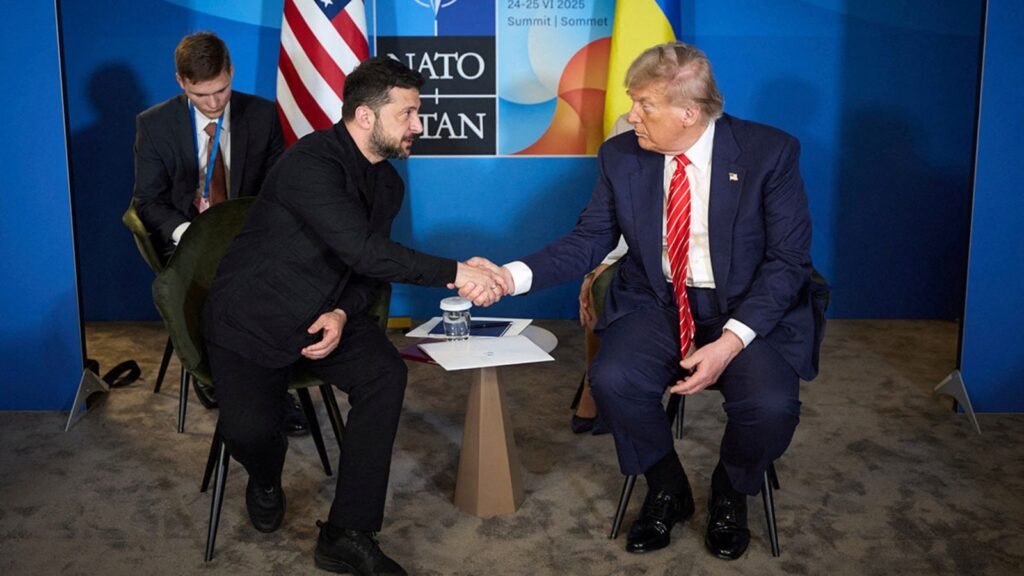
- Trump said Ukraine can win back all of its territory, calling Russia’s war “aimless.”
- Zelensky praised Trump as a “game changer,” saying he now grasps the battlefield reality.
- Moscow bristled as Trump mocked its military as a “paper tiger.”
- Trump urged NATO allies to shoot down Russian aircraft if they violate airspace.
At the United Nations this week, President Donald Trump delivered the kind of diplomatic surprise that only he could conjure: for the first time, he declared that Ukraine could win back all of its lost territory. Coming from the man who once floated the idea of “land swaps” with Russia, this was a striking pivot—and one that is already reshaping perceptions in Moscow, Kyiv, and Washington alike.
Having reported on this war from Kyiv’s bunkers, Moscow’s press briefings, and Washington’s strategy rooms, I can say with certainty: Trump’s shift is a genuine turning point. His words jolted the war narrative because they signal something neither the Kremlin nor Ukraine’s leadership expected—an American president openly suggesting not just survival for Kyiv, but outright victory.
From Washington: Trump Breaks the Mold
In Washington, foreign policy elites have long debated whether Ukraine’s ambitions to reclaim every inch of its pre-2014 borders were realistic. Successive administrations hedged, balancing support for Kyiv with caution about pushing Russia too far. Trump shattered that cautious consensus.
“Why not?” he asked, pointing out that Russia, after three and a half years of grinding conflict, had failed to achieve its objectives. He mocked the Kremlin’s military machine as a “paper tiger,” noting that any real superpower would have finished the job in a week.
NATO’s Warning to Russia: Airspace Violations Push Europe to the Edge
This blunt language, dripping with Trump’s signature bravado, resonated in Washington. Republicans who once doubted his Ukraine policy suddenly found themselves nodding. Even Democrats—publicly skeptical of Trump’s approach—quietly admitted that the clarity of his message cut through years of fog. More importantly, Trump recommitted to supplying weapons to NATO allies, leaving Europeans to funnel them to Ukraine. It was both a reassurance of American support and a reminder of his America First philosophy: the U.S. equips allies, while they shoulder frontline responsibilities.
From Kyiv: Zelensky Calls Trump a “Game Changer”
In Kyiv, Trump’s remarks were received with relief, even enthusiasm. President Volodymyr Zelensky, who has often faced uncertainty over American intentions, praised Trump as a leader who “clearly understands the situation and is well informed.” After years of frustration at Washington’s hedging, Zelensky sounded almost giddy, calling Trump’s stance a “game changer.”
Read More: Trump Says Ukraine Can Take Back All Lost Territory
For Ukraine’s soldiers and civilians alike, Trump’s words injected a rare dose of optimism. On the ground, morale has wavered. Russia controls roughly 20% of Ukrainian territory, and the front lines are frozen in a brutal stalemate. Ukrainian officers quietly admit they lack the troops and heavy equipment needed to mount a sweeping counteroffensive. Yet to hear the president of the United States declare outright victory as possible—it rekindled belief.
Trump’s willingness to label Russia’s war effort as “aimless” was especially important. For Ukrainians, it was confirmation that Washington now sees through Moscow’s propaganda. Zelensky himself pointed out that Trump’s intelligence picture was “closer to the reality held by Ukraine” and that he was no longer leaning on Putin’s narrative.
From Moscow: The “Paper Tiger” Stings
In Moscow, Trump’s comments landed like a slap. Russian officials immediately dismissed Estonia’s claims of airspace violations earlier this week, accusing NATO of fabricating provocations. But Trump’s words struck a deeper nerve. To call the Russian military a “paper tiger” is no small insult in a country where pride in military power is sacred.
ALSO READ: Trump at the UN: A Bold Defense of American Sovereignty in a World of Weak Institutions
Kremlin insiders fear that Trump’s shift signals a hardening U.S. posture—one that could embolden Ukraine and NATO. Already, Russian forces have been paying a steep price for incremental gains in eastern Ukraine, losing men and equipment without achieving breakthroughs in cities like Pokrovsk. Trump’s depiction of Russia as floundering reinforced a truth many in Moscow dare not say aloud: the war has dragged on far longer and cost far more than anticipated.
Even more worrying for Russia was Trump’s endorsement of NATO shooting down Russian aircraft if they enter alliance airspace. With drones already straying into Poland and jets skirting Estonian skies, Trump’s declaration could push the Kremlin into a dangerous corner. Yet the fact remains: NATO countries have the right to defend their borders, and Trump just gave them the political cover to do so.
Energy and Sanctions: Trump’s Rebuke of Europe
Trump did not stop at Russia. He chastised European allies for continuing to import Russian energy while pledging loyalty to Ukraine. “Think of it—they’re funding the war against themselves,” he said. It was vintage Trump: blunt, confrontational, but undeniably accurate. European gas purchases remain a lifeline for Moscow’s war economy, undercutting the sanctions regime.
From Brussels to Berlin, this rebuke will sting. But for Ukraine, it was music to the ears. Kyiv has long demanded tougher sanctions to choke off Moscow’s finances. If Trump pushes Europe to finally wean itself off Russian energy, it could do more damage to the Kremlin than any battlefield advance.
A Decisive Moment
Trump’s position on Ukraine has shifted over time, from hinting at compromise to now openly envisioning Kyiv’s full territorial restoration. Critics will call it inconsistent. But from Kyiv to Moscow to Washington, one truth is emerging: Trump has injected new pressure into a war that was drifting toward stalemate.
For Ukrainians, it is hope. For Russians, it is humiliation. For Washington, it is clarity.
And for the world, it is Trump at his most disruptive—reminding allies and adversaries alike that when he speaks, the global chessboard shifts.