


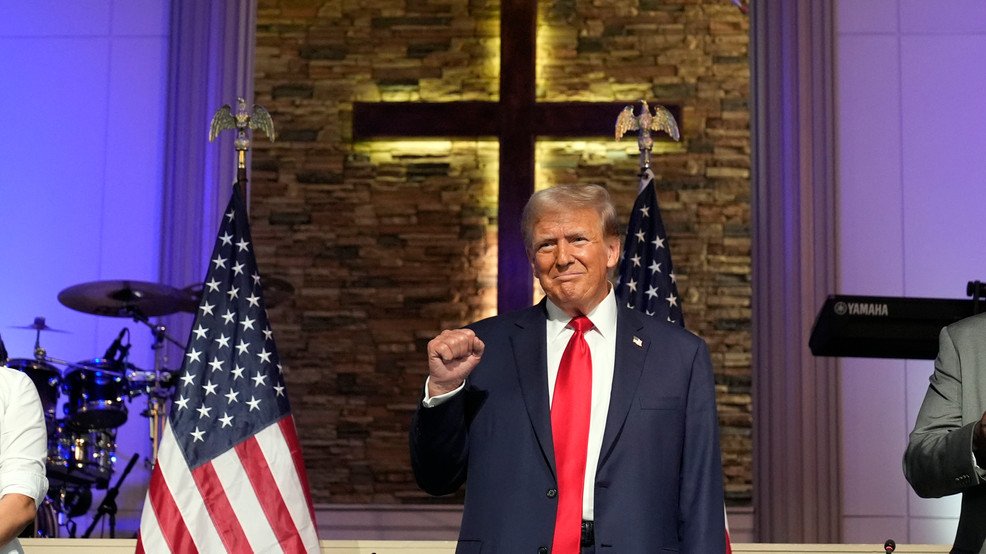
- Trump warns Nigeria of military action to stop Christian persecution.
- U.S. lawmakers hail Trump’s decisive Christian Rights Crusade.
- Pakistan praised as a rare Muslim nation improving minority protection.
- Trump’s global mission redefines human rights and U.S. moral authority.
In a rare blend of faith and foreign policy, U.S. President Donald J. Trump has reignited global attention with what he calls a “Christian Rights Crusade.” After ending nearly a dozen bloody conflicts—including the limited but dangerous war between nuclear-armed Pakistan and India, where Pakistan downed seven Indian jets—President Trump has now turned his moral focus toward a new mission: defending persecuted Christians across the world.
This is not the Trump of rallies or partisan battles. This is the commander-in-chief who ended wars, restored America’s military deterrence, and now seeks to defend faith—a mission that could define his legacy as both a peacemaker and a protector of religious freedom.
The Nigeria Warning: A Defining Moment
In his latest and perhaps most controversial announcement, President Trump issued a blunt ultimatum to Nigeria: stop the killings of Christians—or face U.S. military action. Speaking on Truth Social, the President ordered the Defense Department to prepare for “fast, vicious, and sweet” intervention if the Nigerian government fails to protect Christian communities under assault by Islamist extremists.
Trump’s message was clear: “If we attack, it will be fast and vicious—just like the terrorists attack our cherished Christians.”
Nigeria, Africa’s most populous nation, has long struggled with extremist groups like Boko Haram, whose insurgency has killed tens of thousands over the past 15 years. While human rights experts say many victims have been Muslim, the targeting of Christians in certain areas has drawn deep concern from Washington.
Trump’s Christian Rights Crusade has already found strong backing in Congress. Representative Tom Cole, chair of the Appropriations Committee, hailed the President’s resolve, citing “the alarming and ongoing persecution of Christians across Nigeria.” The committee’s 2026 national security bill now includes expanded funding for international religious freedom programs and direct assistance to Christian communities targeted by extremist violence.
The Global Map of Persecution
The Christian Rights Crusade is rooted in what President Trump and his allies describe as the “existential threat” facing Christians in many regions. From Nigeria to Myanmar, North Korea, China, and parts of the Middle East, Christians continue to suffer violence, imprisonment, and intimidation.
Trump threatens US military action in Nigeria over treatment of Christians
By re-designating Nigeria as a “Country of Particular Concern,” Trump’s administration has signaled that religious persecution will not go unnoticed—and certainly not unpunished. The designation opens pathways to sanctions, diplomatic pressure, and even humanitarian intervention.
Yet amid this sweeping policy, one country stands apart: Pakistan. Once on the same watchlist, Pakistan has made measurable progress in ensuring the protection of minorities. Under its recent governments, Islamabad has reformed laws, encouraged interfaith dialogue, and taken stern action against those inciting sectarian hate.
For the Trump administration, Pakistan’s turnaround represents a model for others—a demonstration that Muslim-majority nations can safeguard Christian and minority rights without compromising their faith or sovereignty.
From Peace to Faith: Trump’s New Doctrine
President Trump’s first term was marked by a foreign policy that prioritized ending wars, protecting borders, and reviving American pride. Now, in his second term, his moral focus has expanded from national defense to spiritual defense.
ALSO READ: Taiwan Challenges China: Island’s Defiance of “One Country, Two Systems” Sparks New Geopolitical Tensions
White House insiders describe Trump’s Christian Rights Crusade as part of a broader “Freedom First” doctrine—an evolution of “America First.” The policy aims to combine military strength with moral responsibility, positioning the U.S. as both a superpower and a moral power.
Critics warn that Trump’s rhetoric could inflame tensions in Africa and beyond, but his supporters argue that decisive leadership is long overdue. For decades, the West has expressed concern about Christian persecution but has stopped short of action. Trump’s approach, though blunt, is forceful—and, many say, necessary.
Faith, Force, and the Future of U.S. Diplomacy
The Christian Rights Crusade reflects a deeper transformation of American foreign policy. For decades, the U.S. has defended democracy and capitalism abroad. Under President Trump, faith has entered the equation as a moral pillar of diplomacy. He argues that protecting Christianity is synonymous with defending civilization itself.
In this emerging worldview, American military power is not merely a weapon—it is a shield for the oppressed. Trump’s commitment to Christian protection may also resonate deeply with his conservative voter base, who see global religious freedom as a sacred extension of American values.
Pakistan: The Exception That Proves the Rule
Among the nations under scrutiny, Pakistan is the rare example of reform. Despite its turbulent history, it has significantly improved the security of minorities and invested in policies that promote interfaith harmony. U.S. officials quietly acknowledge Pakistan’s progress—something President Trump himself reportedly cited in private discussions as “commendable and worth global recognition.”
By contrasting Nigeria’s failures with Pakistan’s successes, Trump underscores his broader message: protecting faith is possible—if nations have the courage and conviction to do it.
A Savior of Faith, A Restorer of Strength
President Donald Trump’s Christian Rights Crusade may be remembered as a turning point in global diplomacy. Having ended wars and restored American pride, he now casts himself as the defender of faith, confronting radicalism and tyranny wherever they threaten believers.
If the United States follows through on its warnings to Nigeria, history may remember Trump not just as a statesman or a reformer—but as the first modern Western leader to wield power in defense of faith, freedom, and humanity itself.