


-
Trump’s new China Doctrine replaces confrontation with managed engagement.
-
The Kuala Lumpur truce stabilizes ties while preserving U.S. leverage.
-
Beijing sees this as a window to rebuild; Trump sees it as proof of dominance.
-
The coming Trump–Xi summits may define the next decade of superpower rivalry.
President Donald J. Trump, the self-styled dealmaker who once waged an economic war on China, is now preparing to rewrite history—on his own terms. The same man who tore apart decades of bipartisan engagement with Beijing is poised to relaunch it, not as a gesture of goodwill, but as an assertion of power.
In Kuala Lumpur this week, top trade negotiators from the United States and China wrapped up tense, high-stakes talks that yielded a framework for a fresh understanding between the two superpowers. What emerges is a “transactional truce”—China resumes purchases of American soybeans and eases rare-earth restrictions, while Washington considers rolling back the 20% fentanyl-linked tariff and holding off on new punitive measures.
Trump’s $350 Billion South Korea Deal Redefines U.S. Global Trade Leadership
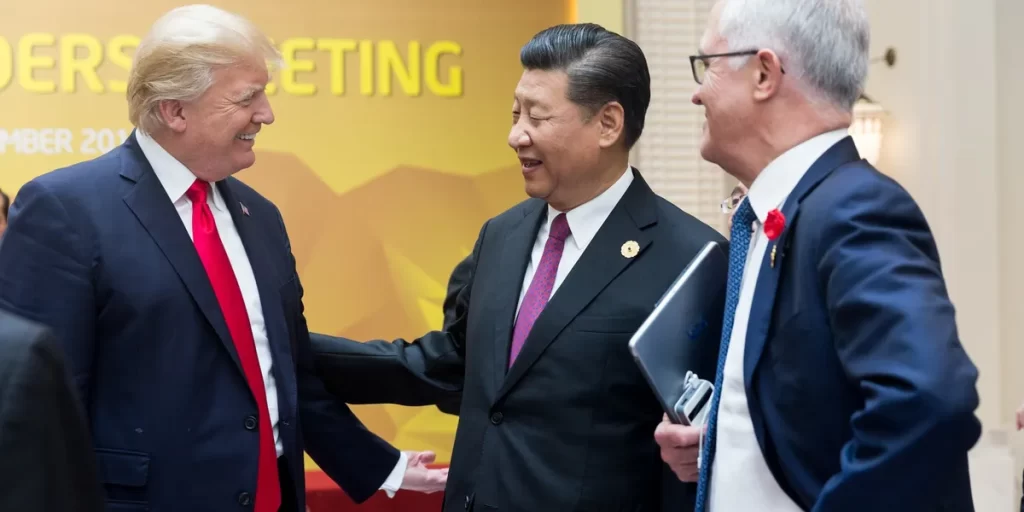
But this is no mere pause in hostilities. It is the foundation of a new geopolitical architecture—one that seeks to manage, not dissolve, rivalry. The stage is now set for a Trump–Xi summit in South Korea, followed by Trump’s potential visit to Beijing next year—a symbolic act that would broadcast a powerful message: the world’s two largest economies are back at the table, and it was Trump who made it happen.
From Trade War to Tactical Truce
To understand the gravity of this shift, one must recall how sharply Trump had departed from the playbooks of his predecessors. Bill Clinton and Barack Obama both operated under the assumption that economic integration would tame China’s authoritarian instincts. Trump shattered that illusion. He weaponized tariffs, technology bans, and diplomatic isolation to drive Beijing into economic discomfort.
READ MORE: After Demolishing U.S.-China Relationship, Trump Is Rebuilding It His Way
Now, he is repurposing the very tool he once discarded: engagement. Except this time, it is stripped of idealism. Trump’s new diplomacy is not about reforming China—it’s about restraining it. The idea is to convert confrontation into a structured rivalry where America sets the terms of coexistence.
As one former Obama adviser, Evan Medeiros, put it, “The first Trump presidency put the U.S. and China on a pathway toward long-term competition. Now it appears that Trump is flipping his own script.” Indeed, what Trump is doing now, no administration before him has dared to do—build a controlled détente rooted in transactional realism, not liberal fantasy.
Why This Truce Matters
The Kuala Lumpur framework offers something both sides desperately need: breathing room. For Trump, it’s an election-year triumph—a chance to tout the restoration of American exports and the protection of Midwest farmers. For Xi Jinping, whose economy is struggling with deflation, property crises, and capital flight, it’s an opportunity to stabilize China’s domestic front without conceding political ground.
ALSO READ: Pakistan’s Logical Stand Shines in Istanbul as Peace Talks with Afghan Taliban Enter Final Round
But make no mistake: this truce is tactical. Beijing’s concessions are temporary gestures designed to appease Washington, not surrender to it. Xi’s core interests—from Taiwan to technological supremacy—remain untouched. China will buy soybeans, but it will not stop subsidizing state firms or scaling its artificial intelligence dominance.
Yet for Trump, even symbolic wins are strategic victories. The image of a U.S. president who first punished China and then brought it back to the table—without compromising—plays perfectly into his “America First” narrative.
The Great Game of Perception
What emerges from this evolving Trump–Xi dynamic is a new kind of power politics—a performance for both domestic and global audiences. For Xi, the optics of hosting Trump in Beijing would send a powerful message to his people: that even the most unpredictable American president is compelled to engage with China’s rise.
For Trump, the very act of re-engagement reinforces his claim to global leadership. Unlike Obama’s careful balancing or Biden’s cautious containment, Trump’s approach fuses coercion with charm, tariffs with talks, and unpredictability with precision.
His administration’s new diplomatic calendar—a full year of leader-led engagements—is the antithesis of his first term’s chaotic approach. It signals not softness, but strategic maturity: the recognition that economic confrontation, while popular, is unsustainable without channels of communication.
The Prophecy: Trump’s Inevitable Reordering
If history is any guide, Trump’s second-term approach could mark the beginning of a new order in U.S.–China relations—one where rivalry is managed through structured engagement, not unending escalation.
Here lies the prophecy: Trump’s renewed diplomacy will not bring harmony, but hierarchy. He is constructing an engagement framework that forces Beijing to play by America’s rules of negotiation while maintaining economic leverage. His version of détente will mirror his personal style—volatile but effective, unpredictable yet anchored in transactional gain.
This “Trump Doctrine” of controlled engagement could well outlast his presidency. It may become the blueprint for future administrations—proof that America can compete and cooperate simultaneously, without losing strategic dominance.
For decades, Washington sought to change China. Trump seeks to contain it, without shutting the door entirely. His engagement is not a surrender, but a recalibration—a recognition that in a world of interdependence, even superpowers must negotiate the terms of their rivalry.
A Fragile Future
Still, this détente stands on delicate ground. The same unresolved tensions that fueled the trade war remain: Taiwan, military posturing in the South China Sea, and the technological arms race in semiconductors and quantum computing. A single misstep, tweet, or naval encounter could reignite confrontation.
But until then, Trump’s gamble is paying off. He has managed to reassert control over a relationship once spiraling toward open hostility. Beijing’s tactical patience meets Washington’s transactional mastery—and in that uneasy equilibrium, Trump has found what every great strategist seeks: time.
Time to rebuild American supply chains. Time to secure allies across Asia. Time to shape the rules of engagement before China catches up.
This, ultimately, is the genius of Trump’s China strategy 2.0—not peace for peace’s sake, but peace for power’s sake.