


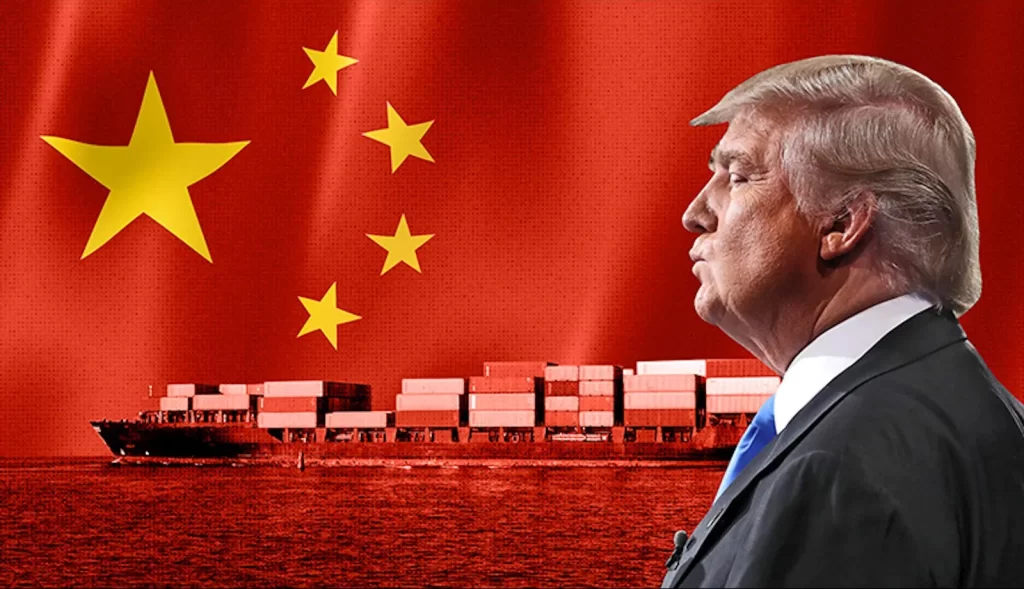
- Trump’s 100% tariffs mark the most aggressive U.S. trade move against China in decades.
- Beijing’s rare earth export restrictions threaten the global tech and defense industries.
- A full-blown trade war could destabilize markets, raise consumer prices, and disrupt global supply chains.
- Both nations risk long-term economic damage — and the world may be forced to choose sides in an emerging economic cold war.
It began, as so many tremors in the modern economy do, with a post on Truth Social. On Friday morning, President Donald Trump — part showman, part commander in chief — declared that the United States would impose a hundred percent tariff on all Chinese imports. The tone was unmistakably combative, the language vintage Trump: dramatic, unfiltered, and meant to shock. By evening, markets had convulsed, analysts were scrambling for historical parallels, and what had seemed like a tentative calm between Washington and Beijing had dissolved into the familiar hum of confrontation.
For weeks, both sides had been playing what diplomats call a “holding game.” Beijing had quietly restricted exports of certain rare earth minerals — those obscure but indispensable elements that make the modern world go round, from fighter jets to electric vehicles. Washington, meanwhile, had tried to appear unbothered, projecting steadiness even as its defense and tech sectors fretted over supply disruptions. But when China expanded its controls on Thursday, effectively asserting dominion over any product containing even trace amounts of rare earths, Trump’s patience snapped.
He called the move “sinister and hostile.” And then, as if to make sure the world was listening, he went further — threatening to double tariffs on every Chinese good entering the U.S. The announcement sent the S&P 500 tumbling more than two percent, tech shares plummeting in concert, and oil prices sliding to their lowest levels since May.
It wasn’t just the markets that shuddered. Diplomats did, too. The long-awaited meeting between Trump and China’s leader, Xi Jinping — once seen as a possible moment of reconciliation — now seemed like a relic of a more hopeful week.
The Return of the Trade War
For anyone who remembered the tariff skirmishes of 2018 and 2019, this was déjà vu with higher stakes. Back then, Trump had waged his trade war with the swagger of a businessman confident that the world would bend to the logic of American leverage. The results were mixed: some manufacturing jobs returned, inflation rose, and China retaliated in kind.
Global Trade War Erupts: China and Europe Strike Back as Trump’s Tariffs Escalate
This time, though, the terrain is more fragile. Inflation still stalks American consumers, global supply chains remain brittle from pandemic disruptions, and the world’s appetite for uncertainty has worn thin.
Economists warn that a blanket tariff of 100 percent on Chinese imports — “over and above” the existing levies, as Trump put it — could ignite a shockwave greater than anything seen during his first term. American manufacturers still depend on Chinese parts; retailers still rely on Chinese textiles and electronics. For U.S. consumers, it could mean higher prices on everything from smartphones to sneakers.
China’s Leverage
Beijing’s move on rare earths wasn’t spontaneous. It was strategic. China mines roughly 70 percent of these minerals and refines around 90 percent of the global supply — the quiet heart of modern technology. Every battery, every missile guidance system, every wind turbine and smartphone owes something to those elements buried deep in China’s soil.
READ MORE: In Retaliatory Move, Trump Threatens 100% Tariffs on Chinese Goods
By tightening its grip, Beijing reminded Washington that even in a world of sanctions and export controls, it still possesses a weapon that no other nation can easily replace. In the short term, this may look like self-sabotage — cutting off a lucrative trade with the United States. But in Beijing’s calculus, the signal matters more than the revenue: China will not be coerced.
Trump’s reaction — tariffs, threats, and a possible diplomatic freeze — was both predictable and politically useful. The president’s base has long cheered his stance against what he calls “economic bullying” by China. With elections approaching, he has cast himself once again as the defender of American industry, railing against unfair trade practices and promising to “bring jobs home.”
ALSO READ: Trump’s Tariff Tsunami: Asia Feels the Aftershocks, America Faces the Risks
But the White House’s confidence may be misplaced. Many of the same corporations Trump aims to protect — from Apple to Tesla, Nvidia to Boeing — depend on Chinese suppliers and markets. Their stocks sank within hours of the announcement, a silent vote of no confidence in economic nationalism.
In Kentucky, soybean farmer Caleb Ragland was more blunt. “Trade wars are harmful to everyone,” he said, recalling the devastation of 2019, when China slapped tariffs on U.S. agricultural products in response to Trump’s levies. “We were just recovering.” Beijing’s retaliation this time will almost certainly target American agriculture again — a sector that, despite its patriotic symbolism, remains acutely exposed to the ebb and flow of global markets.
For American families, the pain could be less visible but more insidious. Inflation, which has only recently shown signs of easing, could reignite. Imported goods, from washing machines to winter coats, could double in price. Economists call it “tariff inflation,” but for most households, it will simply feel like another squeeze.
The Politics of Retaliation
In Washington, the language of the moment has turned martial. John Moolenaar, the Republican chair of the House Select Committee on China, called Beijing’s mineral restrictions “an economic declaration of war.” It was rhetoric that seemed to echo the president’s own instincts — that trade is not just commerce, but combat.
Yet this framing obscures a complicated truth: the two economies are too entangled to be true adversaries. American innovation still powers much of China’s tech industry; Chinese manufacturing still fills the shelves of America’s stores. The idea of “decoupling” has become a political slogan, but in practice, it remains a fantasy — an expensive one.
In Beijing, officials have begun preparing their own countermeasures: an antimonopoly investigation into the U.S. chipmaker Qualcomm, new port fees for American ships, and perhaps more to come. The message, in its understated way, was unmistakable: two can play at the game of economic coercion.
For Trump, confrontation with China has always been as much about performance as policy. His language — “sinister,” “hostile,” “massive” — is less the vocabulary of statecraft than of spectacle. The promise of tariffs is both an economic strategy and an electoral gambit. By portraying himself as the last line of defense against Chinese exploitation, he taps into a deep American unease about decline — the fear that the world’s factory floor, and its future, lies somewhere east of the Pacific.
Still, the risk is immense. The tariffs could backfire, choking the very industries Trump seeks to protect and deepening the inflation he vows to tame. As Wendy Cutler, a former U.S. trade negotiator now at the Asia Society Policy Institute, observed, “The détente was fragile to begin with. This could shatter it entirely.”
A New Cold War, Fought With Commerce
The question now is whether the U.S. and China can step back from the brink — or whether this is the beginning of a new kind of Cold War, one fought not with tanks and missiles but with trade bans, tariffs, and technology embargos.
Trump seems to believe America can win by sheer force of will — by “using our own monopolies,” as he put it, a cryptic reference to the technologies and financial systems the U.S. still controls. Beijing, for its part, appears equally convinced that the West’s dependence on its minerals and manufacturing base gives it the upper hand.
Between them lies a world anxiously watching — investors, farmers, factory workers — all caught in the gravitational pull of two superpowers locked in a contest for dominance.
On Friday evening, as markets closed and the dust settled, the numbers told their own story: the S&P 500 down 2.7 percent, the Nasdaq off by its widest margin since April, oil dipping below $59 a barrel. What began as a social-media broadside had, in a few short hours, become a global event — a reminder that the war between Washington and Beijing is no longer confined to boardrooms or embassies.
It plays out now in the invisible arteries of the world economy — in the circuits of a smartphone, the gears of a factory robot, and the price of soybeans in the heartland.
And in that sense, Trump’s tariff thunderclap was more than a policy announcement. It was a signal flare in a long, darkening struggle — one that may define the next decade of global power.