


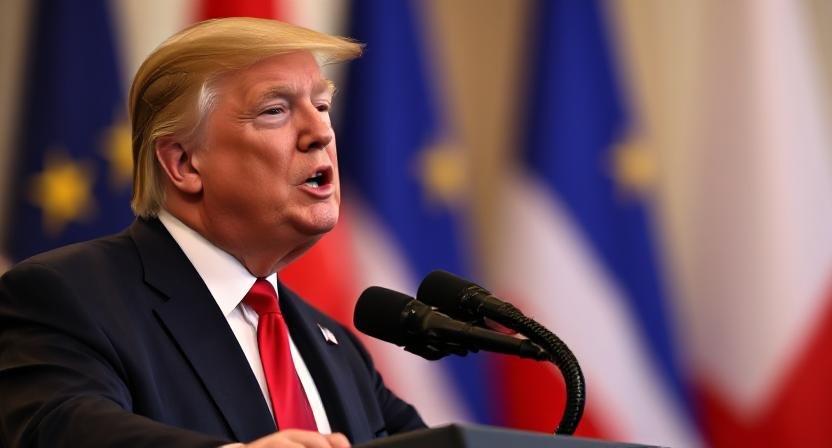
- Trump ties trade deals and tariff relief to massive fossil fuel purchases, pressuring allies to slow climate goals.
- EU signs a $750 billion U.S. energy deal, risking its 2050 emissions targets amid American economic leverage.
- Scientists warn global temperatures have already crossed 1.5°C, heightening climate crisis fears.
- Critics call Trump’s approach “climate obstructionism,” while supporters frame it as energy security and sovereignty.
President Donald Trump’s second term is shaping into a high-octane campaign—not for re-election, but for fossil fuels. With tariffs, trade deals, and blunt diplomatic pressure, Trump is orchestrating a geopolitical counteroffensive against global climate ambitions, demanding allies and rivals alike ditch wind and solar and double down on oil, gas, and coal.
At the center of this drama is a White House that sees green energy as both an economic threat and a geopolitical inconvenience. In Europe, where wind power supplies 20% of electricity and where nations aim to reach 50% by 2050, Trump’s message has been consistent: abandon “climate alarmism” or face American tariffs, fees, and visa restrictions.
“This isn’t just climate skepticism anymore,” said Jake Schmidt, Director at the Natural Resources Defense Council. “It’s climate obstructionism backed by the full force of the U.S. economy. Trump isn’t walking away from climate agreements—he’s trying to pull others with him.”
The Tariff Hammer: Trade as a Fossil Fuel Weapon
Trump’s most audacious move came last month when he struck a $750 billion energy deal with the EU, tying tariff reductions to massive purchases of American oil and gas. South Korea agreed to buy $100 billion in liquefied natural gas, while Japan pledged $550 billion in U.S. energy investments, including a $44 billion Alaska-to-Asia gas corridor.
Brazil Considers U.S. Court Challenge Over Steep Trump Tariffs: Background, Updates, and Analysis
The administration has warned that countries supporting global emissions cuts—like the recent $100-per-ton shipping emissions fee—risk American retaliation. European diplomats privately admit this pressure has already softened some governments’ climate commitments.
Climate Consequences: The Data Doesn’t Lie
-
1.5°C exceeded: 2024 was the hottest year on record, with global temperatures 1.5°C above preindustrial levels.
-
Extreme weather: Droughts, wildfires, and heatwaves killed thousands across Europe, Asia, and North America.
-
Emissions math: Scientists warn the world must halve emissions by 2030 to avoid catastrophic climate tipping points.
Yet U.S. policy is moving in the opposite direction. At the London Energy Forum in April, Energy Secretary Chris Wright denounced net-zero laws as “sinister goals,” calling them threats to national sovereignty.
READ MORE: Trump, With Tariffs and Threats, Tries to Strong-Arm Nations to Retreat on Climate Goals
The Politics of Oil and Fear
The Trump administration frames fossil fuels as geopolitical security. “Freedom and prosperity come from abundant energy, not green ideology,” Wright told Europeans in April. The White House insists wind and solar make countries vulnerable—economically and militarily—because they rely on subsidies, rare earth minerals, and unstable weather patterns.
“Europe spends $350 billion annually on green energy while asking America to underwrite its security,” argued Diana Furchtgott-Roth of the Heritage Foundation. “Trump sees that as hypocrisy—and he’s using leverage to change it.”
But critics counter that Trump’s strategy risks locking the world into a high-emissions future precisely when scientists say time is running out.
Global Diplomatic Fallout
Trump’s climate hardball has fractured traditional alliances:
-
Paris Agreement: The U.S. exit in January signaled Washington’s full retreat from global climate diplomacy.
-
UN Climate Talks: America skipped April’s shipping emissions summit and warned it might boycott November’s Brazil climate conference.
-
Trade vs. Climate: EU diplomats privately admit U.S. pressure is forcing them to balance trade access with emissions targets.
David L. Goldwyn, a former U.S. energy diplomat, calls this “a systematic attempt to dismantle climate multilateralism.”
ALSO READ: Trump’s Tariffs: The Bold Path to Making America Great Again
The Road Ahead
Most nations plan to submit stronger climate pledges at the UN summit this fall, but Trump’s fossil fuel offensive could dilute ambitions. Analysts warn that a divided West gives China, the world’s largest emitter, an excuse to delay its own decarbonization plans.
Europe remains defiant—on paper. But with $750 billion in U.S. energy purchases locked in, its climate credibility is under strain.
For now, Trump is winning tactical battles: energy exports are booming, oil lobbyists are ecstatic, and allies are signing contracts instead of emissions pledges. Yet the strategic cost—a warmer, riskier planet—may outlast his presidency by decades.