


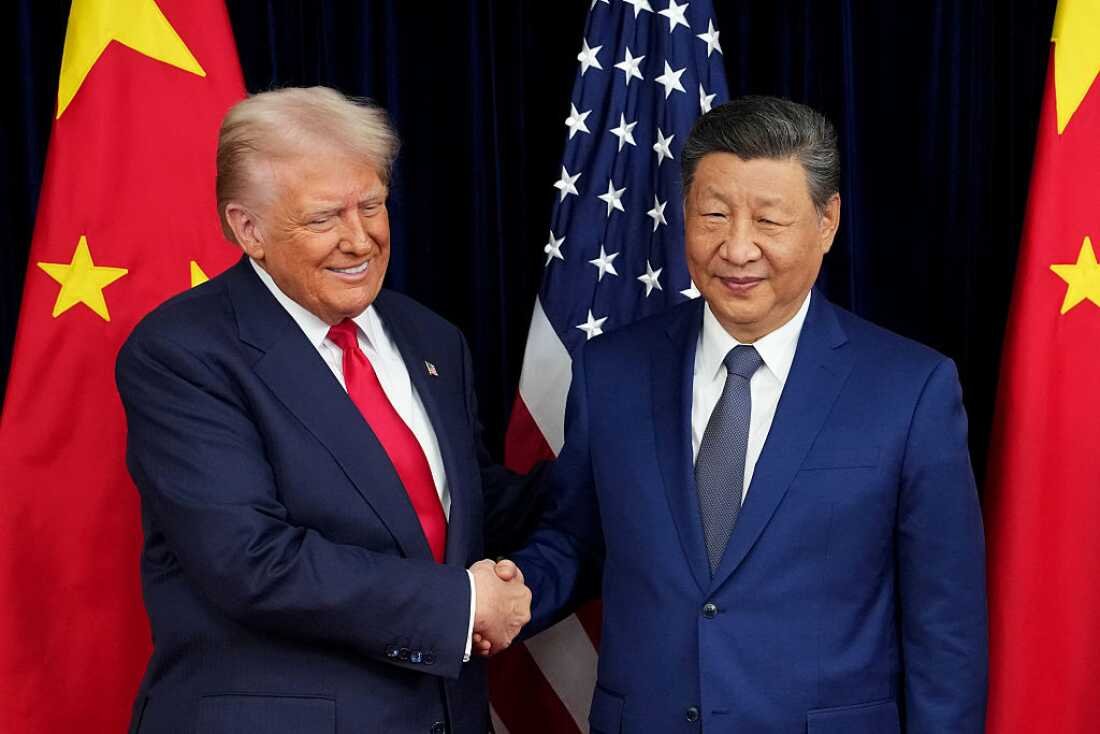
- Trump-Xi Summit 2026 unfolds after U.S. courts limit presidential tariff authority, reshaping negotiation leverage.
- China gains bargaining space on trade, rare earth exports, and semiconductor restrictions.
- Washington retains influence through export controls and long-term trade investigations.
- The summit signals a transition from tariff wars toward systemic technological and geopolitical competition.
The upcoming summit between U.S. President Donald Trump and Chinese President Xi Jinping is no longer merely a diplomatic engagement — it has become a geopolitical recalibration shaped as much by judicial power as by statecraft. As Trump prepares to travel to Beijing for the first visit by an American president since 2017, a U.S. Supreme Court ruling striking down sweeping emergency tariffs has fundamentally altered the strategic landscape ahead of negotiations.
What was once expected to be a high-pressure bargaining session dominated by American economic coercion is now emerging as a more balanced contest of leverage, with Beijing entering talks in a strengthened position.
Trump China Tech Restrictions Freeze Signals Strategic Thaw Ahead of Xi Summit
Trump-Xi Summit: The Collapse of Trump’s Tariff Hammer
For much of Trump’s political career, tariffs have served as both economic weapon and negotiating doctrine. At their peak, duties on Chinese goods climbed as high as 145 percent, reshaping global supply chains and forcing multinational corporations to reconsider manufacturing footprints. The Supreme Court’s decision invalidating broad emergency tariffs, however, removed Trump’s ability to rapidly impose sweeping trade penalties without legal constraints.
Trump Iran War Risk: Military Escalation, Midterm Politics, and America’s Strategic Dilemma
The ruling eliminates key second-term levies on China and replaces them with a temporary 15 percent global tariff framework applied equally to allies and competitors — a measure set to expire within 150 days. The immediate consequence is strategic: Washington has lost its fastest and most unpredictable instrument of economic pressure just weeks before negotiations begin.
For Beijing, this represents a rare moment where institutional limits within the American political system directly enhance Chinese diplomatic leverage.
Beijing’s Renewed Bargaining Power
Chinese policymakers now approach the summit with greater confidence. During earlier negotiations, Beijing’s commitments — including massive soybean purchases and expanded imports of U.S. industrial goods — were closely tied to tariff concessions. With those tariffs legally dismantled, China regains flexibility over trade concessions previously extracted under pressure.
Xi Gains Leverage Before Trump Summit After Tariff Reversal
The shift is particularly significant in sectors tied to political symbolism inside the United States. Agricultural exports, aerospace contracts, and energy purchases were central to Trump’s domestic economic messaging. Without immediate tariff threats, securing large-scale Chinese buying commitments becomes far more complicated.
Equally important is China’s control over rare earth minerals — critical components for American defense systems, electric vehicles, and advanced manufacturing. Access to these materials has increasingly become Beijing’s counterweight to U.S. technological restrictions, transforming supply chains into instruments of geopolitical influence.
Technology, Taiwan, and Strategic Tradeoffs
Xi’s negotiating team is expected to press for concessions beyond tariffs. Chief among them are relaxed export controls on advanced semiconductors, fewer restrictions on Chinese technology firms, and adjustments in U.S. policy language surrounding Taiwan.
For Beijing, Taiwan remains the central sovereignty issue underpinning relations with Washington. While a dramatic policy reversal is unlikely, Chinese officials may seek symbolic shifts — reduced arms sales rhetoric or softened diplomatic framing — that could be presented domestically as strategic progress.
At the same time, the United States retains alternative tools. Trade laws under Sections 301, 232, and 122 allow tariffs following investigations, though these mechanisms require months rather than days to implement. Export controls also remain a potent lever, particularly in advanced chips, aerospace components, and industrial software — areas where American dominance still constrains China’s technological ambitions.
Markets, Supply Chains, and Strategic Timing
The legal uncertainty surrounding tariffs has already begun influencing global markets. Chinese exporters are expected to accelerate shipments to the United States while duties remain temporarily lower, attempting to front-load trade before new restrictions emerge.
Multinational companies, meanwhile, continue diversifying production across Southeast Asia. Manufacturers operating in southern China increasingly maintain parallel facilities in Vietnam and elsewhere, reflecting a structural reality: corporate strategy now assumes permanent geopolitical volatility between the world’s two largest economies.
Even positive legal developments are therefore treated as temporary windows rather than lasting solutions.
A Negotiation Defined by Systemic Rivalry
Despite Beijing’s apparent advantage, the broader trajectory of U.S.–China competition remains unchanged. The Supreme Court ruling does not signal reconciliation; instead, it underscores a deeper reality — that domestic political institutions increasingly shape foreign policy outcomes in both powers.
For Trump, the summit represents an opportunity to demonstrate strategic adaptability, replacing unilateral tariff escalation with negotiated outcomes. For Xi, it offers validation of China’s long-standing argument that American political fragmentation limits Washington’s ability to sustain economic pressure.
The meeting in Beijing will therefore not resolve the rivalry. Instead, it will test whether two competing visions of global order — one rooted in economic nationalism and the other in state-directed globalization — can coexist without triggering another cycle of escalation.
In the emerging era of great-power competition, leverage is no longer determined solely by military strength or economic size. It is increasingly shaped by legal systems, supply chains, and the internal constraints of political power itself — forces now quietly redefining the balance between Washington and Beijing before the first handshake even takes place.