


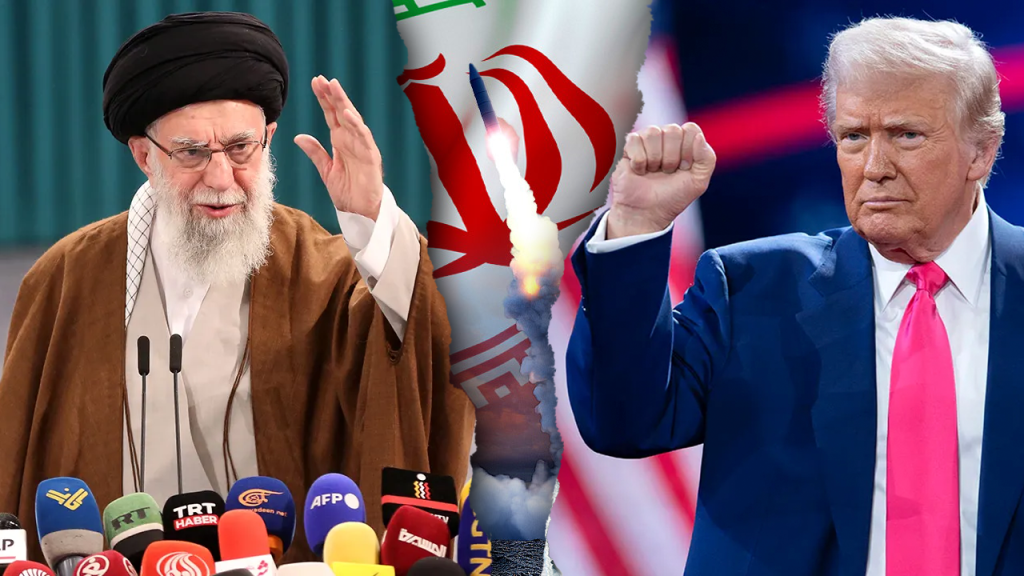
- Trump Iran war risk grows as U.S. military deployments signal possible escalation against Tehran.
- Midterm election dynamics increase political stakes of foreign policy decisions.
- Iran’s regional capabilities raise fears of energy market disruption and wider conflict.
- Strategic ambiguity over war objectives fuels debate among policymakers and voters.
President Donald Trump has brought the United States to the edge of a potential military confrontation with Iran at a politically delicate moment, underscoring the growing tension between an increasingly assertive foreign policy and domestic economic anxieties ahead of crucial midterm elections. The emerging crisis highlights a familiar but consequential dilemma in American statecraft: whether projecting strength abroad reinforces political authority at home—or risks undermining it.
Over recent weeks, Washington has ordered a substantial military buildup across the Middle East, deploying additional carrier strike groups, long-range bombers, and advanced air assets capable of sustaining a multi-week air campaign.
U.S. Prepares for Iran Attack: Military Buildup, Tehran Tensions, and Drone Threats
U.S. officials describe the moves as contingency planning designed to pressure Tehran into negotiations over its nuclear program. Yet the administration has provided only limited public explanation of the strategic objectives behind possible military action, leaving allies, markets, and voters uncertain about the endgame.
This ambiguity comes at a time when economic concerns dominate the American political landscape. Polling throughout early 2026 shows inflation, housing affordability, and wage growth ranking far above foreign policy among voter priorities.
Trump pushes US toward war with Iran as advisers urge focus on economy
Trump won reelection in 2024 largely on promises to stabilize prices and avoid costly overseas conflicts under his “America First” doctrine. Now, his focus on Iran risks complicating that domestic narrative, particularly as economic improvements remain uneven.
Within the administration itself, consensus appears incomplete. Senior officials acknowledge privately that there is no unified agreement on launching strikes, reflecting divisions between national security hawks advocating deterrence through force and political advisers wary of electoral backlash. Republican campaign strategists increasingly argue that prolonged military escalation could distract from economic messaging central to retaining congressional majorities in November.
US Attack on Iran Appears Imminent as Trump Weighs Final Decision Amid Massive Military Buildup
The political risks are significant. Control of Congress hangs in the balance, and a shift in either chamber would constrain Trump’s legislative agenda while intensifying scrutiny of foreign policy decisions. Republican strategist Rob Godfrey notes that Trump’s electoral base remains skeptical of extended foreign entanglements, having embraced his earlier pledge to end “forever wars.” Limited, decisive action might command support, but a prolonged confrontation with Iran—a far more capable adversary than recent U.S. targets—could fracture that coalition.
Iran presents a fundamentally different strategic challenge from past interventions. Unlike weaker states, Tehran possesses extensive regional proxy networks, missile capabilities, and the capacity to disrupt global energy markets through the Strait of Hormuz, a chokepoint through which roughly one-fifth of global oil supply transits. Any sustained conflict could therefore trigger economic repercussions far beyond the Middle East, potentially raising energy prices and undercutting domestic economic confidence in the United States and Europe alike.
Trump has repeatedly warned that Iran must agree to strict limits on its nuclear program, insisting Tehran “cannot have a nuclear weapon or the capacity to build one.” U.S. forces previously targeted Iranian nuclear facilities in June, prompting threats of retaliation and intensifying regional tensions. Yet analysts note that the administration’s stated objectives have shifted over time—from responding to Iran’s internal repression to nuclear nonproliferation demands and even suggestions of regime change—without a clearly articulated strategy linking military action to achievable political outcomes.
The absence of a coherent public case contrasts sharply with the extensive justification presented by President George W. Bush ahead of the 2003 Iraq invasion. While that campaign ultimately rested on flawed intelligence, its strategic rationale was clearly communicated. Trump’s approach, by comparison, relies more heavily on deterrent signaling than structured persuasion, leaving independent voters—often decisive in midterm elections—uncertain about the necessity of escalation.
Supporters argue that calibrated military pressure could strengthen U.S. leverage and force diplomatic concessions without triggering a broader war. Critics counter that the scale of U.S. deployments risks locking Washington into action; failure to follow through could invite perceptions of weakness internationally, while escalation could produce unpredictable regional consequences.
Historically, foreign policy has rarely determined midterm outcomes. But Trump’s Iran strategy may prove an exception because of its direct economic implications. Energy market volatility, defense spending increases, and geopolitical uncertainty could quickly translate into domestic political costs, particularly if voters perceive military action as undermining economic stability.
Ultimately, the Iran crisis encapsulates the central paradox of Trump’s second presidency: a leader elected on promises of domestic renewal now confronting the strategic realities of great-power competition and nuclear proliferation. Whether confrontation strengthens American deterrence or weakens political momentum at home will depend less on military capability than on strategic clarity—and the administration’s ability to persuade voters that escalation abroad serves prosperity and security at home.