


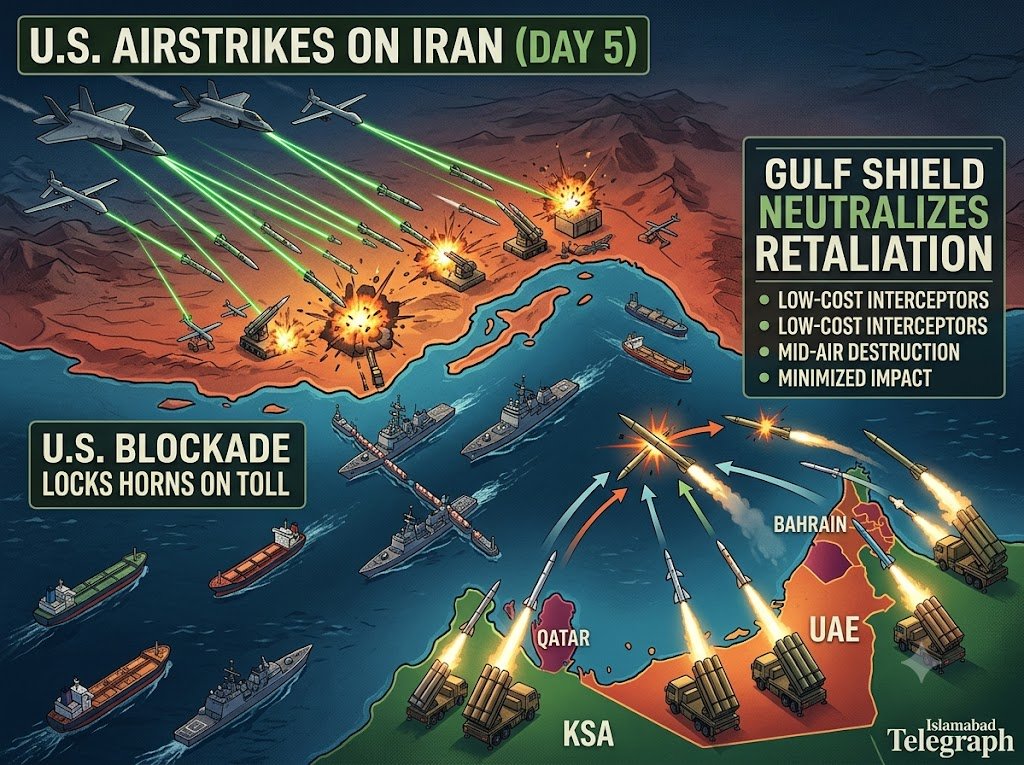
- U.S. airstrikes on Iran entered their fifth consecutive day as American forces launched a ferocious overnight wave of laser-guided precision strikes targeting coastal defenses, drone launch depots, and fast-attack craft near the Strait of Hormuz.
- Widespread Regional Retaliation: Tehran countered by launching waves of ballistic missiles and suicide drone swarms directly targeting key U.S. military bases in Jordan, Kuwait, Bahrain, Qatar, and the UAE.
- The “Gulf Shield” Interception: Newly deployed, low-cost American interceptor missiles supplied to Gulf allies successfully neutralized incoming Iranian projectiles mid-air, rendering the strikes largely ineffective.
- Technological Shift in Warfare: The conflict has permanently reshaped Middle Eastern defense dynamics, proving that Gulf countries have developed the specialized technical expertise to cost-effectively mitigate asymmetric missile attacks.
The Middle East has plunged back into full-scale regional conflict as intense U.S. airstrikes on Iran continue for a fifth consecutive day.
U.S. Central Command (CENTCOM) confirmed that overnight, American forces unleashed a ferocious wave of precision laser-guided missiles to systematically eliminate “dozens of military targets” along Iran’s coastline and near the highly contested Strait of Hormuz.
In response, Tehran has launched a sweeping regional retaliation campaign, targeting U.S. military installations across Jordan, Kuwait, Bahrain, Qatar, and the UAE. However, a newly deployed shield of low-cost, highly sophisticated U.S. interceptor missiles has allowed Gulf allies to neutralize the vast majority of incoming Iranian ballistic projectiles mid-air, radically shifting the defensive dynamics of modern theater warfare.
Night Five: Inside the Laser-Guided U.S. Blitz
According to CENTCOM officials, the fifth night of aerial operations marked the most intense bombardment since the collapse of last month’s preliminary truce agreement.
Strait of Hormuz Conflict Escalates as Trump Orders Strikes and Global Markets Plunge
Utilizing advanced laser-guided munitions and stealth platforms, the U.S. Navy and Air Force conducted a coordinated seven-hour strike campaign.
The ferocious U.S. airstrikes on Iran successfully neutralized:
- Coastal Defense Batteries: Anti-ship cruise missile sites near Bandar Abbas, Hengam, and Abu Musa.
- UAV Launch Infrastructure: Strategic drone depots and command centers in southern port cities.
- Asymmetric Naval Assets: Fast-attack craft pens utilized by the Islamic Revolutionary Guard Corps (IRGC) to threaten commercial shipping.
President Donald Trump, speaking during a Fox News interview, issued an uncompromising ultimatum, warning that the U.S. is prepared to “knock out all their power plants” and “all their bridges” next week if Tehran refuses to return to the negotiating table. Trump’s aggressive posture is backed by an active maritime blockade of all ships carrying Iranian cargo or heading to Iranian ports.
Iran’s Regional Pushback: Target America
Refusing to capitulate to the blockade or the aerial blitz, Iran has aggressively expanded the conflict’s geography. The IRGC and Iranian Army announced simultaneous retaliatory missile and drone operations—striking directly at the network of U.S. military hubs in neighboring countries:
- Jordan: Loitering munitions targeted the U.S. Al-Azraq Air Base.
- Kuwait: Swarms of suicide drones targeted key military installations and airfields.
- Bahrain & Qatar: Ballistic missiles were directed at the U.S. Navy’s Fifth Fleet headquarters at Juffair and the Sheikh Isa Air Base.
The “Gulf Shield”: Low-Cost Interceptors Neutralize the Threat
Despite the scale of Iran’s missile barrages, the expected devastation across Gulf capitals has failed to materialize.
In a quiet technological revolution, U.S. allies—including Saudi Arabia, the UAE, Bahrain, Qatar, and Kuwait—have deployed a new generation of low-cost, highly sophisticated defensive projectiles provided by the United States. Specifically engineered to combat Iran’s vast arsenal of cheap loitering munitions and short-range ballistic missiles, these interceptors have successfully neutralized incoming threats mid-air, rendering the strikes largely ineffective.
U.S. hits dozens of Iranian targets as Trump threatens power plants and bridges
Military strategists note that this represents a permanent shift in Middle Eastern defense. Historically, intercepting cheap drones required multi-million-dollar Patriot missiles, creating an unsustainable economic deficit for defenders. The new, cost-effective defense system has allowed Gulf countries to develop a highly specialized regional expertise, effectively minimizing the impact of Iranian retaliatory strikes on civilian infrastructure and oil installations.
Locked Horns: A Historic Deadlock
The war has returned to the Middle East with a level of technological intensity never before seen in naval or aerial warfare. With oil prices creeping steadily back above $85 a barrel, global markets are bracing for a prolonged war of attrition.
The U.S. and Iran have locked horns in a strategic deadlock: Washington remains committed to maintaining a suffocating blockade until Iran yields its claim over the Strait of Hormuz, while Tehran relies on its asymmetric reach to signal that no American asset in the region is safe. Supported by a highly capable allied defense shield, the localized but high-intensity U.S. airstrikes on Iran are poised to serve as the definitive benchmark for 21st-century proxy warfare.